
×

 Article

Explore the comparison between RISC vs CISC processors in this blog. Explore the main differences between RISC and CISC architectures, along with the advantages of migrating from RISC to CISC processors.
Before diving deep into this blog, here is a summary of RISC vs CISC processors.
| Basis for Comparison | RISC Architecture | CISC Architecture |
|---|---|---|
| Emphasis | Software | Hardware |
| Instruction Size | Small | Large |
| Registers | More Registers Used | Less Registers Required |
| Pipelining | Easy | Difficult |
| Addressing Mode | Limited addressing mode required | More addressing mode required |
Nearly all the latest CPUs have different architecture designs to work from “Instruction Set Architecture.” Primarily, there are two types of architectural designs:
These two designs differ in multiple ways. RISC architecture mainly focuses on executing commands while aiding some microprocessor cycles per command for optimum performance, while CISC architecture can perform multiple operations with a single set of instructions.
Also, it has diverse ways of addressing modes to access memory, which depends on the CPU framework, which requires a single set of instructions to carry out many low-level actions.
In the 1960s and 70s, memory was expensive, and assembly programming was tedious. That is the reason the chipmakers packed more logic into each instruction to reduce the amount of code a programmer had to write by hand. This is the reason as to why the CISC comes to an existence due to the necessity.
RISC emerged as a direct challenge to that philosophy. The first RISC projects came from IBM in the late 1970s and early 1980s with the IBM’s 801 project, Stanford’s MIPS project, and UC Berkeley’s RISC-I and RISC-II projects independently showed that simpler, fixed-length instructions. This was combined with efficient pipelining that could outperform the CISC minicomputers which also includes the VAX 11/780. Computer scientists John Hennessy (Stanford) and David Patterson (Berkeley) are widely credited with coining the term “RISC” and later won the 2017 ACM A.M. Turing Award for this body of work.
Reduced Instruction Set Computing, or RISC, is the CPU architecture designed to follow simple instructions. In simple terms, every command will perform small and simple tasks at a fast speed. Did you know? According to the Modor Intelligence report, ARM-based PCs are projected to climb at a 12.16% CAGR during 2026-2031. Here, most instructions are of similar length as they divide all the complex instructions into a simple set of instructions through a process known as Pipelining.
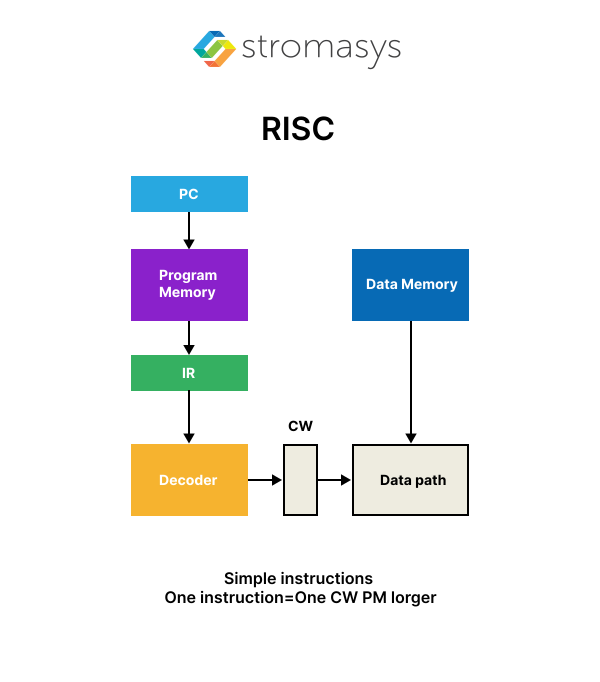
Pipelining is a multi-stage procedure that carries out single instructions in one machine cycle to increase the speed of RISC microprocessors. RISC uses a small set of instructions, so the number of chips used for transistors is small.
In RISC architecture, minimum decoding is required as the data types available in the hardware are fewer. The register needed for general purposes is common to all, while the addressing nodes are simple, and the instruction set is uniform. As a result, when a task is executed, RISC preserves the number of cycles it is carried out by eliminating the code’s unnecessary parts.
Here are some characteristics of RISC architecture:
Here are some of the advantages of using RISC microprocessors in the CPU design:
Here are some of the disadvantages of RISC processors:
Complex Instruction Set Computing, or CISC architecture, is used to execute complex tasks with just a single command. It contains instructions for multiple steps required in an operation for execution in a program. Therefore, CISC architecture has comparatively smaller programs, while the size of their instruction set is large and requires quite some time to produce output.
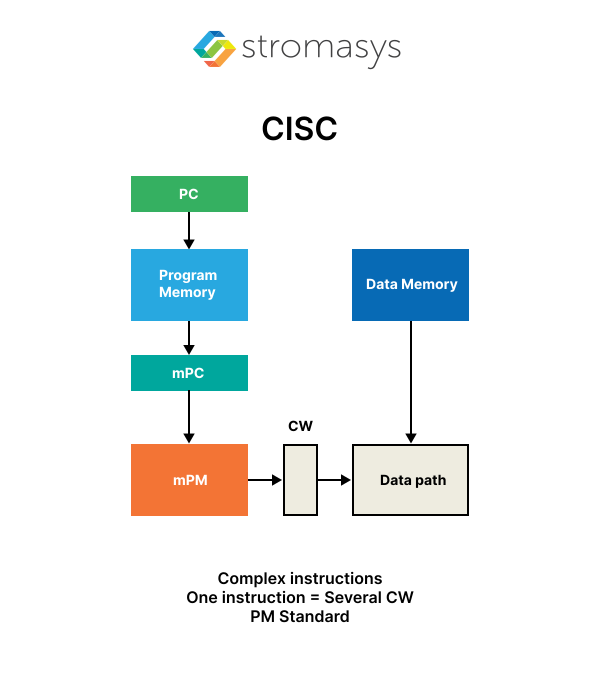
In CISC architecture, various measures are taken to secure every instruction set, which means an extra set of commands for each instruction, which prolongs the output result. Depending on the instruction size, the instruction may take two or more machine cycles. Moreover, it doesn’t use the pipelining process as RISC architectures.
Here are some noteworthy features of CISC architecture in CPU frameworks:
Here are some characteristics of CISC architecture:
Here are some of the advantages of using CISC microprocessors in the CPU design:
Here are some of the disadvantages of CISC processors:
Here is a brief analysis of how the RISC vs CISC architecture approaches enhance CPU performance.
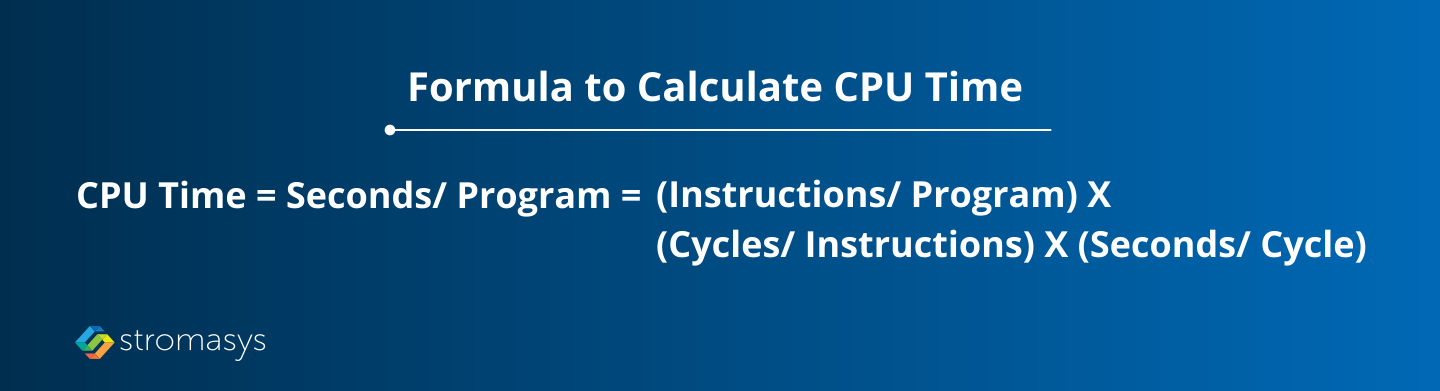
RISC microprocessor is more popular for high-level language dependency as it uses simpler and faster instructions. However, when a task or programming is performed in assembly language, instructions are needed to carry out many tasks, as executing a program in assembly can be very tedious and prone to error. Due to this, the CISC architecture framework was developed to aid assembly programs.
For Example:
A task for the addition of two 8-bit numbers
1. RISC Architecture Approach:
Here, in the task of performing addition, the program is divided into three parts, i.e., load, operate, and store, which makes RISC programs long and requires more memory to store instructions while needing fewer transistors as the commands are simple and less complex.
2. CISC Architecture Approach:
Here is an in-depth comparison of CISC vs RISC processor :
| CISC Architecture | RISC Architecture |
|---|---|
| CISC architecture is known as Complex Instruction Set Computing. | RISC architecture is known as Reduced Instruction Set Computing. |
| Emphasizes hardware. | Emphasizes software. |
| Functions both on Microprogrammed and Hardwired Control Unit. | Functions only on the Hardwired Control Unit. |
| For the storage of complex instructions, transistors are being used. | For the usage of more registers, transistors are used. |
| Registers are used in less quantity. | Many registers are used. |
| The size of commands or instructions may vary. | Instructions or commands given are fixed in size. |
| Can perform operations like REG to REG, REG to MEM, and MEM to MEM. | Can easily execute Register to Register Arithmetic Operations. |
| The size of the code used is small. | The size of the code used is large. |
| More than one clock cycle is required to complete a single instruction. | Instruction can be executed in a single clock cycle. |
| Many instructions are given to perform the task, also known as Complex Instruction Cycle. | The number of instructions given to execute the task are less compared to CISC and is also known as Reduced Instruction Cycle. |
| The addressing modes are complex and large. | The addressing modes are simple and limited. |
| It consumes more power as compared to RISC. | It consumes less power. |
| Less or efficient usage for RAM storage. | Requires heavy usage of RAM storage. |
| Less dependency on pipelining procedure. | Highly dependent on pipelining procedure. |
| CISC supports array. | RISC does not support array. |
| For return addresses and procedure arguments, stack is used. | In RISC, for return addresses and procedure arguments, registers are often used. Also, for certain processes, memory references can be avoided. |
| The implementation programs are well hidden from the machine-level programs in CISC processors. The clean abstraction between program and its execution is provided by ISA. | Machine-level operations are more transparent in RISC designs. Also, certain instruction sequences are restricted some RISC processors restrict for efficiency. |
| The unified cache is used by CISC architecture for data and instructions. | RISC architecture uses split instruction cache and data cache. |
| The examples for CISC processors are: Personal computers, Motorola 68K, x86, PDP-11, and VAX. | The line of RISC processors are ARM, RISC-V, DEC Alpha, AMD 29K, ARC, Atmel AVR, PA-RISC, SPARC, Intel i860, Blackfin, SuperH, i960, Power, Motorola 88000, MIPS, and Power. |
Aging legacy systems are mostly developed using RISC architecture, which lacks flexibility, scalability, and the ability to carry out complex instructions. Stromasys offers cross-platform emulation and virtualization solutions to migrate from outdated legacy applications to a modern platform like x86 systems or the cloud.
The x86 servers have a CISC-based architecture, which ensures they can easily interact with other solutions and perform complex tasks. Stromasys Charon emulation solutions create an interface similar to the original legacy hardware on a newer platform like, x86, so all the previous legacy applications run more efficiently.