
×

 IT/OT Convergence in Manufacturing
In the modern age, manufacturing needs to be technologically forward for processes to be as modernistic as possible. However, they are not. They suffer from backdated OT guaranteeing stability, that does not match the speed of updates in IT. Downtime and operational disruption in OT is countered by the data silos and cyber risks of IT. One is incomplete without the other, yet they are disconnected.
Only IT/OT convergence is the solution. Yet, combining the two without maintaining protocol is risky. The right strategies are essential for the massive systems in manufacturing to be convergent, interconnected, and supportive of each other's growth. Following the right tips and modernizing with the right tools is crucial for the job.
 Article

Before moving to what IT/OT convergence in manufacturing brings to organizations, we must understand what it is and why it’s important. First, let us see what they bring to the table.
IT and OT are two separate technological estates using different systems and providing different values.
Not balancing IT and OT modernization can result in problems like:
Balancing their development and allowing seamless data flow between the two is essential for the advantageous aspects of Industry 4.0, like real-time visibility and optimization, predictive maintenance, autonomous operations, and flexible reconfiguration.
While both IT and OT are critical for manufacturing success, they also face certain differences in how they work and update. As a result, you face the following problems:
The OT landscape is rife with legacy equipment. IDC’s InfoBrief 2025 reports that some of these assets are over 15 years old in about 50% of industries. This makes it hard for them to secure, upgrade, or integrate.
Manufacturing IT modernization is different from that of OT. They have different risk tolerance, governance models, and priorities. Misaligned operational styles slow modernization, unless through collaboration.
As Jeffrey Hojlo, IDC research vice president says, “It is true that IT teams move more quickly to change than OT.”
TXOne Networks’ 2024 Annual OT/ICS Cybersecurity Report has observations on cyber incidents experienced by 67% of organizations in the past 12 months, where their OT environment was affected. Maximum cases targeted IT equipment that fell over to OT.
This shows how vendor access without identity control, shared accounts, and flat networks of OT environments fall prey to the increased connectivity of the IT systems, which introduces new attack surfaces.
IT/OT convergence in manufacturing is difficult with gaps in their data provisions. According to Imprivista’s Manufacturing’s Digital Transformation Dilemma, the ability to provide real-time operational data to front-line workers was reported by only 30% of manufacturers, which is worrying.
As a result, data may be produced in real time, but it is hardly supplied to those who can make use of it in a productive way.
IT systems update much faster than OT equipment. However, these fast changes can be difficult for factory hardware to follow. The disconnect can cause halts in production, which is debilitating for manufacturing.
According to “The True Cost of Downtime 2024” by Siemens, the world’s 500 biggest companies lose 11% of their revenues or USD 1.4 trillion to unplanned downtime. Much of it is due to the lack of IT/OT convergence.
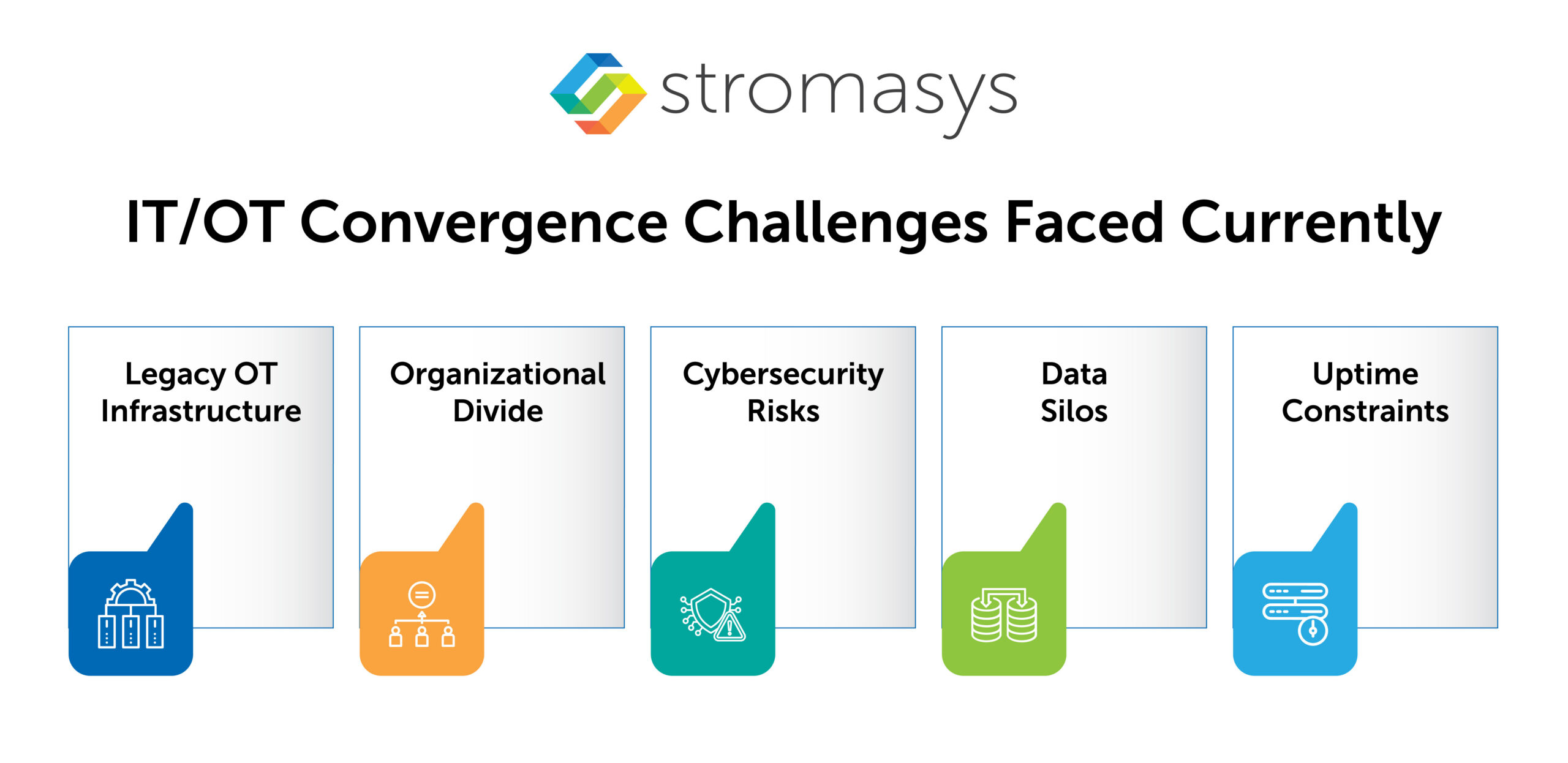
While IT/OT convergence in manufacturing is difficult to bring, making it happen is key for modernization where IT and OT are codependent and co-enhancing. This is possible by following strategies such as these:
The first step towards modernization to solve IT/OT convergence challenges is an assessment of the current landscape of operations happening across IT and OT. Map interfaces and data flows, identify critical assets and dependencies, and assess the overall readiness for developmental integration.
When you design a unified, future-ready system, plot integrations that preserve the high points of both sides – the flexibility of IT and the reliability of OT. Ensure that upgrades to either do not affect the uptime or updates of either. This also prevents a single-layer convergence that is forced rather than natural.
Enable data flow from OT systems to IT software. Real-time data is most valuable, as you get information of every point during every activity exactly when they occur. Only think about updating a machine if it fails to provide the necessary visibility.
Before going to connected systems, draw a reference architecture. Data flows, system boundaries, and integration methods must be redefined to prevent any anomalies after the final step. Lay down what you need, remove what you don’t.
Use a validated pilot program using a small, coordinated system that defines the overall IT-OT architecture. Test every section after the migration to determine consistency and weaknesses. The goal is to ensure that the final result, when done, will equate to the test one. This minimizes risks and builds trust to create a seamless, integrated system.
Do not integrate your system all at once; any problem you face will become three, then nine, then more, if you try to identify and solve them in one go. A cleverer approach to balancing OT stability and IT modernization is to use stagewise movement – starting with the most dated machine and incrementing as you move further.
Cybersecurity is a major failure for enterprises, and only IT/OT convergence in manufacturing processes can fix that. Only 15% of manufacturers have a robust security and compliance system in place, and 12% have a mature one that exceeds in excellence and sophistication.
Even disaster recovery is in bad shape. To close these gaps while maintaining productivity continuity, enforce security and compliance systems that match every part of the IT/OT system. It helps you answer for every segment, singled as well as connected.

While the above steps help in following a structured protocol, there are certain tips that will help you in IT/OT convergence in manufacturing at certain points before, during, and after modernization. These include:
Maintaining a system as modern and secure as you can while ensuring manufacturing IT modernization coupled with OT advancement and their constant interconnectivity – that is the best way for true IT/OT convergence in manufacturing.
Let’s look at a practical example of a food processing facility at work. It connects its PLC-controlled packaging line, which is OT, with its ERP production scheduling system, which comes under IT.
OT: PLCs and sensors to monitor production speed, output counts, and defect rates, logging in completed package counts in real-time
IT: The ERP platform coordinating inventory, production orders, and quality records, while receiving up-to-the-minute production counts, order status, and quality alerts
Convergence: The production count from the PLC data sent to the ERP using a secure network protected from cyber harm
You can now eliminate manual data entry and human errors. More importantly, real-time updates are made possible, which is an essential aspect of IT/OT convergence in manufacturing. Work is faster, more accurate, and occurs in an orderly fashion.
Legacy systems are the bane of IT/OT convergence in manufacturing. It is the reason why manufacturing has become slower; it is on the brink of failure. 70% of manufacturers still collect data manually, according to Manufacturing Leadership Council, the digital transformation division of NAM.
A new way for modernization is needed for IT/OT convergence in manufacturing. That way is Stromasys. Make legacy hardware more with the times and reuse them with modern systems in manufacturing. Using them as-is isn’t a choice you should make.
Stromasys offers simple emulation solutions through Charon, a product that makes a manufacturing system taking hours and committing errors, completed accurately in minutes.
It emulates SPARC, AlphaServer, VAX, PA-RISC, and PDP-11 servers through the lift-and-shift process and transports all the software unchanged to x86 servers or the cloud environment. It will feel like running the same hardware, but with faster performance, no unplanned downtime or cybersecurity risks, and the ability for greater innovation.
When we say “unchanged”, we mean it. None of the legacy applications see any alterations so that your original factory employees can keep working without training. Face all the advantages of manufacturing IT/OT convergence while operating the same software you used to.
Having no disaster recovery is, well, disastrous. This is what a cement manufacturer in Saudi Arabia was worried about. Despite being successful, the company faced a problem – a single location of operation with an on-premises facility. The usual problems of legacy hardware were already there, too.
They were looking for a cloud solution for all their problems. Thankfully, Stromasys came to the rescue. Using Charon-SSP and AWS Cloud, they created a robust disaster recovery plan. What’s more, they now reduced downtime and power consumption, had much better performance than before, and saved bucks at every level.
Best of all, they could now integrate with modern IT while ensuring both business continuity and sustainability. All this was possible with Charon-SSP, a product as innovative as it is necessary for IT/OT convergence in manufacturing with Stromasys.
Modernization is important for every industry; manufacturing is no different either. However, what truly is different is the need for maintaining a balance between IT and OT, while keeping them connected.
However, they operate on different principles and take advantage of different work methods. Making them modern while keeping them interconnected has limitations unless the right strategy is used.
Yet, operational transformation is picking up speed. Converged technologies for greenfield projects will go to about 50% in the next few years, as BCG predicts. Manufacturers will become more conscious of how to run their company operations and open doors through true IT/OT convergence in manufacturing.
Manufacturing requires systems to remain stable while embracing innovation with the times. Yet, in most cases, IT modernizes way before OT while OT maintains stability and is less likely to change. The clash between the two makes it difficult to advance both together.


The IT landscape is rapidly evolving, and businesses still running legacy hardware are facing numerous...
Read More
DEC Alpha hardware has been pivotal to many businesses due to its reliability, performance, and...
Read More
Legacy application migration is a new trending buzz of IT discussion. Businesses are migrating from...
Read More