
×

 What's the best strategy for Solaris to Linux migration without disruption?
Migrating from Solaris workloads running on the SPARC hardware to Linux requires complex choices around architecture, risk, and cost. There are two primary approaches to migrating these workloads, i.e., the lift-and-shift strategy and the complete rewrite. Both these approaches offer different timelines, budgets, and modernization outcomes.
Businesses need to assess their hardware EOL, application complexity, skills, and compliance. Based on this analysis, businesses need to choose a strategy that suits their requirements by mitigating risk while leveraging the benefits of Linux, such as scalability and cloud readiness. Lift-and-shift migration uses emulation methodology, which means it moves the Solaris workloads to Linux without making any changes in the original code. At the same time, the rewrite approach means rebuilding the entire code from scratch.
 Articles

Migrating from Solaris to Linux is a significant step that many businesses take when they want to transform their aging SPARC servers. Solaris operating system was designed to run on Sun SPARC hardware, which has been known for its reliability and high-end computing capabilities for decades.
However, over time, it is unable to keep pace with the rapidly evolving digital landscape. Here are some key factors for Solaris to Linux migration:
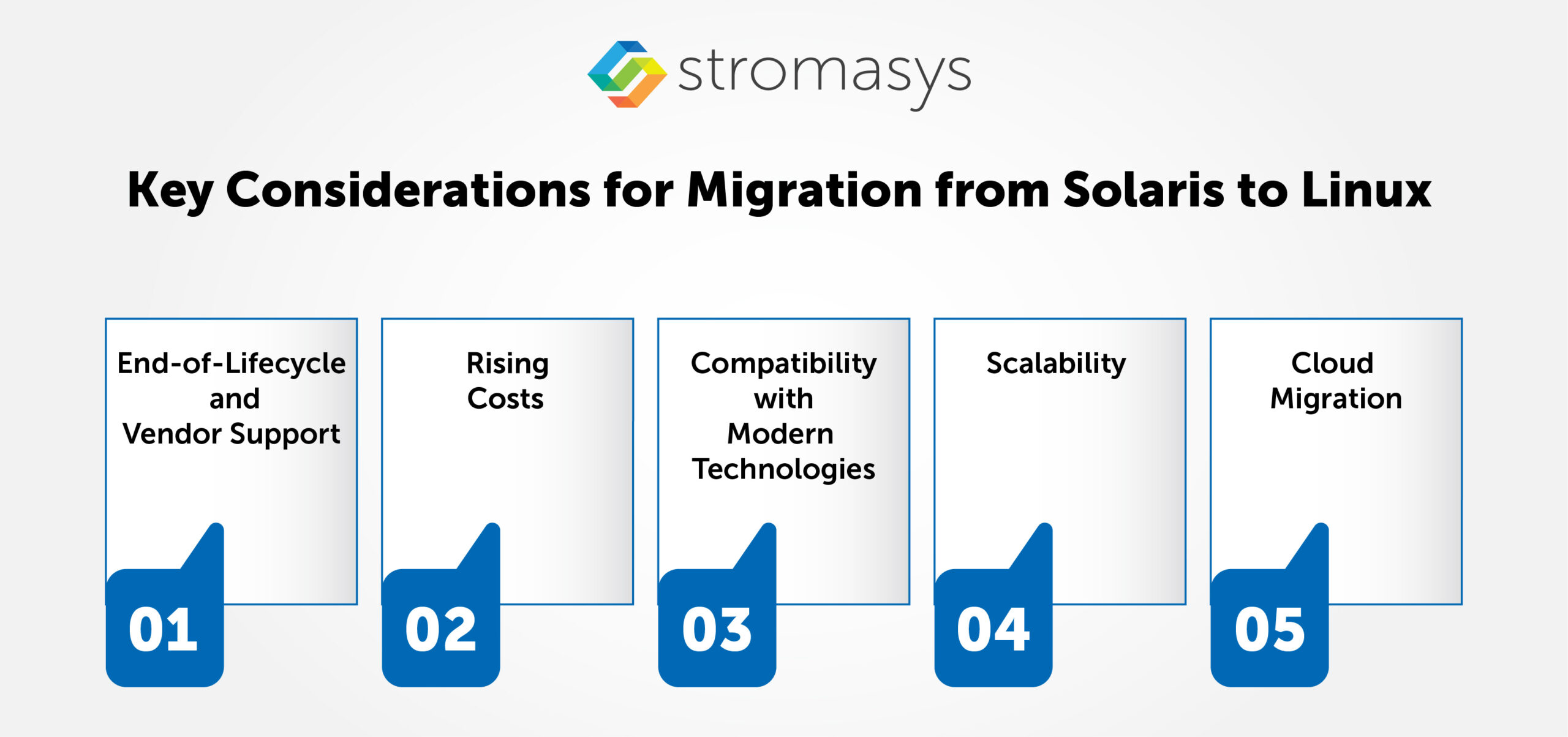
Oracle Corporation had already announced the end of support for the outdated SPARC hardware where Solaris OS was operating. This has resulted in many organizations struggling with no security updates, a lack of vendor assistance, and a shortage of skilled personnel for hardware maintenance.
Did you know?

Maintenance of aging SPARC hardware is costly. Not only does it require skilled experts to manage them, but finding replacement parts is difficult due to hardware obsolescence.
SPARC hardware is built on an outdated architecture, making it challenging to integrate with modern, innovative technologies. Linux is an open-source platform that is compatible with several modern technologies and cloud capabilities and offers frequent updates to ensure business continuity and innovation.
Due to SPARC’s monolithic architecture, it is unable to fulfill the growing demands of businesses, whereas the Linux platform is highly scalable.
Linux is a default operating system for several cloud providers, as it makes it easier for them to leverage the cloud infrastructure and its benefits, whereas SPARC hardware faces compatibility challenges.
Despite several advantages, there are still some Solaris to Linux migration challenges that can slow down the transformation process.
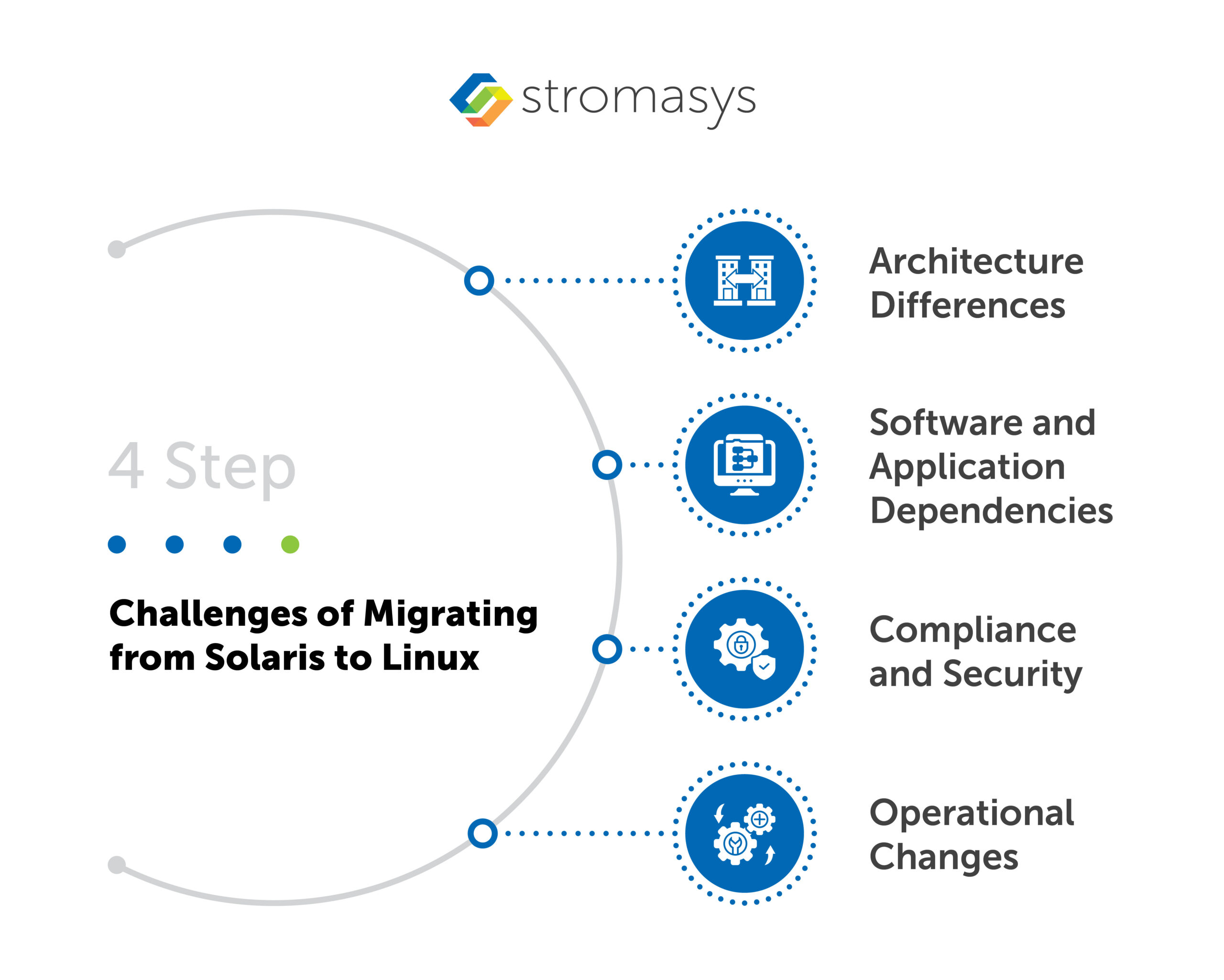
The Solaris operating system (OS) typically runs on SPARC servers, while Linux operates as a host on modern platforms, such as x86 or cloud infrastructure. It means Solaris cannot run natively on Linux without relying on emulators, such as Charon SSP.
Many legacy applications and resources that rely on Solaris, such as specific libraries, system calls, and other components, may not be compatible with Linux. They may require some additional applications or direct equivalent to run on Linux seamlessly.
With the migration of legacy applications to Linux, businesses should ensure that they meet all relevant industry standards and local regulations. Non-compliance can result in hefty fines and legal penalties, as well as endangering sensitive information.
Solaris administration is different from Solaris and may require experts with in-depth knowledge and skills in Linux. They should also have experience operating Solaris and other applications on Linux.
Because of these challenges, a careful Solaris to Linux migration step-by-step work plan and strategy is crucial. Therefore, organizations should assess their current infrastructure to identify critical applications and understand dependencies to choose the right strategy for Solaris to Linux migration.
When migrating Solaris workloads to the Linux platform, businesses typically consider three main approaches to modernization: lift-and-shift, rewrite, and refactoring. Each of these migration strategies has its risks and benefits.
The lift-and-shift Solaris to Linux migration approach involves moving Solaris applications and workloads as-is to Linux without modifying their original codebase. This process is also known as re-hosting and often requires an emulation or virtualization procedure to replicate the SPARC environment on a new platform (such as an x86 server or cloud ecosystem) with a Linux OS running as the host.
Migration from Solaris to Linux using a lift-and-shift approach is the fastest way to modernize the infrastructure. This strategy allows businesses to continue using existing legacy applications while leveraging modern technologies with minimal disruption. It is a cost-effective solution and has minimal migration risks.
Rewrite means redeveloping the application to run it natively on Linux as the primary host. In rewriting the migration approach, businesses will either wholly or partially redevelop the source code to leverage modern technologies.
The businesses want to completely overhaul their SPARC hardware, as they are unable to meet the current requirements and are hindered by it. This migration approach is usually chosen when the system is completely outdated and no longer functional. It needs a fresh start to enhance its efficiency, scalability, and performance.
Here is a detailed comparison between the lift-and-shift and rewrite migration strategies:
| Strategy | Description | Pros | Cons |
|---|---|---|---|
| Lift-and-Shift | Moving applications with no changes in the original code. Using emulation or virtualization solutions for a seamless migration process. |
|
|
| Rewrite | Rewriting code from scratch to meet the growing operational demands. |
|
|
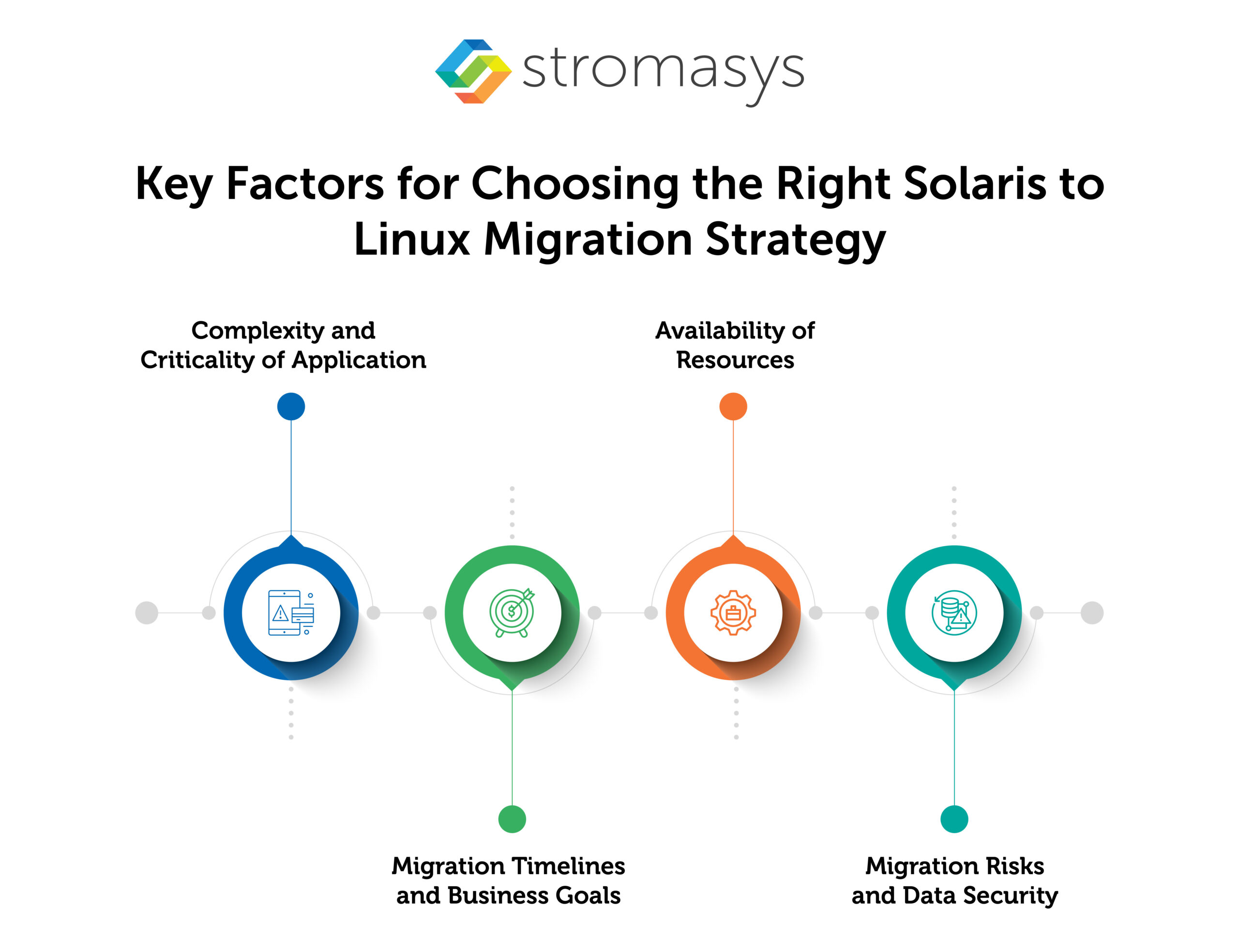
Here are multiple factors that will help in selecting the right Solaris to Linux migration approach:
Here are some best practices to follow for those who want to mitigate Solaris to Linux migration challenges:
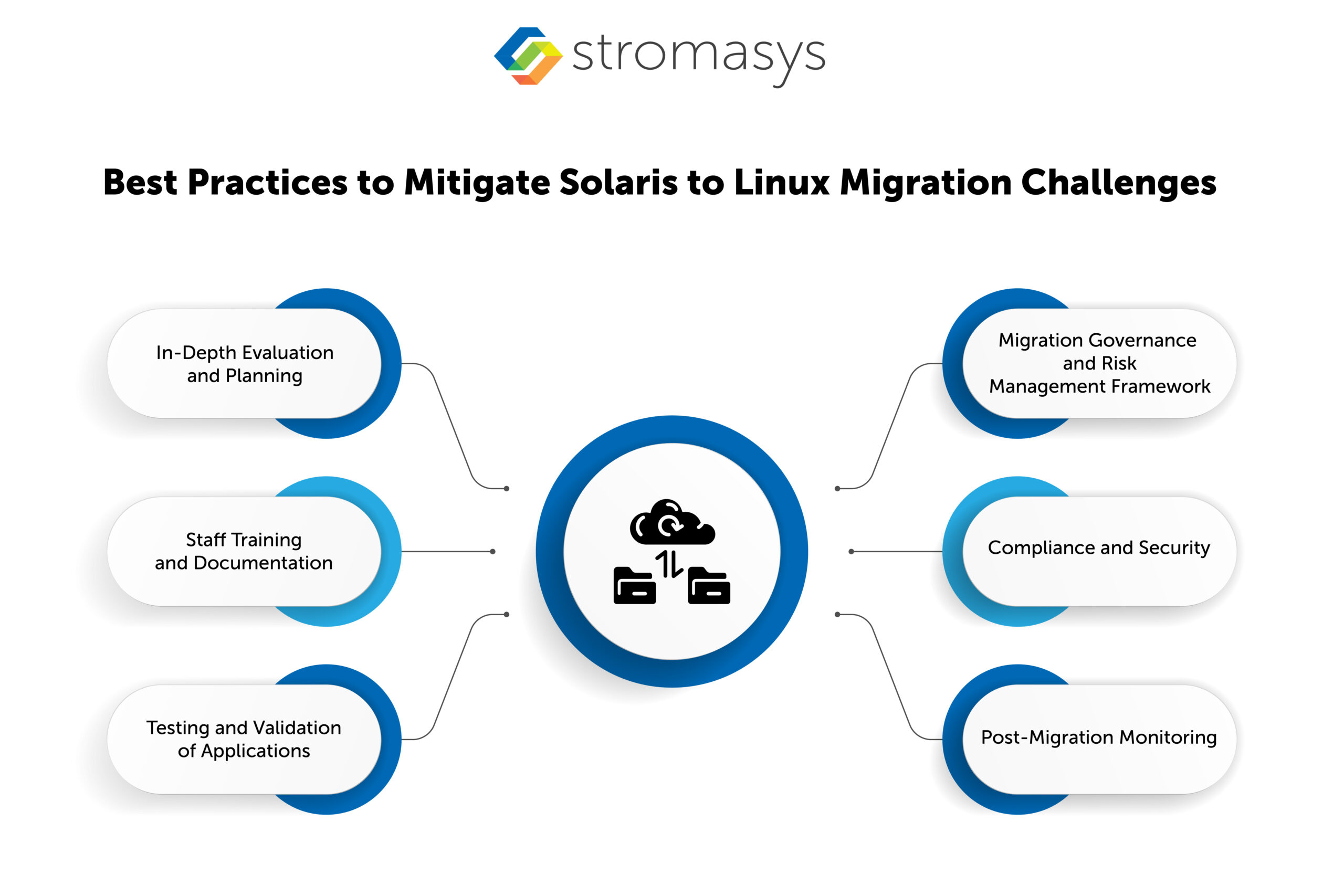
Accessing the infrastructure before the migration from Solaris to Linux will help identify any dependencies and clarify the application’s functionalities. It will help in evaluating the compatibility of applications with Linux-Based on business impact and technical complexity and define clear migration phases that prioritize critical applications while managing risk and resource allocation effectively. It will also help determine which Solaris to Linux migration approach best suits the business requirements.
It is essential to have a clear idea of the objective of migration. There should be a proper framework for this migration project with guidelines, a budget, and a timeline. Having an understanding of the teams participating is essential, along with taking robust security measures, which will help secure the data. It will also help identify any potential risks and measures that can be taken to mitigate them, ensuring a smooth Solaris to Linux migration.
It is crucial to have skilled personnel who have in-depth knowledge of legacy applications and Linux. They can easily manage Linux administration and troubleshooting skills. Before beginning the Solaris to Linux migration, it is necessary to have detailed documentation about the legacy applications and the migration procedure. It is also recommended to train staff on the migration process and how to manage Solaris applications in a Linux environment.
It is recommended to conduct a detailed evaluation of the current security infrastructure to identify vulnerabilities. It is also necessary to verify whether all applications migrated to the new Linux ecosystem are meeting industry standards and compliance regulations. Implementing a robust security infrastructure is also required to protect sensitive data.
Verifying all applications to ensure they are working seamlessly and checking their efficiency is essential. Also, engaging end-users to validate the workflows.
It is essential to monitor the performance of the Solaris application after it has been migrated to the Linux environment. It will help in seamless operations and navigating through application health and resource usage.
By following these best practices, businesses can easily minimize migration risks and ensure a seamless transition from Solaris to the Linux environment without any hassle or disruptions.
Migrating Solaris Workloads with Charon SSP

Stromasys is a global leader in transforming legacy systems. Its Charon SSP emulator mimics the environment of the SPARC hardware on an x86 server or cloud infrastructure with Linux as the host where Solaris applications are migrated and operate seamlessly. It utilizes lift-and-shift technology to migrate SPARC and Solaris workloads without modifying the source code, thereby minimizing disruptions.
The Solaris to Linux migration is the process of moving legacy applications and workloads from the Solaris operating system on SPARC hardware to a new, modern x86 platform with Linux running as the host.


Companies still rely on mission-critical applications running on Sun SPARC, Alpha, or other legacy systems like PDP, VAX,...
Read More
SPARC hardware has been trusted by companies around the world for decades now, and rightly...
Read More
Sun SPARC hardware was introduced in the late 1980s and was popular for its high-end...
Read More