
×
 How to minimize the legacy system migration risk with the security-first approach?
A security-first exit strategy for legacy infrastructure comprises a structured plan that focuses on minimizing the risk through isolation, stabilization, and controlled modernization, before completely exiting the outdated systems. It does not treat security as a final step before cutover. It eliminates the chances of outdated, unpatched, or unsegmented legacy systems being compromised through cyberattacks.
The security-first exit strategy works in a phased framework, i.e., Isolate (reduce attack surface immediately), Stabilize (freeze hardware risk), Modernize (update applications and OS in stages), and Exit (decommission on your timeline. Here, each step minimizes the risk independently. So, the delay in one stage doesn't leave the whole environment exposed to attacks the way an all-at-once migration would.
 Article

Well, you can say that most companies think of a legacy system exit plan as a scheduling problem, but no, it is not. It is actually a security problem that is wearing down the scheduling disguise. So, here is a blog on how you can build a security-first exit strategy for legacy infrastructure.
Let’s understand the real problem first. Legacy systems should have been retired when they were declared obsolete by their vendors. This means no support and struggling to find replacement parts when the system crashes. Not only can it result in operational shutdown, but due to its lack of security, it can also result in data breaches and non-compliance. This overall impacts the brand’s reputation and damages the customer’s trust.
So, stop treating legacy infrastructure risk as a static label with an old equivalent to vulnerable. Some of the significant security challenges are unpatched dependencies, end-of-life hardware, and protocols that no longer receive fixes, which accumulate daily while the migration timeline slips.
The IBM Cost of a Data Breach Report 2026, shows the average cost of a data breach has reached $4.99 million globally. This report has also shown the regulatory fines different industries paid due to non-compliance. Healthcare has spent around $7.42 million per breach, while financial services came in at $5.56 million, industrials at $5.00 million, and energy at $4.83 million.
According to Bridewell’s Cyber Security in Critical National Infrastructure Report 2026, more than three-quarters (77%) of utilities organizations were hit by cyber attacks. It involved outdated software or unavailable patches on legacy equipment in the past year.
These numbers show the risks in legacy system cybersecurity. Attackers do not care about your legacy modernization roadmap. They do not wait for you, so the longer the system stays live without isolation and stabilization controls, the larger the attack surface grows. Continuing to work on them is a RISKY DECISION!
Most legacy infrastructure migration efforts often fail. Why? The reason is simple: teams treat security as something that happens during or after the cutover. The business leaders only acknowledge legacy as a risk at the very last moment.
And finally, they need to move fast by either migrating everything, replacing the full legacy infrastructure, and just closing the gap with one move, which is the wrong step. Any misstep can cost them their operations.
A full rip-and-replace project can be expensive and slow, while doing nothing is not going to solve the problem. It means isolating the system, freezing the hardware risk, and taking small, controlled steps to modernize legacy infrastructure. This way, the final exit will take place on your schedule and not the attacker’s or the vendor’s end-of-support date.
Instead of treating migration and legacy infrastructure security as different workstreams, build an exit strategy with this four-layer framework.
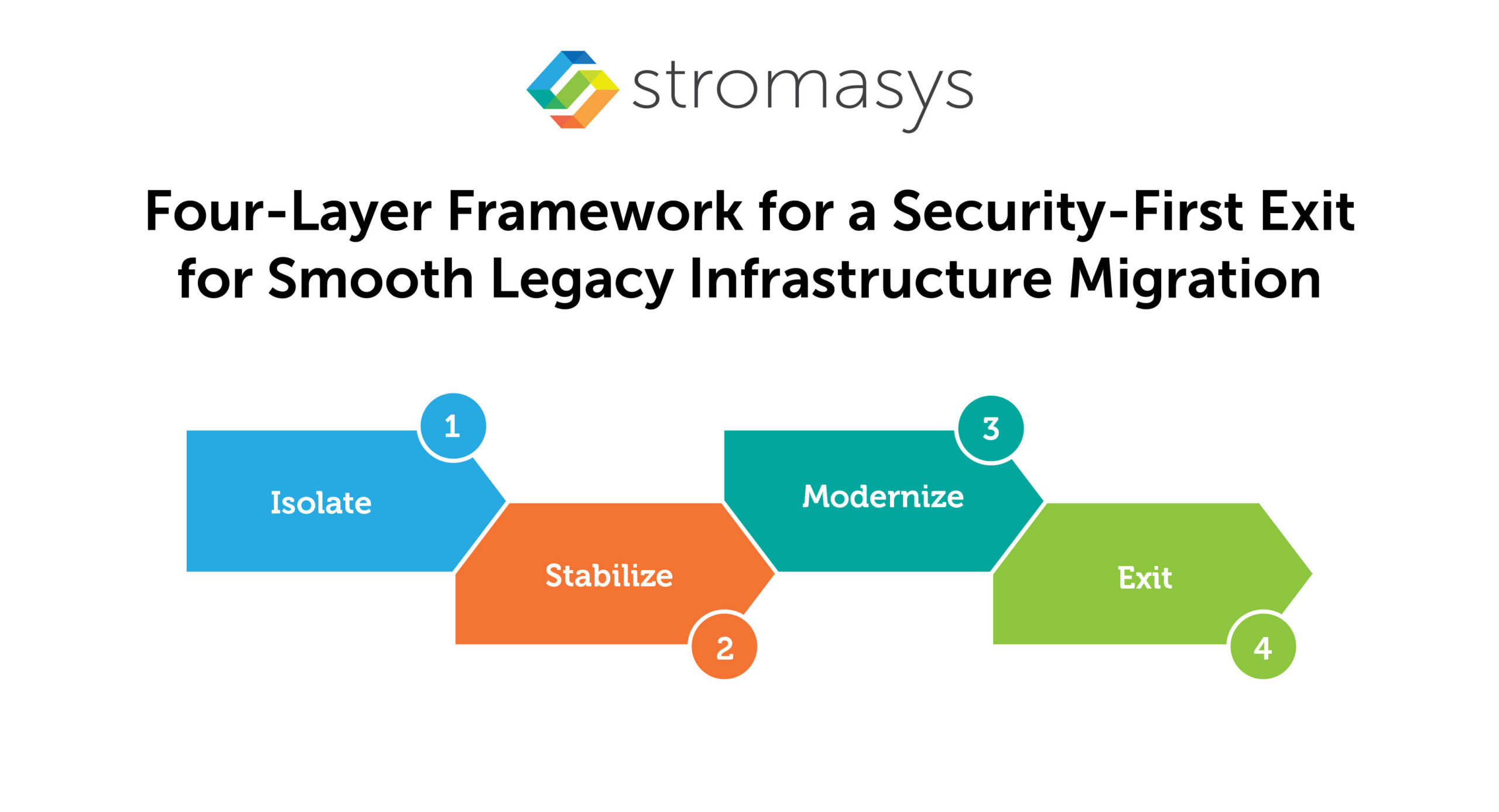
You can begin with network segmentation and access control. Reduce the attack surface immediately before prioritizing migration plans. Contain lateral movement paths. In any case of a legacy system security breach, this isolation will help in determining whether it will be a contained incident or a complete company-wide shutdown.
Eliminate the hardware dependency risks using emulation or abstraction layers while addressing the existing applications or software stack issues. This will decouple the data layer and critical workloads from the physical obsolete hardware. Now, your system can seamlessly continue to operate, but the hardware underneath will no longer be the single point of failure.
After isolation and stabilization, it’s time to modernize legacy infrastructure with phased application and OS-level updates. You will now need to prioritize based on the high-risk components first, not what’s easy to move first. It is suggested to work on systems that have the highest chance of risk exposure and have the widest attack surface. Replace authentication mechanisms, remove deprecated protocols, and introduce modern monitoring where possible without a full rewrite.
Decommission on your own timeline, backed by the current data. Understand what can be exposed and what is actually exposed. But also make sure all your migrated workload is stable and working efficiently. The exit from the legacy infrastructure is the final step that should occur on your timeline, not on the attacker’s clock.
This four-step legacy infrastructure migration is a sequence layer that separates genuine migration strategy from a reactive scramble. Each layer is designed to minimize risk independently. By following the steps, you can convert an open-ended risk into a managed project without any hassle.
The most common mistake that many companies make is treating “we’ll secure it during the migration” as a plan. Well, it doesn’t work that way, and keeping things piled up for the last minute is not a smart option.
Legacy migration projects are already overloaded with data conversion, integration testing, and business continuity requirements. And prioritizing these factors often defers security hardening many times.
It is not a slow-moving trend that teams can plan around casually. It’s an active, accelerating target pattern. Here are some external functions that force the hand in accelerating your migration timeline:
Various reports have revealed that in 2025, the manufacturing sector was one of the most targeted industry sectors for cyberattacks. Check Point Research has published that there was a rise in attacks due to vulnerable legacy infrastructures, complex supply chains, and increased scaling of RaaS (ransomware-as-a-service) operations. Organizations that treat legacy system security as a migration workstream rather than a system hygiene routine generally discover the true cost only after an incident.
Legacy modernization eliminates the aging hardware and allows you to incorporate modern security measures. It also ensures seamless compliance and adheres to current regulatory standards.
Full rip-and-replace can be an expensive and slow process. It is also a risky legacy modernization method. But there are other alternatives that are cost-effective and quick, like legacy emulation. With hardware emulation, you can easily move your critical workloads to a new, more secure and supportive platform. It is a way to remove the aging physical platform from the critical path while you complete application modernization and data migration.
This new modern platform is scalable, more compatible with advanced security measures, and offers better disaster recovery plans. It is a temporary stabilization layer, but if your operations are running efficiently, then it is a solution that ensures continuity for several more years. This is a factual engineering option, not a product pitch. It buys controlled time without expanding the unpatched attack surface further.
Stromasys is the global leader in legacy system migration. It eliminates legacy infrastructure risks by modernizing the outdated hardware. Its product, Charon emulator, is available for both on-premises and cloud environments, giving you the flexibility to choose the environment in which you want to run your critical workloads.
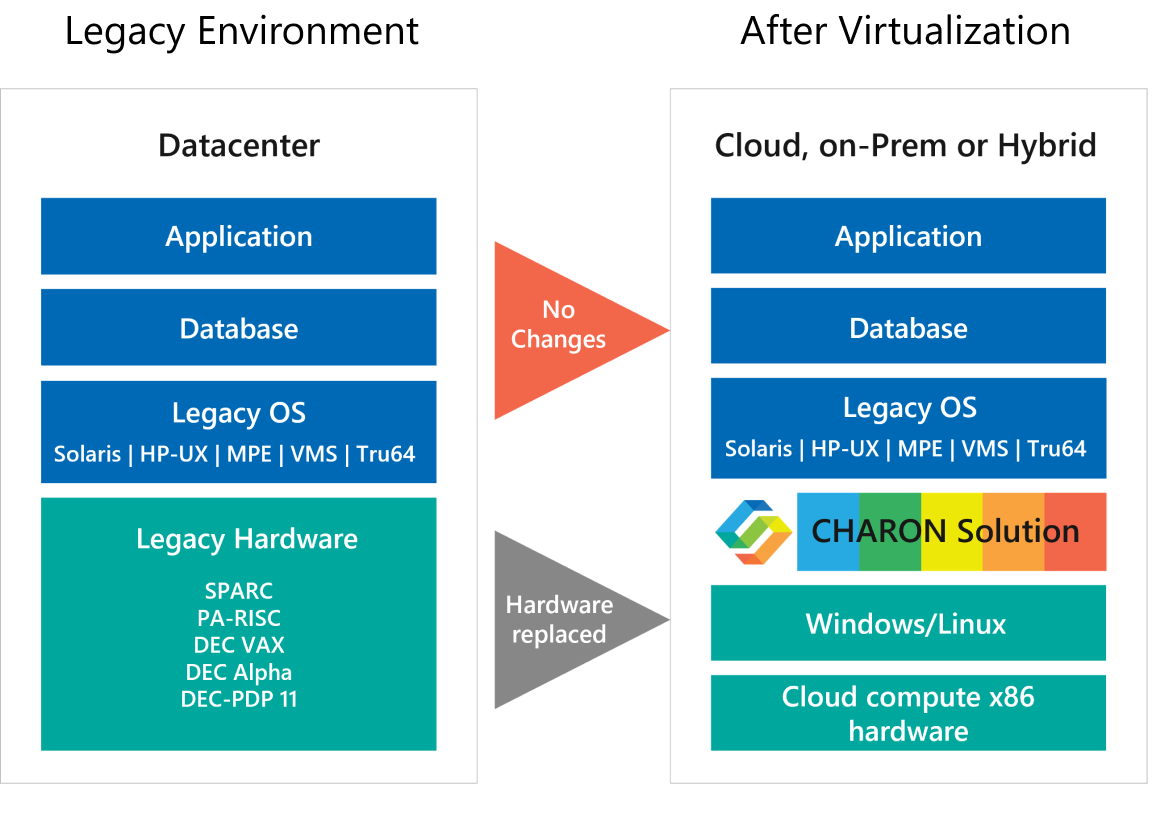
It helps in preserving the existing legacy investments while leveraging the benefits of modern platforms like scalability, security, compatibility with advanced security tools, compliance with industry standards, robust DR plans, and better performance.
An exit plan should not be the last step of your security strategy. It should be prioritized as well when you are planning a migration. Everyday running operations on a legacy system leaves this unpatched, unsegmented, and unmonitored outdated infrastructure exposed to cyber attacks.
While you continue to make decisions regarding migration, you might already be compromised. That’s why it’s said that organizations that don’t move faster cannot get it right, but they also need to move in the right order.
Isolate before panicking, stabilize before rushing, and modernize before taking an exit. Legacy infrastructure security isn’t a phase you reach at the end of a migration. It’s the framework the entire migration has to be built around, from the very first planning conversation.
The best exit strategies aren’t the fastest ones on paper. They’re the ones where nothing was left exposed to save time. Well, the legacy system will not wait, nor will the attackers.
Security-first means reducing exposure and increasing control before the migration project reaches the cutover phase. It is emphasized that security should not just be treated as an essential step while planning the migration.


The IT landscape is rapidly evolving, and businesses still running legacy hardware are facing numerous...
Read More
DEC Alpha hardware has been pivotal to many businesses due to its reliability, performance, and...
Read More
Legacy application migration is a new trending buzz of IT discussion. Businesses are migrating from...
Read More