
×
 WHAT ARE THE BIGGEST CHALLENGES IN TRADITIONAL LEGACY MIGRATION AND HOW CAN AI AUTOMATION CAN SOLVE THEM?
Legacy system migration can be an expensive and risky project if not properly planned. The traditional approaches are slow, resource-heavy, and dependent on resources that are retiring. But it is all changing now due to AI. AI-driven legacy system migration solution automates code analysis, assists in documentation, testing, and risk prediction. It also helps in reducing project timelines, minimizing costs, and eliminating the uncertainty involved in migrating legacy workloads.
AI-driven legacy system migration seamlessly highlights potential risks, offers practical tips, and a low-disruption process, which makes it an option for efficient digital transformation.
 Articles

Also, with the evolving digital landscape, the pressure to migrate is getting real. Aging hardware is becoming harder to support. Compliance requirements are becoming strict while the experts in legacy are retiring. Traditional legacy system migration is no longer enough. But AI has changed that. With AI-driven legacy system migration, businesses can seamlessly modernize their infrastructure cost-effectively.
AI-driven legacy system migration is a better alternative to traditional legacy modernization. As AI helps in automating heavy lifting, the IT team can focus better on building strategies.
Before moving to the technicalities, let us first understand the process of legacy system migration. It is a process of moving from an old, outdated infrastructure to a new one. There are various means to transform the outdated infrastructure, from re-hosting on the cloud or other hardware infrastructure to completely rewriting applications in modern programming languages to gradually replacing modules with new microservices.
Here are the most common legacy migration strategies, the “5 R’s.”
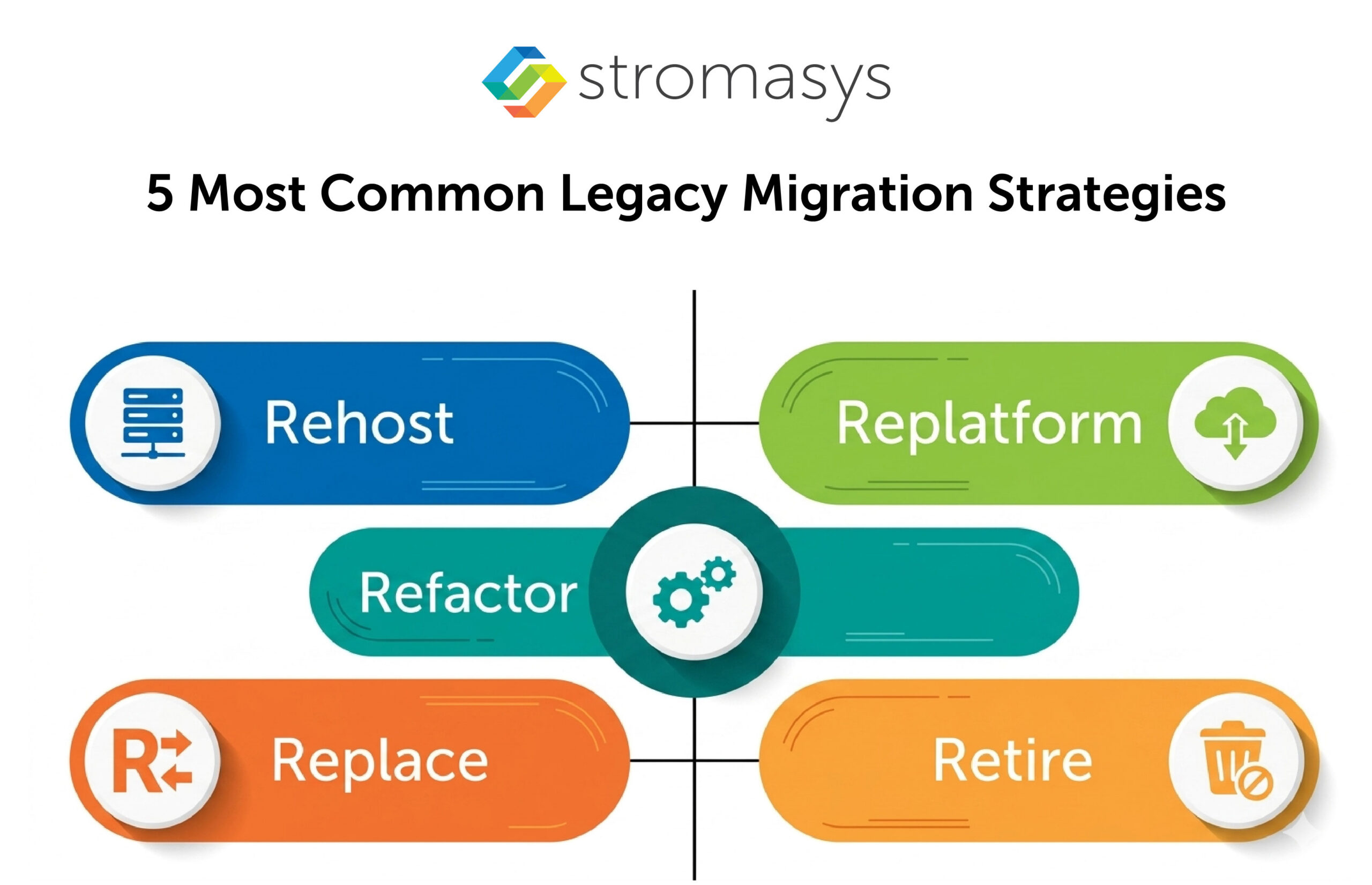
It is a legacy migration approach to move the critical workloads from outdated systems to a modern platform without any modifications. It uses the lift-and-shift migration approach.
Moving the applications to a new platform with some minor changes for better compatibility.
Re-architecting the code to leverage modern capabilities better and improve efficiency. It is more expensive than rehosting and replatforming.
It is a methodology to completely replace the entire aging infrastructure by either building a new one or using off-the-shelf.
Decommissioning the systems that are no longer used.
Each of the above-mentioned legacy modernization approaches comes with a different risk level, cost profile, and business outcome. The basic challenge is to figure out which strategy fits your business requirement and to calculate a rough estimate of the migration process before executing it.
With time, the traditional method of legacy migration has lost its popularity. Why, the reason is simple. It is often manual, slow, and risky.
Here, the IT teams mostly spend their time on code analysis and documentation. They often rely on “tribal knowledge” from aging specialists who might retire soon. This results in projects dragging on for years and even budget overruns. The challenges that mostly include data loss, unexpected downtime, and business disruption. This process makes testing rigid and time-consuming, and it’s hard to scale efforts across teams. Today, the cost of IT technical debt related to legacy systems is estimated to be approximately $1.52 trillion globally.
So here are some challenges that make the traditional legacy migration difficult:
The bottom line is that traditional legacy migration treats every project like a custom art project, which is expensive, slow, and unpredictable. But with AI-driven legacy system migration, companies can completely change the dynamics.
Here is a misconception that AI makes migration faster. Well, it makes the process fundamentally smarter. Instead of the IT teams struggling to manually trace every line of code, AI tools can analyze entire codebases in hours, map dependencies automatically, and even translate legacy languages like COBOL into their modern equivalents.
Here are some best practices of AI-driven legacy system migration that help in eliminating migration challenges:
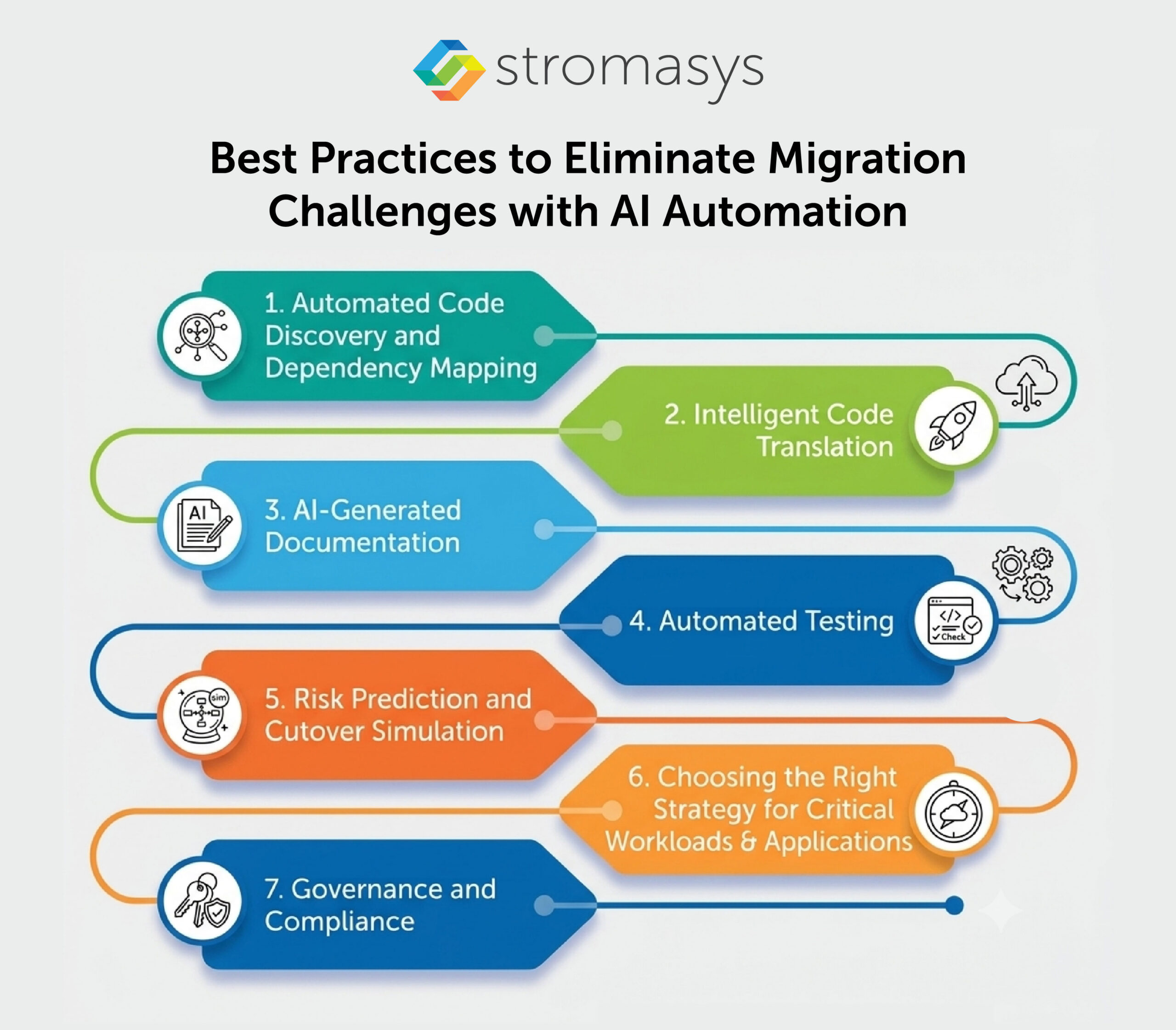
AI scans legacy codebases and maps the legacy infrastructure entirely. It then documents the dependencies and what the critical workloads are. This documentation alone saves a lot of time and helps in the legacy migration process.
Modern AI tools can translate legacy applications like COBOL, PL/1, and other legacy languages into their modern equivalents. It is basically modifying or rewriting the applications while preserving the original business logic.
For systems with zero documentation, AI can generate reports with plain-language descriptions of what each module does. This makes the task simple for the new developers to understand what they will be working with.
AI generates regression tests and integration test cases. This is completely based on observed system behavior while optimizing the time and cost of the validation phase.
Before the actual migration goes live, AI will simulate production workloads on the new system and flag any potential issues that can impact the results.
It is necessary to choose the right strategy, which is only possible if you have a proper understanding of your infrastructure and business requirements. For instance, not every system needs to be rewritten. Some legacy workloads are working perfectly fine and can be easily emulated or rehosted on a modern platform, while there may be some legacy applications that may require rewriting or full refactoring along with AI assistance. As it is perfectly said, one-size shoes don’t fit all.
For regulated industry sectors like finance, healthcare, defense, and manufacturing, the migration approach should account for data sovereignty, audit trails, and regulatory requirements from the beginning of the process.
AI automation in legacy transformation isn’t just theoretical. AI is transforming the digital landscape across major industries.
Here are some real-life success stories of AI-driven legacy system migration:
Based on a McKinsey report, a leading FinTech company needed to modernize 20,000 lines of legacy code. This was a task initially estimated at 700–800 hours for complete migration. The company deployed generative AI agents, and they cut migration time by 40%. There is another example of a top-15 global insurer. They used a similar GenAI-assisted modernization and improved code modernization efficiency by over 50% and accelerated coding tasks by more than 50%.
Based on the full-stack reports, one of the healthcare providers wanted to modernize its patient management system. They used AI-assisted code translation to convert approximately 65% of their legacy codebase automatically. This reduced their migration timeline by up to 50% with 99.99% accuracy in patient data migration. It also saved $12M in direct cost savings and an 85% reduction in post-implementation issues.
A study report from Think Palm showed that a government agency running a decade-old core system with limited documentation used GenAI to analyze millions of lines of code. They use AI automation to map dependencies and extract thousands of forgotten business rules. It resulted in an analysis that would have taken years being completed in days, enabling a structured, low-risk modernization roadmap without disrupting public services.
Stromasys is widely known among organizations when it comes to legacy system migration. Its trademark product, Charon solutions, emulates many legacy infrastructures like VAX, Alpha, SPARC, PA-RISC, and PDP-11 run on modern x86 hardware or cloud, without code changes or operational disruptions.

Charon uses the lift-and-shift migration approach to move the legacy applications and workloads. It is a legacy migration strategy that preserves the existing business logic while leveraging the benefits of a modern platform. This legacy transformation improves scalability, security, and agility while optimizing costs. It also helps in the integration of modern technologies like AI.
With this AI-driven legacy system migration, businesses can not only reduce the modernization timeline but also prevent any potential challenges. It is a low-risk, perfect legacy modernization solution for industries like defense, oil & gas, manufacturing, and more.
Stromasys offers flexibility to choose from both on-premises (x86 server) and cloud environments (AWS, Azure, OCI, or Google Cloud). It has stable partnerships with cloud providers for seamless legacy migration. Charon is the leading enterprise-grade legacy system migration solution. It has been highly recommended by many industry leaders for improving operational efficiency, optimizing costs, and great customer experience.
Traditional legacy system migration is known for its longer timeline, being expensive, and a risky process. But the presence of AI is now changing the equation. It does not eliminate the complexity, but it makes it far more manageable by simplifying the processes.
You can just say that AI amplifies human judgment to get better results, which means the grunt work can be managed by AI while human resources can work on innovation and building strategies. Based on the Modor Intelligence report, the legacy modernization market reached $24.98 billion in 2025 and is projected to hit $56.87 billion by 2030.
With AI-driven legacy system migration, enterprises can seamlessly manage discovery, documentation, testing, and risk prediction so that resources can be better utilized. Every day operating on legacy is compounding legacy debt, while the skilled resources are declining fast. This ensures better utilization of both technology and talent.
Integration of AI in legacy migration helps in automating the modernization process. It includes code analysis, dependency mapping, documentation generation, test case creation, and risk prediction. This helps in reducing migration timelines significantly and lowers the reliance on scarce legacy expertise.


The IT landscape is rapidly evolving, and businesses still operating on legacy hardware are facing...
Read More
DEC Alpha hardware has been pivotal to many businesses due to its reliability, performance, and...
Read More
Legacy application migration is a new trending buzz of IT discussion. Businesses are migrating from...
Read More