
×

 How to Strategize Legacy System Migration
Legacy hardware is outdated, one way or another. Besides machine problems, expect a dip in revenue and workers with expertise as well. In this situation, rather than continuing with the system that does not work, use what does. Use legacy system migration. Life will be much better and easier after migrating your legacy infrastructure and experiencing the gains.
However, a legacy system migration will only be a success if you follow certain tips and tricks to make the process infallible. Using these strategies will make the exercise smoother and without any hassles. Even better, use Stromasys. You will be able to virtualize your system without any hurdles.
 Article

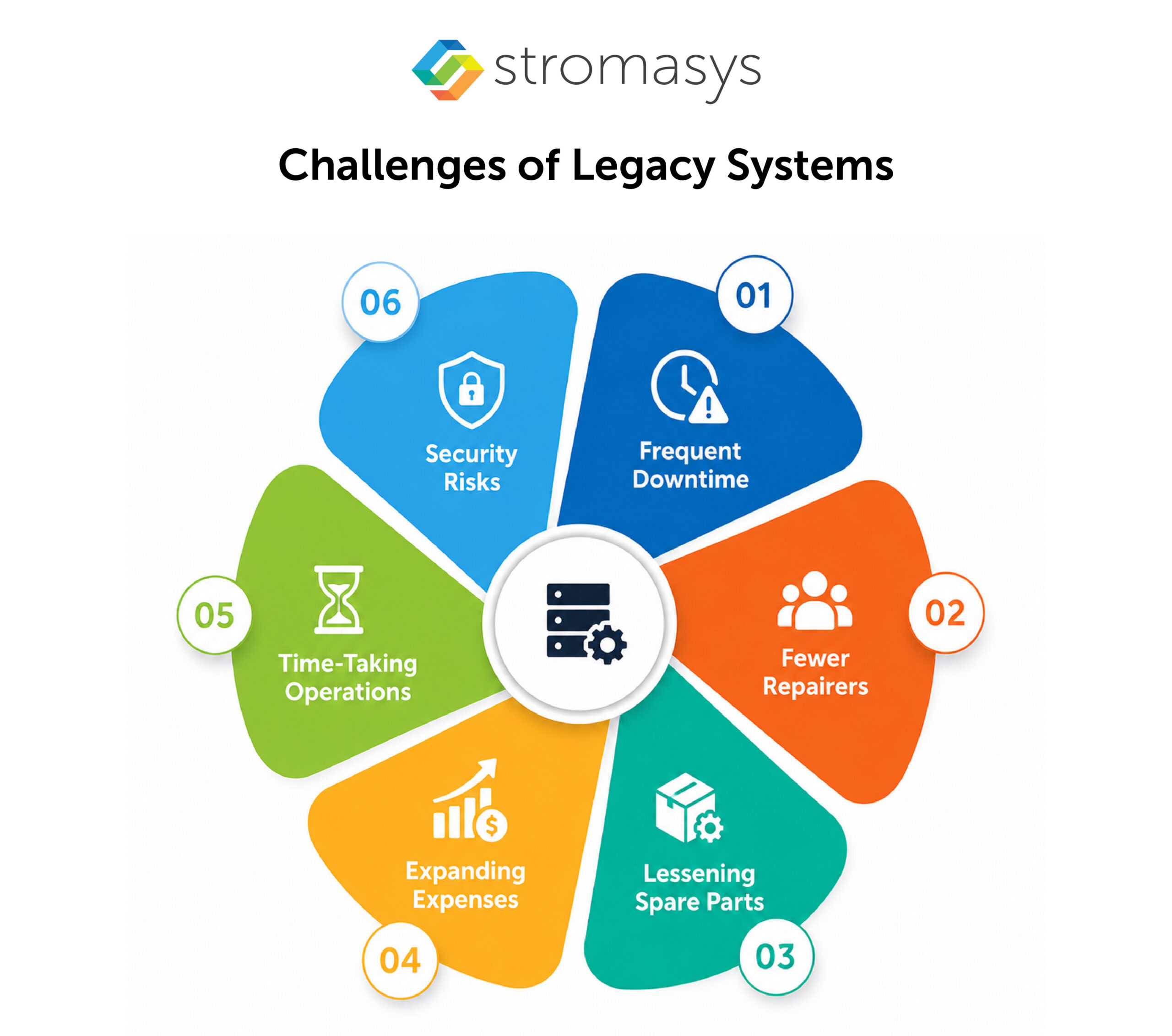
Legacy systems are used even today, despite several several operational risks. While many corporations and government agencies have changed their hardware, most haven’t. They have the tendency to wait until their system crashes completely or a mishap that entirely stops their work is encountered. Leave legacy system migration challenges; what they run into simply by owning these systems include:
Downtime is natural. However, unplanned downtime becomes more frequent as your machine gets older. Interrupted operations cause ROI to fall and brand reputation to be tarnished, overall affecting productivity and creating risks.
Finding people who have the expertise required to repair your hardware becomes tough as more days go by. Just like your own workforce, fewer people have the knowledge needed to fix your hardware until there are none.
Even if repairmen are found, the same cannot be said about spare parts. Vendors slowly start keeping fewer items until they stop selling. Even if a vendor agrees to find what you need, expect a good amount of time before you get it.
As your platform nears end-of-life, operating it and getting it fixed through repair or replacement becomes costly, too. If you are losing money on both counts, it makes no sense whatsoever to continue with such a system.
While you are making less money, the machines are also more time-consuming than before. Slower processing means the work gets finished late, and as a result, you get fewer products or services delivered.
Old infrastructure does not have the same security as new ones. While compliance requirements have changed, aging hardware also does not have the ability to pander to new threats that attack in so many ways.
According to codeaura.ai, 68% of legacy system modernization efforts remain just that – efforts. Despite that, legacy system migration services are a hotshot right now due to the need for innovation and modernization as soon as possible for companies going through exorbitant expenses and operational issues. The advantages are many; you get to enjoy:
Every legacy system migration syncs you to modernity and gives you an edge over your competitors for many years.
While there are many options of migration, what you select depends on various factors, like your requirements, possibilities, demands, etc. What you finally go for is an amalgamation of all these. Your choices include:
In the end, what you pick depends on your needs and the kind of money you can expend.
Legacy technologies still haunt a good 88% organizations, according to itp.net. Yet, even though finding the right legacy system migration strategy may seem tough, we have got your back. Here are a few suggestions that will make your life easier, besides the migration of course:
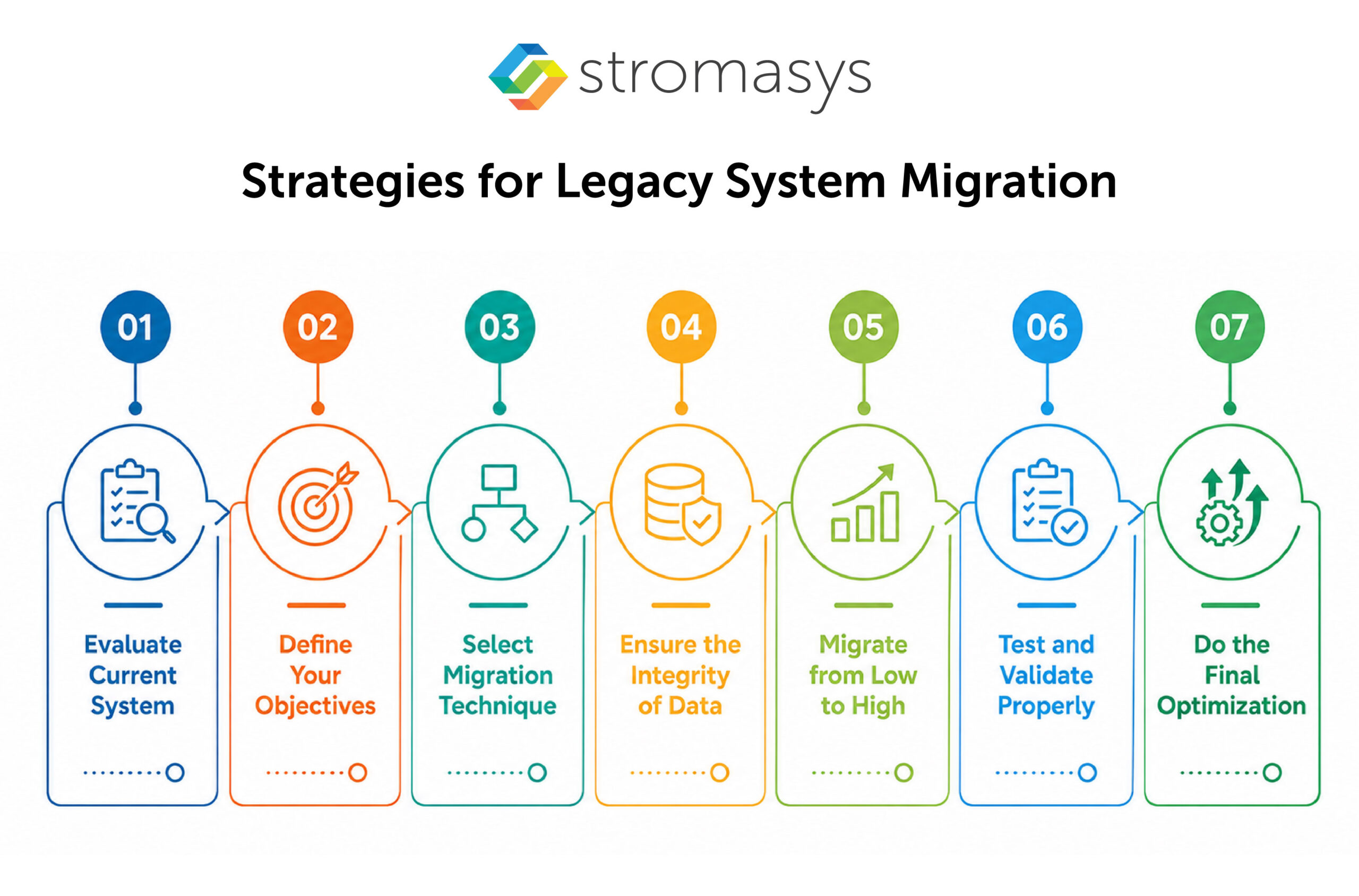
Your current infrastructure may be problematic, but knowing the how and the why, as well as the how many, is what genuinely helps you. Conduct a thorough assessment and audit to gauge your limitations and truly understand what you need and what you can do without currently.
Set goals for what you want to achieve and what is possible with what you can realistically get. See what is objectively in line with the system. Most of the time, your ends are higher than you can accomplish; only a few times are they lower. These cases can be detrimental for your company.
While many strategies work for you, choose the one that suits your needs best. Selection depends on what your business has, what it needs, the money you can spend, what your employees require, and any other condition you may have. The technique should be completely optimized for your business.
You do not know if the legacy system migration will be successful. It is better to have safeguards in place so that failures do not upset your data. Create backups that will keep the accuracy of your data intact and maintain its security. You can use this to check its validity and correct any unwanted changes.
It is best to migrate your system from smaller sections, slowly moving to larger ones. This gives you the chance to test migration quality and assure stakeholders of the justifiability of the process. Once that happens, increase the load so that the most serious migration happens in the end with everyone in focus.
Testing, as we said, is important for understanding if the migration was successful. Both the data and the new hardware/software must be checked to make sure they are ready to be deployed as per your requirements. Rectify any issues that you find so that problems don’t crop up later.
Monitor the performance and refine processes after migration while connecting with whatever tools you need, original or new. Also, do not forget to train your employees or give them pointers where they need. Conduct a final review to make sure the newly migrated system is working normally.
Once the process is complete, you can use the system to do the same tasks as before. Post migration, it should be working better.
Stromasys does legacy migration through rehosting or “lift-and-shift”. Legacy platforms, like any, take time to migrate, and this could be a problem for a high-stakes company. Stromasys makes it easier for them, completing the workload within days.
What basically happens is simple. Stromasys provides the Charon emulation software, which copies the legacy system and makes it operate from the old hardware to the new one. No external changes are viewed as a result. You get to keep using the old set-up on the outside while having completely new hardware inside. You get both on-premises and cloud environments as you need.
EIS Wire & Cable is a company that felt the full convenience of Stromasys and Charon. It faced intense pressure to move from its AlphaServer ES40, which was close to failure. Finding both replacement parts and repair servicemen was becoming tough.
Stromasys swooped in with Charon-AXP and showed changes they did not expect. MRP processing time was reduced from 15 minutes to less than one, while increasing redundancy greatly. At the same time, decreased backup times and increased space helped EIS, along with the absence of system failure fear.
Such apprehensions being gone are possible only with Stromasys. They hardly felt the challenges in legacy system migration and helped complete the task in less than a day. The right software can unlock such benefits with ease and confidence.
A lot of hardware and software systems nowadays are in the realm of legacy or fast approaching the area. Whether you remain there or migrate as soon as possible is a chasm too hard to solve. Often, sticking with your current system, albeit outdated, seems like the better idea.
Legacy system migration may seem like a difficult job, but finding the right option to migrate makes it easier. The right method, migrating tool, and other requirements have to be decided, judging what you want and what you have. All these come together to ensure your strategy for the migration will succeed.
Staying with your old infrastructure sounds like a good plan, but behind it lies yens of problems. Solving them through migration is the best way to get through. Sure, you may face certain troubles, but the result afterwards is rewarding.
Rehosting is a bad idea if you have a lot of technical debt. It may carry low risk, but only if you use it for applications that are stable. For legacy systems, using it does not mean you don’t have to change your system; it gives you more time for a full-fledged complete migration.


The IT landscape is rapidly evolving, and businesses still running legacy hardware are facing numerous...
Read More
DEC Alpha hardware has been pivotal to many businesses due to its reliability, performance, and...
Read More
Legacy application migration is a new trending buzz of IT discussion. Businesses are migrating from...
Read More