
×
 How can businesses save costs by using AI for legacy system modernization?
Legacy system modernization is no longer optional. It is essential for business continuity and to keep your infrastructure running. AI is transforming the way organizations are modernizing decades-old mainframes, COBOL applications, and proprietary systems by automating code analysis, migration planning, and testing. Reports have shown that organizations that have used AI to modernize their legacy systems have seen 30-40% faster timelines and significantly reduced risks.
However, AI is not the answer to all the solutions. Despite its advantages, human expertise still remains critical, and technical limitations exist. Many companies are adopting hybrid approaches. It is the combination of AI intelligence with Stromasys Charon emulation to modernize safely without betting everything on a single cutover. It lowers costs, preserves knowledge, and offers competitive agility that transforms IT from an expensive cost center into a strategic advantage.
 Article

Modernizing the legacy systems transforms the business IT infrastructure into a modern environment without disrupting the operations. And guess what? Here enters artificial intelligence (AI). It is fundamentally changing how organizations approach legacy system modernization and turning it into a data-driven, manageable transformation. Let’s explore how AI is breaking down the challenges of legacy application modernization, the benefits, limitations, and best practices.
COBOL was one of the most popular legacy applications that ran on mainframes for several decades. They were everywhere, powering critical operations, but later on started causing operational challenges. Similar to COBOL, there were other legacy software like Tandem, IMS (Information Management System) Databases, SAP R/3 or Legacy Custom ERP, VAX applications, and AS/400 (IBM i) ERP that have been operating for decades, but with evolving technology, they are becoming a hindrance to business operations.
Here is the list of legacy system challenges:
Maintaining legacy infrastructure is expensive. Reports have shown that companies spend 60-80% of their IT budgets on maintaining these outdated legacy systems. Based on the GAO 2025 reports, the U.S. federal government roughly spend 80% of its IT budget on operations and maintenance of legacy systems.
Another significant challenge of operating on legacy systems is security vulnerabilities. Old systems are designed on monolithic frameworks, meaning they often lack modern security features. This makes them prime targets for breaches.
Not only security challenges, but they also struggle to integrate with today’s cloud and SaaS tools. This incompatibility with modern technology slows down innovation and hinders business growth.
The IBM Cost of a Data Breach Report found that legacy systems have also contributed to higher breach costs. It was seen that the companies using legacy systems experienced $5.62 million breach costs on average, as compared to $3.86 million for those who have modernized their infrastructure. $5.62 million breach costs
Let’s not forget that the experienced engineers are retiring as well, and only a few resources may be skilled in legacy platforms and applications like COBOL or mainframe systems. This results in a serious skills gap and results in companies paying premium prices for specialized expertise.
One of the biggest fears businesses had been operational disruption. A failed migration will disrupt the business for several days or weeks. Then there is another challenge with undocumented code and “tribal knowledge”. It is the stuff only a few veterans can understand.
Tight budgets, unclear ROI timelines, and no one wants to lose critical functionality that’s been battle-tested for years.
In short, doing nothing and standing still is expensive and risky. But, without any proper assessment, jumping into a migration project blindly is scarier. That’s where AI can come in handy for legacy system modernization.
Instead of relying solely on manual code reviews and tribal knowledge, AI brings automation, intelligence, and predictability to the modernization journey.
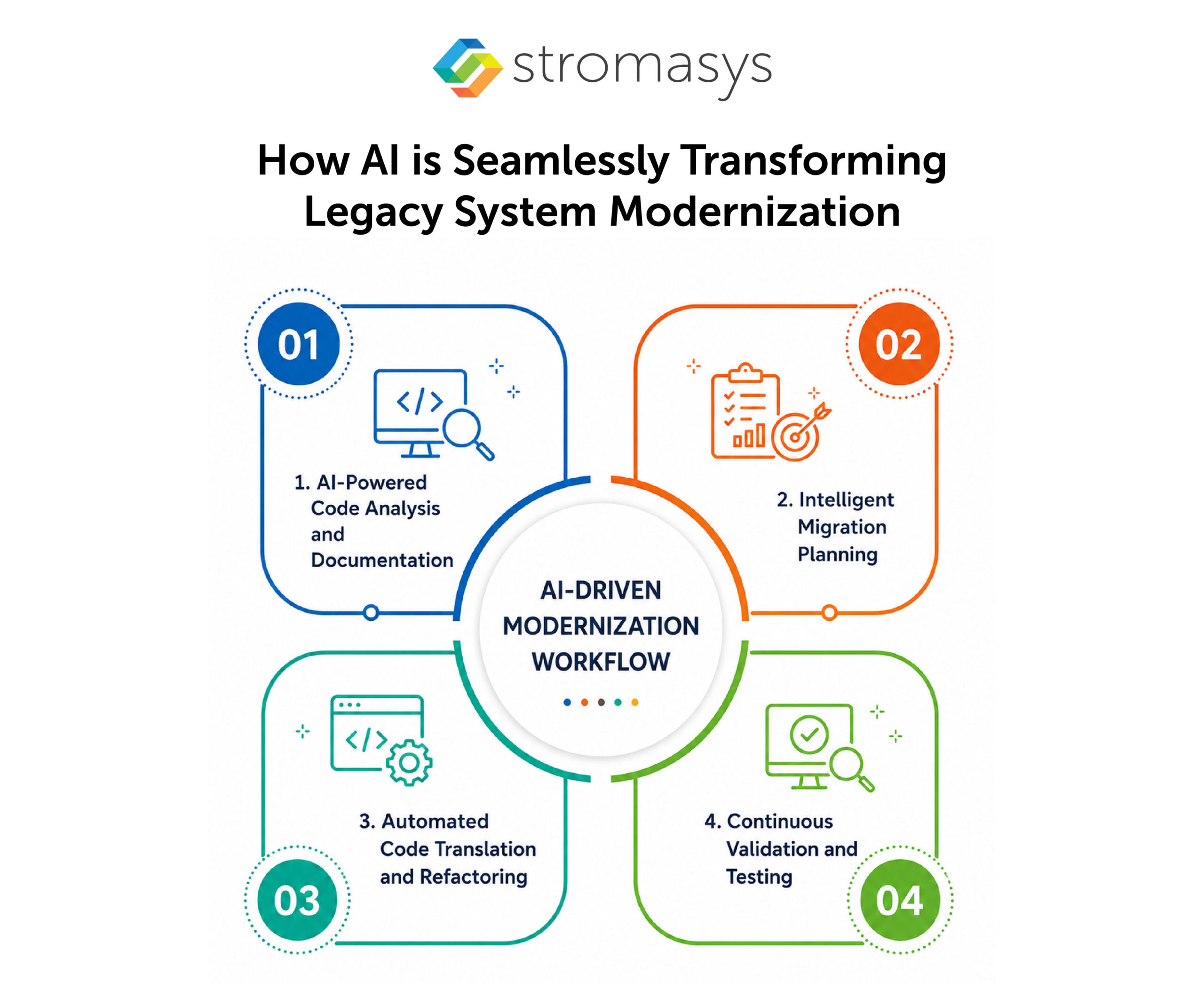
AI can scan millions of lines of code, map dependencies, and automatically figure out business logic. It generates natural language documentation from spaghetti code and ensures it is easily understandable. Also, the impact analysis predicts what potential changes can influence the system and ensures there are no random surprises.
AI algorithms assess the complexity and risk of the legacy systems and then prioritize workloads based on business value versus technical debt. Then it generates test cases based on the existing behavior and turns it into data-driven decisions. Based on the research from McKinsey, AI-assisted migration planning can reduce project timelines by 30-40% by automating discovery and assessment phases.
AI tools and technologies convert COBOL to Java or mainframes to microservices. The pattern recognition helps in modernizing architecture while preserving core business logic. It acts as a bridge in preserving the existing investment while leveraging the modern benefits.
In AI-based legacy systems transformation, testing is continuously running while the migration process continues. This helps in detecting any anomaly before it can impact the business and helps in optimizing early. Reports have shown that organizations using AI for testing during modernization projects report 50% fewer post-migration defects compared to traditional legacy migration approaches.
While AI accelerates modernization, sometimes you need a bridge strategy, which is a way to modernize safely without halting the business operations. That’s where Stromasys comes in.
Stromasys brings the Charon emulation solution that uses the lift and shift migration approach to transform the existing legacy infrastructure. It allows seamless AI integration that speeds the migration process. It allows organizations to run legacy systems designed for obsolete hardware like VAX, Alpha, SPARC, PA-RISC, or PDP-11 on modern x86 servers or cloud infrastructure without any changes in the existing code.
The Stromasys approach gives the organizations some “buy time,” which means they can see how their business is operating after this migration strategy is implemented. Instead of rushing with complete application rewrites or system overhauls due to failing hardware, you can:
You can think of Charon emulation as your safety net. You can experiment with AI-driven code translation, test new architectures, and validate migrations while your business continues running on emulated legacy systems. It’s like getting the best of both worlds, the benefits of the modern infrastructure, along with the legacy system reliability.
Here are some best practices that organizations should follow for a seamless AI-driven modernization:
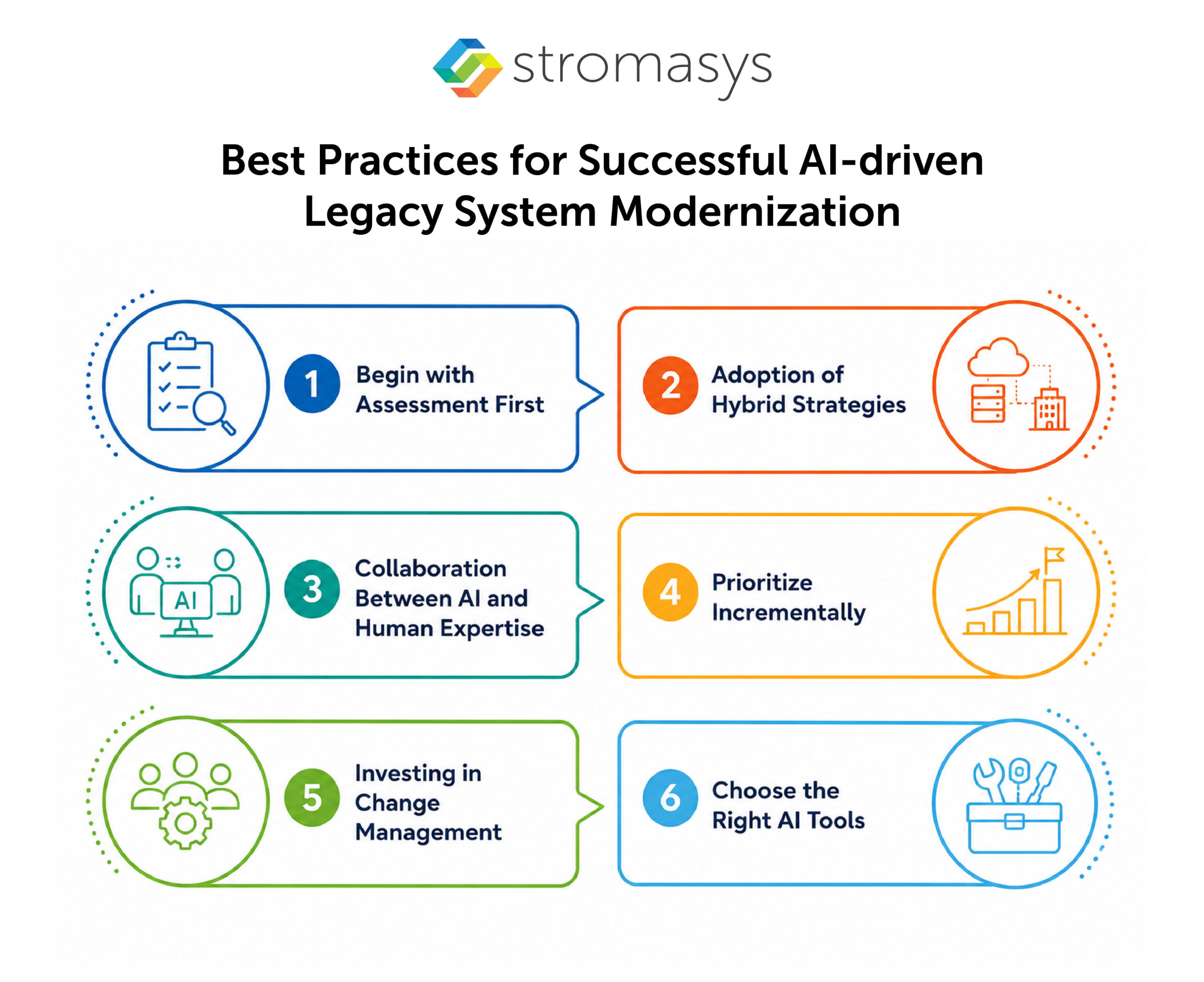
Choose the Right AI Tools: Select transparent AI tools for debugging and validation.
AI is making legacy system modernization possible. It has become safer, smarter, and more affordable than ever. But it’s not a set-it-and-forget-it solution. But you will need guardrails, expertise, and smart partners.
It is predicted that by 2027-2030, autonomous AI agents will be handling more of these legacy systems’ modernization. Predictive maintenance ensures that any potential failures are prevented before they can even occur, and AI will converge with its low-code or no-code ability for faster results. The legacy modernization market is booming and projected to grow at 17.64% CAGR over 2026-2031, based on the Modor Intelligence report.
The question isn’t whether to modernize your legacy systems but how to do it smartly, safely, and with the proven AI technology. There is no right time to decide when to modernize. It is best to proactively analyze your aging infrastructure and transform it at the earliest to avoid any major pitfalls.
Legacy system modernization is a process of transforming the outdated infrastructure, like legacy mainframe systems, old programming languages like COBOL, and obsolete hardware, to modern architectures or languages, depending on the organization's requirements and what is more maintainable, secure, and cost-effective for them.


The IT landscape is rapidly evolving, and businesses still running legacy hardware are facing numerous...
Read More
DEC Alpha hardware has been pivotal to many businesses due to its reliability, performance, and...
Read More
Legacy application migration is a new trending buzz of IT discussion. Businesses are migrating from...
Read More