
×

 Can Charon emulation run legacy UNIX and OpenVMS workloads on any hypervisor?
Charon software emulates the original PA-RISC, SPARC, Alpha, and VAX hardware so the critical existing HP-UX, Solaris, Tru64, and OpenVMS workloads continue to run exactly as before without any recompilation, recertification, or porting on any modern hypervisor. Production deployments already exist on Microsoft Hyper-V (hundreds of instances at a major European telco), Proxmox VE (steel-industry AlphaServers and VAX systems), Nutanix AHV, Huawei HCI and other KVM platforms. Because the Charon emulator host itself runs as a standard virtual machine, the emulated server inherits high availability, live migration, snapshots, and backup from the underlying hypervisor, whether it is a commercial, Windows-based, or KVM-based. This helps organizations retain complete freedom to choose the most cost-effective virtualization layer.
 Article
For many organizations, the most critical applications still run on hardware designed decades ago: SPARC servers running Solaris, PA-RISC systems running HP-UX, AlphaServers running Tru64 and OpenVMS, and even VAX machines. The software still does its job well. The problem is everything around it — spare parts that are harder to find every year, support contracts that keep getting more expensive, and a shrinking number of engineers who know how to keep the boxes alive.
Rewriting or re-platforming these applications is usually slow, risky, and expensive. Charon emulation offers a different path: keep the operating system, the applications, and the data exactly as they are, and move them onto modern infrastructure, that is, a virtual infrastructure. But which virtual infrastructure is it?
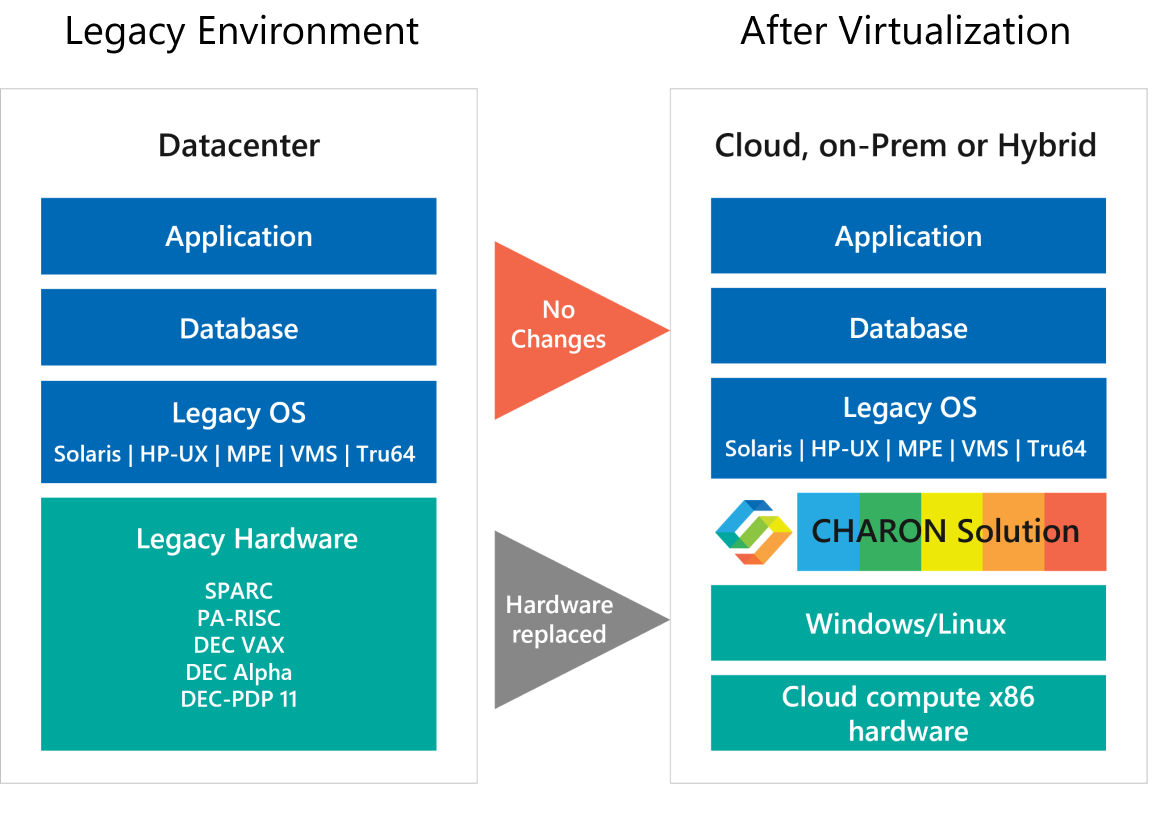
Charon recreates the original hardware in software. The emulator runs as an application on a standard x86-64 host, and the legacy operating system boots on it believing it is running on its original SPARC, PA-RISC, Alpha, or VAX server. Binaries, kernels, licenses, and databases are moved over unchanged — no recompiling, no porting, no application rewrite.
Because the Charon host is itself just a virtual machine, the emulated server inherits whatever the underlying virtualization layer provides: high availability, live migration, snapshots, centralized backup and monitoring. Whether that layer is a commercial hypervisor, a Windows-based hypervisor, or one of the many KVM-based platforms, the legacy workload behaves the same way.
That flexibility is not theoretical. Here is how it looks in production.
A major European telecommunications operator had a large estate of SPARC/Solaris and PA-RISC/HP-UX servers supporting core business and network-related systems. Instead of a multi-year migration program, the operator consolidated the estate onto Charon-SSP and Charon-PAR running on Microsoft Hyper-V, the virtualization platform already used across its data centers.
Today hundreds of emulated Solaris and HP-UX instances run on that platform, hosting around 40 different UNIX-based applications and databases. The operations team manages them with the same tools and processes it uses for the rest of its Windows and Linux workloads, while the application owners see the same operating systems and the same software they have always run.
A global steel producer relies on specialized vertical applications — production control, plant automation and quality management — that were certified on Tru64 UNIX and OpenVMS. Re-certifying that software on a new platform would have meant high cost, long validation cycles, and real operational risk.
The company now runs half a dozen Charon-emulated AlphaServers (Tru64 UNIX) and VAX systems (OpenVMS) on Proxmox VE, an open-source KVM-based platform. Because the emulated hardware looks exactly like the original to the operating system, the applications run unmodified, and no re-certification was required. The aging physical servers have been retired, while the plant-floor applications continue to run as before.
The same pattern repeats across very different industries. Customers in sectors such as manufacturing, finance, healthcare, transportation and the public sector run Charon emulation on Nutanix AHV, on Huawei hyperconverged infrastructure, and on other KVM derivatives, hosting UNIX-based applications that range from ERP back ends to industrial and engineering systems.
In most of these cases, the choice of hypervisor came first — driven by a broader data-center strategy — and Charon simply fitted into it. The legacy workloads did not dictate the platform; they followed it.
The virtualization layer has become one of the most significant line items in infrastructure budgets. Licensing models differ widely: some platforms are sold as per-core subscriptions with minimum core counts per processor, while others are open source, with optional support subscriptions priced per physical CPU socket regardless of core count.
Consider a typical small cluster for a Charon estate: three hosts, each with two 32-core processors (192 physical cores in total). Using indicative 2026 European list prices:
| Most expensive virtualization infrastructure | Least expensive virtualization infrastructure | |
|---|---|---|
| Licensing model | Per-core subscription, 16-core minimum per CPU | Open source; optional support per CPU socket |
| Unit price (indicative list) | ~€380 per core per year | €0 without subscription; €1,100 per socket per year at the top support tier |
| Licensed units | 192 cores | 6 sockets |
| Annual cost | ~€73,000 | €0 – €6,600 |
| 5-year cost | ~€365,000 | €0 – €33,000 |
Figures are indicative list prices for illustration only; actual pricing depends on different, specific factors.
Even when the less expensive platform is bought with its highest enterprise support tier, the virtualization layer costs roughly one tenth as much — a difference of more than €330,000 over five years for a single three-node cluster. And as servers move to processors with ever higher core counts, the gap widens: a per-core model charges for every additional core, while a per-socket model does not.
Stromasys Charon emulator has been protecting mission-critical legacy workloads for years, in telecom, heavy industry, and many other sectors where downtime is not an option. The emulated servers run the original operating systems and applications unchanged, with the reliability those environments demand — and they gain the resilience of modern infrastructure along the way.
What makes the solution even more compelling today is its freedom of choice. Charon runs on the major commercial hypervisors, on Windows-based virtualization, and on the growing family of KVM-based platforms, from open-source stacks to hyperconverged appliances. That means the legacy estate never locks you into a specific vendor. When virtualization costs rise, you can move your emulated servers to the platform that makes the most economic sense — and, as the numbers above show, choosing the less expensive hypervisor can turn a necessary modernization into a substantial saving.


Charon is the commercial-grade legacy hardware emulator that mimics the behavior of SPARC, PA-RISC, Alpha, and VAX systems in software, so legacy UNIX (Solaris, HP-UX, Tru64) and OpenVMS applications run unchanged on modern x86-64 infrastructure.


The IT landscape is rapidly evolving, and businesses still running legacy hardware are facing numerous...
Read More
DEC Alpha hardware has been pivotal to many businesses due to its reliability, performance, and...
Read More
Legacy application migration is a new trending buzz of IT discussion. Businesses are migrating from...
Read More