
×
 How to Migrate Legacy IT Infrastructure Without Disrupting Business?
Legacy IT infrastructure doesn't age like fine wine. It does not improve over time, but it becomes costly, inefficient, and lacks advanced security measures. With careful planning and implementation, businesses can seamlessly migrate their legacy IT infrastructure.
The migration strategies include developing legacy migration plans, identifying application dependencies, conducting thorough testing, and implementing the strategy for seamless migration. There are several benefits of migrating the IT infrastructure to a modern platform, like enhanced efficiency, robust security, reduced maintenance costs, and improved scalability. It is a crucial step towards business continuity and innovation.
 Article

Highlighting the key differences between legacy IT infrastructure and modern architecture.
| Characteristics | Legacy IT Infrastructure | Modern Systems |
|---|---|---|
| Technology | Designed on outdated systems | Uses the latest technologies like cloud, data analytics, AI, and many more. |
| Architecture | Rigid and monolithic | The modern systems are scalable and flexible which makes them easy to integrate to create new innovative solutions. |
| Integration with latest applications | Rigid and monolithic | The modern systems are scalable and flexible which makes them easy to integrate to create new innovative solutions. |
| Security Architecture | Lacks advanced security measures | Prioritizes modern security practices and follows latest security standards |
| Automation | Rely on manual processes | Follows automation for better efficiency |
| User Experience | Poor user experience | Better users experience due to advanced UI/UX designs |
Here are various components of legacy IT infrastructure:
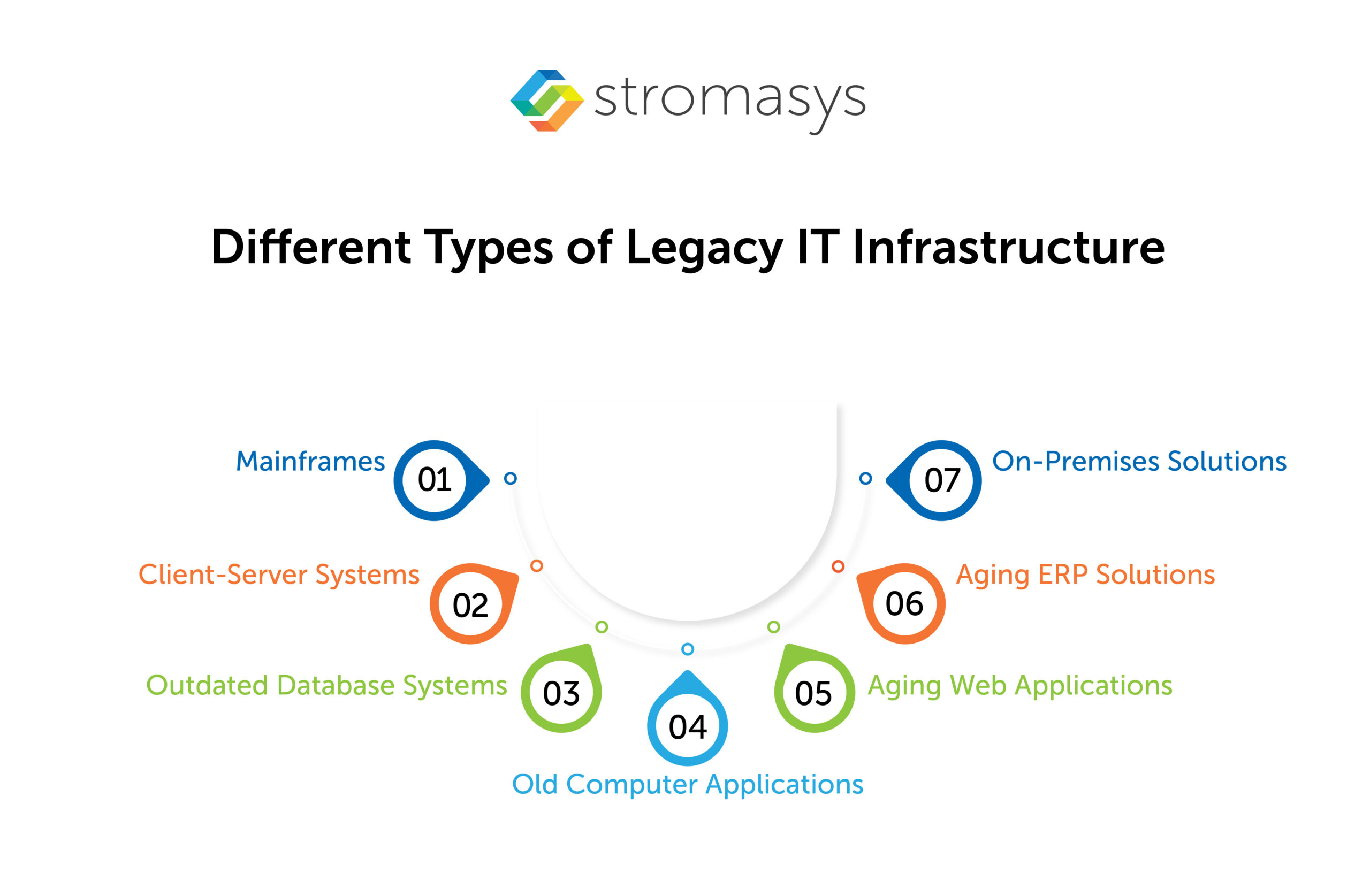
Mainframes were once the titans of computing, standing tall as the monolithic data fortress for large organizations. These centralized computer systems were the pillars of many organizations, but now they are slowing down business as they age. Businesses are now looking for more advanced, secure, and scalable options that can enhance their efficiency.
These systems heavily depended on the central server for storing and processing data. Due to new modern technologies, they are now outdated and lack the scalability and flexibility of the latest applications.
The outdated database systems lack the environment of modern technologies like scalability, infrastructure, security, and performance. They have several limitations, which are making them unpopular now, as they are unable to meet modern business requirements.
Many old computer applications, usually installed and running on a single system, do not offer the same advanced features and accessibility as modern ones, which leads to a poor user experience. Modern applications, like cloud-based alternatives, offer better scalability, flexibility, and security.
These old and aging applications, which are available all over the internet, lack design, responsiveness, and security. Rewriting or migrating them with the latest framework can enhance the user experience and update them according to the latest security standards.
Many applications that manage operations, such as finance and HR, are still struggling with outdated ERP solutions. They are old and offer limited support with integration and mobility. Migrating legacy IT infrastructure to other latest options will offer better flexibility and security.
Businesses that are dependent only on-premises systems also have several limitations. They are expensive, and most of the organization’s resources are busy managing them, making them time-consuming. For the smooth functioning of the on-premises hardware, regular monitoring, maintenance, and patches are essential. They are risky and can result in unplanned downtime that damages brand value, customer experience, and production, thus impacting the overall ROI.
Here are some factors that why businesses are still relying on legacy IT infrastructure:
Several organizations are still relying on legacy hardware, as it has been the core of operations since the beginning. According to a survey report, around 74% of manufacturing and engineering businesses in the UK are heavily dependent on it for their critical operations. Therefore, switching to a modern infrastructure is not a simple decision for them, as it may disrupt their operations, efficiency, and data loss.
Replacing the entire legacy infrastructure can be extremely expensive. For small organizations, maintaining the legacy infrastructure seems a more suitable option than replacing it, even though this option is not suited for the long run.
These legacy systems have been integrated into the business infrastructure since the beginning. Therefore, replacing or upgrading the entire IT infrastructure becomes a hassle. Also, the unavailability of documents adds up to extra complications. Moreover, looking for a skilled personnel who can seamlessly manage legacy IT infrastructure modernization.
Modernization opposition is another hurdle, as people are not always appreciative of changes when they have long been accustomed to certain working procedures. Employees try to push back these changes, fearing these new technologies simply because they are comfortable with their original methods or fear job insecurity. In a survey, more than 21% of employees highlighted their aversion to modernization.
Here are some challenges that businesses will encounter while still relying on aging legacy IT infrastructure:

The aging legacy hardware lacks modern security measures, making it vulnerable to advanced security attacks and risks.
The legacy systems struggle to integrate with the new technologies, which results in operational inefficiencies and restricted functionality.
Outdated legacy systems fail to offer optimum performance due to their limitations in flexibility and scalability. They are not well equipped to integrate with modern technologies. Due to their old infrastructure, they are more prone to wear and tear, resulting in unplanned downtime and additional maintenance costs.
Managing outdated legacy hardware is extremely expensive. A lot of resources are invested in it. Not only are highly skilled personnel required to work on it, but regular repairs and patches are required to ensure it operates. Also, finding its parts can be extremely difficult, as often the parts are obsolete and not supported by the manufacturer.
Old legacy IT infrastructure is not in compliance with the latest regulatory standards and guidelines. It is vulnerable to many advanced security risks, including data breaches and leaks, which can result in non-compliance and legal penalties.
Technology is evolving rapidly, which results in manufacturers and vendors discontinuing support for outdated legacy hardware. There are no updates, patches, or technical support for these aging systems.
Here are some tips to help migrate Legacy IT infrastructure to a modern architecture for seamless operations and efficiency:
Create a plan that outlines the objectives, goals, tasks allocated, timelines for the migration process, and resource distribution. It is an initial and most crucial task that will help get other steps checked.
Create a document with all the interconnections between the systems, applications, and information from both source and destination. This will help prepare a proper migration process with limited disruptions.
Staying agile and flexible is the answer. Businesses must work on creating strategies that should be ready to tackle any unexpected challenges that may arise while transitioning. Adopting flexible and agile principles will be helpful in such situations.
Conducting regular testing to monitor operations and performance is essential to identify any potential issues early on.
Data accuracy and integrity should be highly prioritized. To prevent potential mishaps, it is recommended that data be monitored, cleansed, validated, and backed up.
Opting for advanced security measures like encryption, access controls, and other enhanced protocols helps secure sensitive information from security risks and breaches.
Maintaining a detailed record of all the plans, strategies, systems dependencies, test outcomes, and any other modifications for future reference.
Rather than a sudden transition, incremental migration, a step-by-step procedure that helps identify and address any challenges gradually, is suggested.
Here are some benefits of migrating legacy systems:

By upgrading the IT infrastructure, businesses can run their operations faster, as the processes will be more streamlined due to automated systems. The new infrastructure will enhance efficiency and boost productivity, impacting the ROI.
Modern IT infrastructure can quickly adapt to changing business requirements due to its scalability and flexibility with lower disruptions.
Modern infrastructure offers advanced security measures, with regular updates and patches reducing the risk of cyberattacks and vulnerabilities and thus protecting sensitive information.
The aging legacy IT infrastructure requires regular maintenance and is more prone to wear and tear. To manage it, businesses need to spend a lot of their budget, which can be very expensive. Meanwhile, the new modern infrastructure offers better support, warranties, and compatibility for better results.
Modern IT infrastructure offers better accessibility and user-friendly interfaces. This not only enhances the user experience but also saves time and improves productivity.
The modern infrastructure can adapt to the latest business shifts and integrate seamlessly with other technologies. It effectively adheres to the latest regulation standards, which align with industry objectives.
Upgrading the legacy systems to a modern environment shows the business’s dedication to innovation, elevating its value and attracting a wider audience, such as investors, partners, and customers.
Transforming legacy IT infrastructure is one of the most common ways to remain competitive in today’s business landscape. It shows the business’s dedication to innovation. Stromasys is a global leader in transforming legacy IT infrastructure with more than two decades of experience. They offer Charon emulation solutions for modernizing aging hardware and provide both on-premises and cloud migration options for managing legacy architectures. The Stromasys experts will evaluate the infrastructure to create the best legacy migration strategy for your business and ensure a smooth transition.
Legacy IT infrastructure is the outdated hardware, applications, and workloads that are still used for the business's critical operations. These vintage systems fail to meet the current requirements of modern enterprises.


The IT landscape is rapidly evolving, and businesses still running legacy hardware are facing numerous...
Read More
DEC Alpha hardware has been pivotal to many businesses due to its reliability, performance, and...
Read More
Legacy application migration is a new trending buzz of IT discussion. Businesses are migrating from...
Read More