
×

 How do outdated legacy systems cause downtime in semiconductor manufacturing?
Outdated legacy systems in semiconductor manufacturing account for nearly 20% of financial losses due to unplanned downtime. These aging systems are incompatible with modern technologies, lack vendor support, have inadequate security infrastructure, and incur skyrocketing maintenance costs. These legacy system security risks compile together through unpatched vulnerabilities and outdated security measures.
With legacy hardware emulation and virtualization solutions, businesses can eliminate these challenges. Migration of legacy systems to modern platforms enables semiconductor manufacturers to leverage modern technologies while minimizing downtime, optimizing costs, and improving security.
 Article
The semiconductor industry is the pillar of modern technology, playing a crucial role in various everyday electronics, and its downtime can wreak havoc. It is estimated that nearly 20% of its losses are due to downtime, especially unplanned. Several factors contribute to unplanned downtime, such as improper maintenance of machinery systems or outdated legacy systems that are often difficult to maintain and prone to failures. Legacy systems security risks and compatibility issues further compound these challenges. This will result not only in production shortages but also in monetary losses.

One major Taiwan-based semiconductor manufacturer experienced downtime in 2018, which caused a production delay and an estimated loss of $170 million. Such incidents highlight the vulnerability of system failures in the semiconductor industry. In this blog, we delve into how outdated legacy systems result in downtime in semiconductor manufacturing causing monetary loss and affecting global supply chain.


For any manufacturing industry like semiconductors, the duration when the manufacturing process or operational activities stop is known as downtime. There are two significant types of downtime:
When a manufacturing company is scheduling a halt to stop its operational activities like productions for a scheduled maintenance, manufacturing changes, or upgrades is known as planned downtime. Though this downtime still results in monetary loss, the priority is to manage the machinery maintenance and changeover of products as they remain within the budgeted timeframe.
Unplanned downtime is an unexpected interruption that disrupts the functioning of production and operational activities. It occurs without any prior warning and persists for an unpredictable period, which can create a halt in production and result in a loss of revenue.

Unplanned downtime often results from hardware failure. This may be due to a lack of maintenance, legacy systems security risks, or the continuous use of outdated legacy systems that are incompatible with modern production technologies. Due to unplanned downtime, semiconductor manufacturers lose revenue for every minute the machine is not producing.
Here are some real-world examples of semiconductor manufacturers who faced downtime, resulting in revenue loss.
The impact of downtime on employees and productivity can calculate the true cost of downtime in the semiconductor manufacturing industry. For employee downtime, calculations of wages and overtime are included, while for productivity calculations, orders lost that have affected sales and the loss of any client are considered. By combining these factors, semiconductor manufacturers can easily calculate the estimated fiscal figure due to unexpected interruptions.

There is a direct correlation between the cost related to employees impacted by the downtime and the decline in production.

Outdated legacy systems are the aging hardware that requires regular maintenance, while their manufacturers no longer support some of the vintage hardware. Here are some common outdated legacy systems challenges due to downtime:
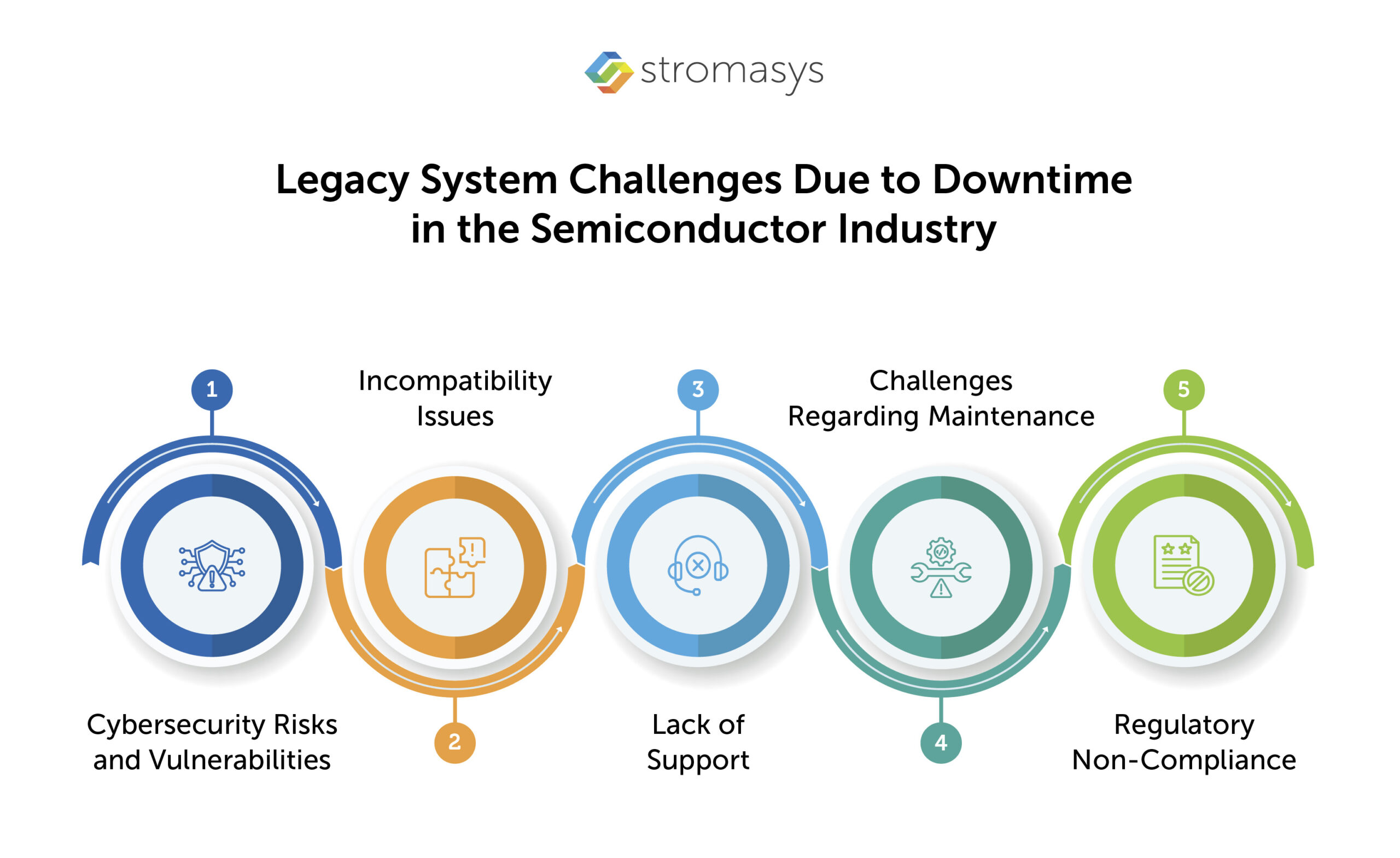
Outdated legacy systems are not updated and lack modern security measures, making them vulnerable to various security vulnerabilities, which can result in system failures and production halts.
Aging legacy hardware are incompatible with the latest technologies and create bottlenecks in production processes. Many semiconductor manufacturing industries are adopting smart manufacturing or Industry 4.0, which means integrating AI, data analytics, and IoT in their production for seamless operations and enhanced productivity. This limitation of aging hardware becomes more apparent, affecting overall operational efficiency.
One of the significant challenges of aging hardware is the lack of assistance and support from their manufacturers (OEMs), which further drives the need for migration of legacy systems to modern, supported platforms. As the hardware and systems age, obtaining replacement parts becomes increasingly difficult. Also, with the rise in modern technology, getting skilled experts to work on legacy hardware is becoming tough, which also contributes to downtime.
Maintaining aging legacy hardware can be extremely challenging and expensive. Also, with a lack of vendor and manufacturer support, managing that hardware becomes increasingly difficult in case of wear and tear, resulting in unplanned downtime.
Older legacy systems struggle to meet the latest industry regulations and standards. They are also vulnerable and more prone to data leaks and breaches, which can result in fines and legal penalties.
These issues often result in frequent system crashes, slow processing speeds, and compatibility issues with modern technologies, leading to unplanned downtime and revenue loss. Thus, reliance on outdated legacy systems ultimately compromises productivity and efficiency and inflates costs.
Stromasys offers legacy hardware emulation and virtualization solutions for outdated systems like DEC Alpha, SPARC Solaris, VAX VMS, PDP, and PA-RISC. For more than 20 years, Stromasys has offered its services in 70+ countries. The Stromasys Charon solution imitates the functions of the original systems on a new modern system like x86 servers or a cloud platform, allowing businesses to run all their existing mission-critical applications seamlessly.
By partnering with Stromasys, semiconductor manufacturers will get the following benefits:

If you are also looking to integrate these modern technologies in your business and your outdated legacy systems are hindering your progress, then you are at the right spot. Just contact our seasoned legacy experts, who will assist you with all your queries and questions in a minimal amount of time.
The outdated legacy systems are a hidden challenge for the semiconductor industry, where every second of production counts and downtime can result in significant monetary loss. The downtime in the business not only halts production, resulting in millions of losses, but also dents the business’s reputation. Instead of depending on aging outdated hardware, migration of legacy systems to modern platforms provides the optimal path to minimize downtime, reduce additional costs, and enhance overall operational efficiency while ensuring continued growth.
Financial impacts include lost production, increased maintenance costs, potential customer loss, and expenses related to rush orders or overtime to make up for lost time.


The IT landscape is rapidly evolving, and businesses still running legacy hardware are facing numerous...
Read More
DEC Alpha hardware has been pivotal to many businesses due to its reliability, performance, and...
Read More
Legacy application migration is a new trending buzz of IT discussion. Businesses are migrating from...
Read More