
×

 Can telecom operators adopt AI and automation without full replacement of their core legacy systems?
Modernizing telecom infrastructure for AI without rebuilding core systems or a rip-and-replace of core systems means preserving existing legacy applications and workloads. These legacy workloads include OSS, BSS, billing, and network cores. While adding automation, data layers, semantic understanding, and AI capabilities around them, operators can leverage benefits like predictive maintenance, faster service rollout, fraud detection, and personalized experiences without the massive cost, risk, and operational downtime.
But automation and AI integration are not possible when telecom operators are operating their workloads on legacy hardware. While full system replacement doesn’t seem like a reliable option, there are other modernization strategies without rebuilding core systems, like emulation solutions. With the Charon emulation solution, telecom operators can move their core critical workloads to new hardware without any modifications. This eliminates any regulatory challenges. When moved to new modern hardware, these telecom operators can now integrate AI and automation processes seamlessly without disruption to drive innovation and growth.
 Articles

Legacy OSS and BSS platforms, billing systems, and core network functions were designed for stability and engineered for uptime and strict regulatory compliance. For decades, they have performed admirably and powered several million connections daily.
Now the problem isn’t the failed systems but the time. With time, several challenges like fragmented product catalogs from mergers, duplicate billing platforms, brittle order flows, and inconsistent data across systems have been introduced.
Many operators still carry decades of technology and process debt. Traditional transformation programs that demand full modernization before any AI adoption are underestimating how quickly the dynamics of the market are shifting. This debt isn’t just a technical inconvenience but a reason that even a small change can become slow, expensive, and hard to predict.
Here are a few recurring issues that often show up across every telecom operator’s environment:
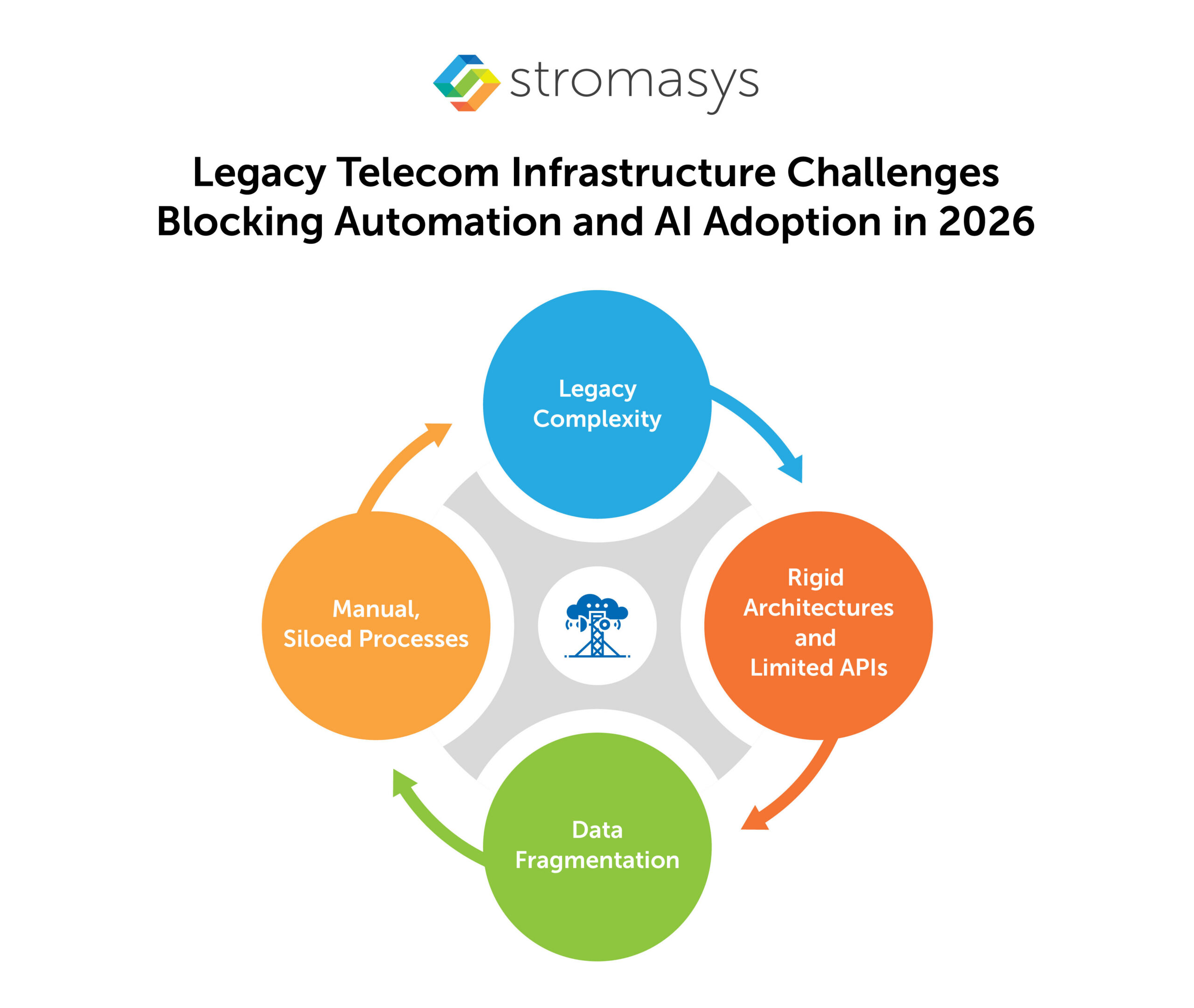
None of the above problems can be simply resolved by adding another layer of AI on top. If anything, by deploying AI on top of such a fragile legacy infrastructure, it will expose the vulnerabilities faster than fixing it.
Full legacy infrastructure replacement or rip-and-replacement modernization approach is very expensive, time-consuming, and risky. There are high chances of operational disruptions due to unplanned downtime, along with issues with regulatory compliance.
Only a very few organizations go for full rewrites as they can be very expensive and risky. Incremental approaches are more common options as they preserve the critical business logic while replacing or augmenting specific components.
Telecom operators who insist on a “perfect core” before touching AI often tend to delay the impact while their competitors move faster and capture the value first. A dual-track model, which is the AI deployment alongside targeted modernization, has proven to be an effective option.
Here are some proven legacy modernization approaches that telecom operators can choose to transform their traditional aging infrastructure in 2026:

Emulation and hardware virtualization are legacy modernization approach that preserves the critical workloads by moving them to a new platform with zero modifications. This eliminates the obsolete hardware that has reached its end-of-life. It creates a virtual environment that is similar to the original hardware so that the critical legacy workloads can operate without any challenges. It is one of the cost-effective means to transform legacy systems.
It is a transformation approach where, rather than reworking the core, operators are deploying AI agents for targeted tasks like order confirmation, churn prediction, or ticket triage. When those agents repeatedly stall or escalate, then this friction indicates where the modernization is actually needed next. This process helps in highlighting the priorities for deeper fixes.
It is a targeted modernization strategy specific to OSS or BSS layers. In this approach, instead of transforming the entire stack, telecom operators focus their effort on the specific components that are actively blocking AI integration while not touching the systems that are stable and working without any issues.
Building a semantic or knowledge layer gives the AI agents the ability to understand context across disparate systems and vendors without creating new data silos. This is increasingly seen as a prerequisite for safe automation at scale.
The human-in-the-loop modernization approach preserves decades of institutional knowledge. It also reduces the risk of moving too fast. Did you know? TCS worked directly with TDC Net to apply a human-in-the-loop AI approach to legacy modernization. This helped them preserve institutional knowledge while reducing transformation risk.
The dual benefit is not just a marketing strategy, but its benefits are real. This enables the telecom operator to keep the stability and compliance posture of systems that support billing accuracy, regulatory reporting, and network uptime, while giving the space to innovate around them.
A modern, stable core gives AI agents traceability and control points. This helps them act safely and allows operators to expand automation seamlessly without keeping it limited to isolated pilots. Business continuity is not a constraint on this approach but is the reason this approach works.
Here are some significant benefits of modernizing telecom legacy infrastructure for automation and AI adoption:
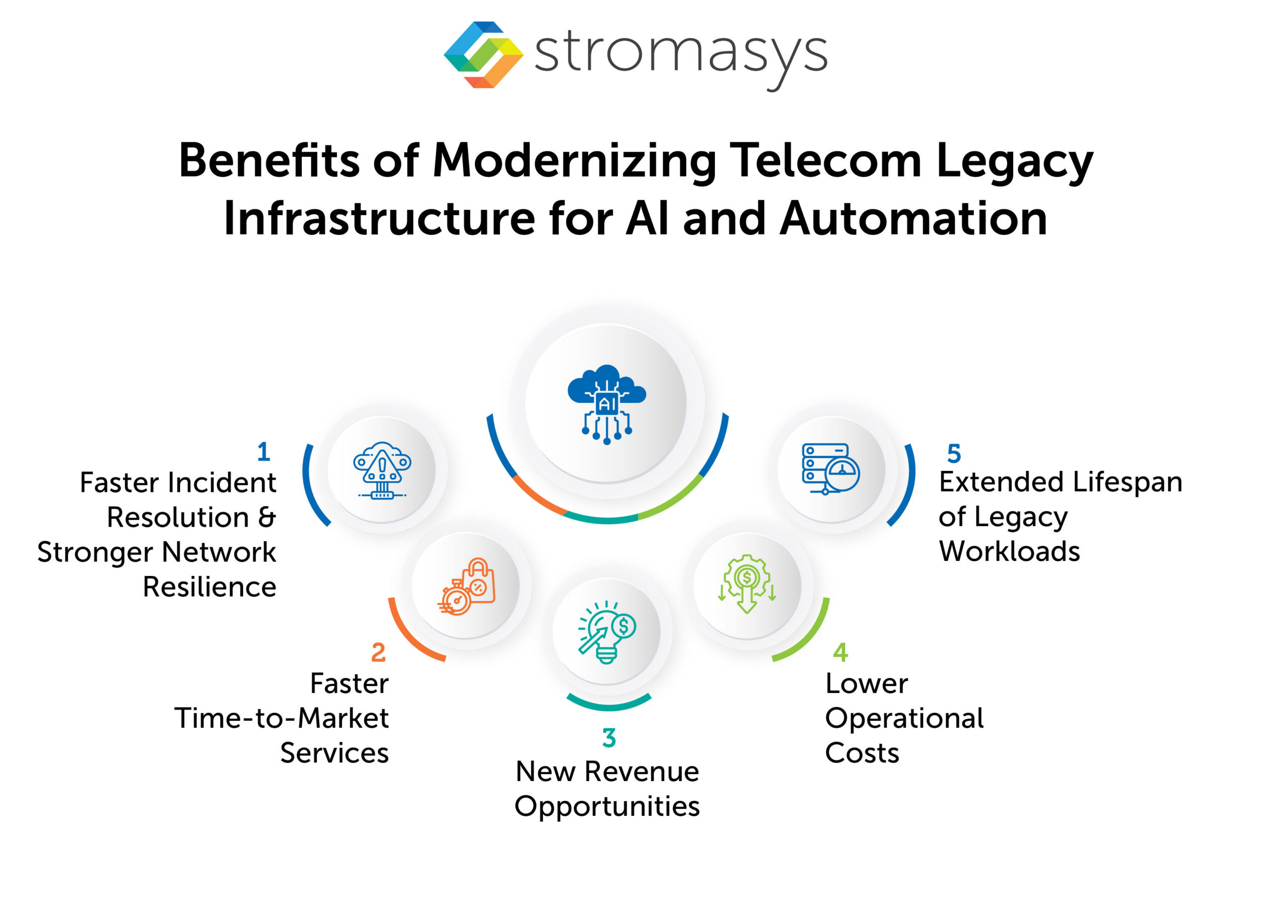
According to a Data Center Dynamics report, 81% of telecom operators are using AI to strengthen networks and operations, and 73% cite modernizing legacy systems as their key focus area for AI use.
This report shows how modernization and AI adoption are considered the same initiative, not two separate ones.
Stromasys is the global leader in legacy hardware modernization. Its Charon emulation solutions allow legacy applications and workloads operating on aging hardware to run without modifications on a new platform (x86 server or cloud environments). It removes hardware obsolescence risks that often stall AI initiatives without rewrites or risky migrations required.
It ensures that regulatory compliance, billing, and network operations dependencies remain as they were on the existing platform. Positioned as the stability layer, Stromasys enables telecom operators to confidently layer AI tools, agents, and analytics on a modern platform.
Modernizing telecom’s legacy infrastructure without rebuilding core systems means keeping existing legacy applications and workloads intact while adding automation, modern data layers, and AI capabilities around them. It involves augmenting or virtualizing legacy systems with modernization approaches like emulation and adding AI layers while keeping core OSS/BSS and network logic intact with minimal disruption.


The IT landscape is rapidly evolving, and businesses still operating on legacy hardware are facing...
Read More
DEC Alpha hardware has been pivotal to many businesses due to its reliability, performance, and...
Read More
Legacy application migration is a new trending buzz of IT discussion. Businesses are migrating from...
Read More