
×

 Understanding the benefits of Server Virtualization and How It extends the life of legacy applications
Server virtualization is a technology that enables a single physical server to behave like multiple servers. This allows each server to work like an independent server with its preferred OS and programs. The splitting process is done by software called hypervisors and provides memory, processing power, and storage to each virtual machine (VM).
When it comes to legacy applications, server virtualization enables them to run on their familiar hardware environment without requiring the actual hardware. As a result, they can run their business-critical legacy applications on today's servers without opting for costly and time-consuming application modernization projects. Additionally, it saves data center space and operations costs by allowing multiple applications to run on a single server.
 Article

Explore our comprehensive list of 12 proven advantages of server virtualization. With this article, CTOs and CIOs will gain valuable insights for a wider perspective.
While going through all these advantages of server virtualization, security, cost savings, and physical space savings can truly make a significant difference in a company.
One of the most sought-after advantages of server virtualization is in legacy data centers. Yes, one major benefit of server virtualization is how it allows business-critical legacy applications to run on modern infrastructure without any code changes.
Virtual machines can emulate older hardware in a modern environment. By decoupling the aging hardware, organizations can negate the risks associated with it and still run their important applications without depending on the outdated servers.
Here is a real-world example of server virtualization. Rochester Electronics was running its critical workloads on the outdated legacy server. It needed to be replaced because it started affecting the legacy intellectual property (IP) that was operating on the outdated SPARC server. They collaborated with Stromasys, and using Charon SSP, they virtualized SPARC systems while keeping their Solaris 2.5.1 OS intact, including kernel options.
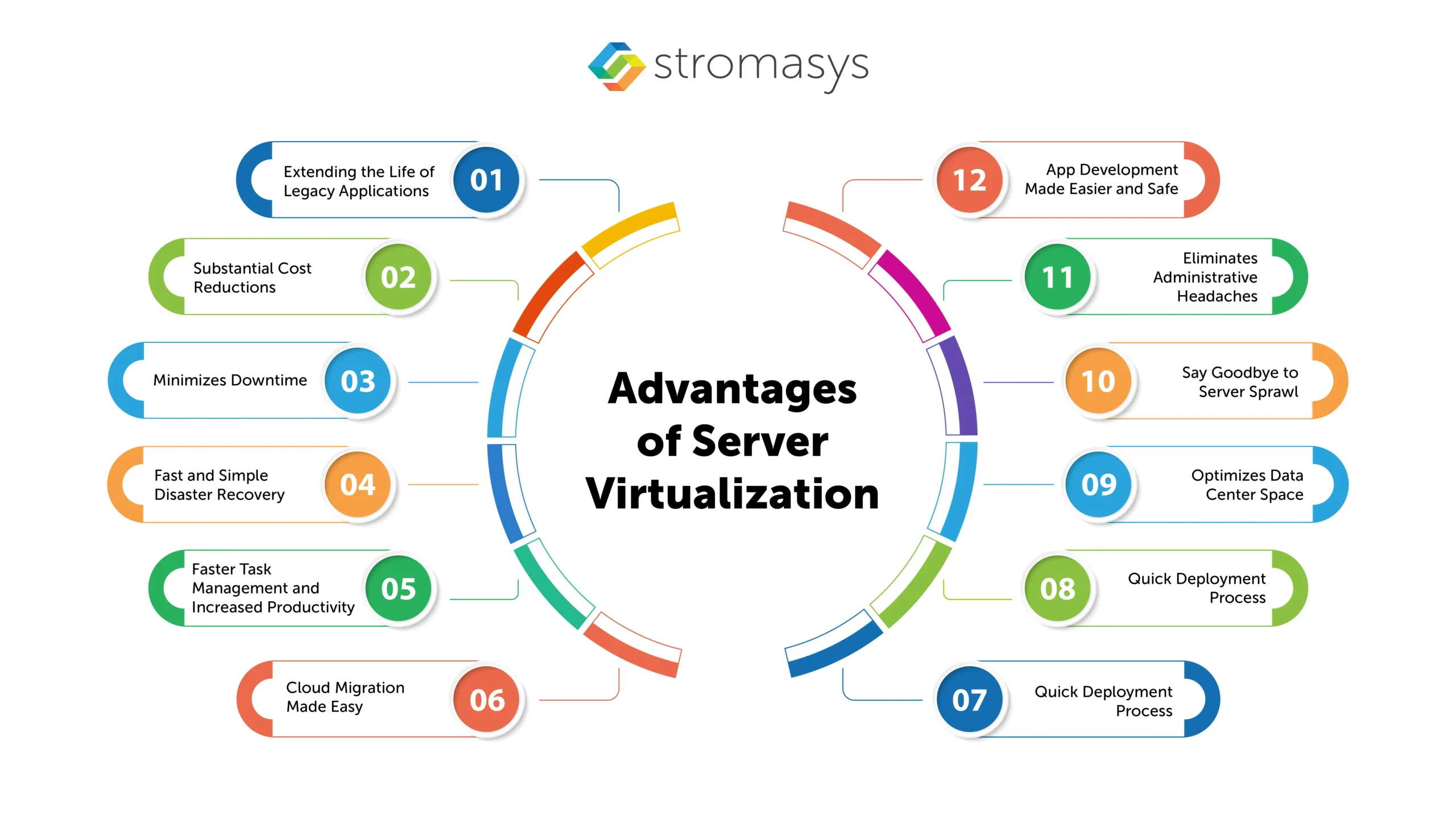
The advantages of server virtualization are how it removes the need for multiple physical servers by enabling one physical server to host several virtual machines which can run multiple operating systems and applications on it. This ultimately helps with cost savings, and these can be later on use for innovation.
This efficient server utilization process does away with the necessity of maintaining multiple physical servers. As a result, businesses can save significantly and reallocate funds to other critical areas. Data shows that virtualization cuts hardware and maintenance costs by up to 40%.
Again, a smaller number of physical servers drastically reduces power consumption and cooling costs. According to biztechmagazine, virtualization-driven server consolidation can reduce energy costs by as much as 80%.
The unplanned downtime is one of the most expensive risks in IT. Siemens’ “The True Cost of Downtime 2024” report reveals that unplanned downtime drains 11% of annual revenues from the top 500 companies, amounting to a whopping $1.4 trillion – up from $864 billion in previous years. In fact, in the automotive sector, each hour of downtime costs an astounding $2.3 million, equating to $600 per second.
This virtualization benefit enables businesses to minimize the chances of downtime. Virtualization optimizes resource use by pooling CPU, memory, and storage across several physical servers. This approach ensures resilience. Therefore, if one server fails, servers are swiftly reallocated from one machine to another – minimizing the disruption caused by hardware failures.
In case of a disaster, virtual servers can be set up quickly at a remote site. This keeps business operations running without delay.
Virtualization is a core technology behind cloud-based services, making disaster recovery affordable for businesses of any size. Recovery happens in minutes, not hours, boosting system reliability and ensuring business continuity.
Deploying new servers is swift and efficient, minimizing time investment. According to G2, Virtual machines complete one-time server management tasks 50-90% faster than physical servers. This improves agility and less time is spent on routine provisioning and decommissioning. It means IT teams have more capacity for strategic work instead of maintenance.
Again, when a server’s role ends, it can be easily decommissioned. This agility optimizes overall productivity. In fact, 73% of small to midsize businesses report spending less time on routine administrative after adopting virtualization, based on the VMware SMB survey report.
The Flexera 2024 State of the Cloud Report reveals a significant trend: 89% of organizations are now adopting multi-cloud strategies for handling their workloads.
Leverage benefits of server virtualization with cloud migration. It can be a game-changing experience. Virtualized servers simplify cloud migration. They eliminate hardware dependencies and compatibility concerns, streamlining the transition process.
Another standout benefit of server virtualization is its quick set up as it deploys systems in minutes. You can duplicate a virtual machine and skip the time and expense of purchasing and installing a physical server.
In the past, setting up a physical server was far more time-consuming. You had to place an order, wait for the delivery, and then spend hours installing the operating system and applications before the server could be used. Physical servers also required racks, cables, and extra space as the infrastructure grew.
Virtualization removes these obstacles. This virtualization benefit offers a straightforward way for businesses to handle growing data needs and stay competitive.
By consolidating multiple virtual machines, server virtualization reduces large server racks, extensive cabling, and additional infrastructure. In addition, fewer physical servers mean less cooling and power consumption, creating more available floor space and reduces operational costs, the benefit of server virtualization that matters regardless of company size.
No matter your business size or available on-premise space, reallocating resources and saving space are always beneficial.
Virtualization platforms provide a single interface for managing multiple virtual servers. Another advantage of server virtualization is that administrators can monitor and control everything in one place. This streamlines IT operations and eliminates the need for several management tools, saving both time and effort.
Server sprawl occurs when data centers keep adding servers for new applications while older ones handle smaller tasks or sit idle. Prior to server virtualization, IT teams frequently over-allocated resources to handle demand spikes. This approach resulted in wasted capacity.
This is one of the clearest virtualization benefits that changes this by allowing multiple virtual servers to run on a single physical server. By reducing hardware needs, it eliminates the necessity for over-provisioning.
One of the important business advantages of server virtualization is that there is no need to make updates, and installations for each server.
Additionally, virtualization optimizes resource allocation. As there is no need for multiple hardware, enterprises can simplify budget planning.
Overall, the advantages of server virtualization allow businesses to focus on strategic initiatives rather than routine tasks to work on business growth and drive innovation.
Virtual servers simplify app development by allowing quick creation, deployment, and removal as needed. Developers can set up testing environments that mimic production servers without disrupting live operations.
As previously discussed, one of the notable advantages of server virtualization lies in its use within legacy data centers. And when talking about that, Stromasys stands out as a leading provider of innovative cross-platform virtualization solutions.
Stromasys’ engineering team has meticulously designed Charon emulator that virtualizes a range of legacy servers like SPARC, VAX, PA-RISC, PDP and AlphaServers. This way, organizations can remove their outdated legacy hardware and still run mission-critical applications.
This process is completed in just a few days with no code changes – zero migration risks involved.
Server virtualization enables a single physical server to operate multiple autonomous virtual servers. This translates into a great deal of cost savings by reducing the number of servers that need to be physically built, more efficient use of hardware, simplified administration, faster implementation and installation time frame (less than one-half an hour or so), better disaster recovery, and enhanced security (i.e., segregating different virtualized servers).


The IT landscape is rapidly evolving, and businesses still operating on legacy hardware are facing...
Read More
DEC Alpha hardware has been pivotal to many businesses due to its reliability, performance, and...
Read More
Legacy application migration is a new trending buzz of IT discussion. Businesses are migrating from...
Read More