
×

 Building Your Data Center Exit Strategy
Having a data center invariably means possessing physical hardware for your operations. While that is the case with most enterprises in the world, it can be a challenge in an age when most industries have migrated to the cloud. However, such a change can be a blessing and a curse if you make a wring move.
The no. 1 priority is to choose a cloud migration partner that suits your data center exit strategy. This is crucial for every company as it can make or break your plan for a smooth migration. It involves the consideration of every possibility, from the service to the cost and data governance to security. The right choice will ensure a data center exit strategy that creates opportunities for you without any unforeseen risks.
 Article

People realize the need for data center exit leading to cloud migration services because of the complications faced in various fields with legacy hardware. The methods to dispel them do not result in a solution; they only increase technical debt, which, when added up, result in monetary debt.
You deal with hardware slowing down, even failing at times, which causes temporary downtime at first, until permanent. In the end, the system requires immediate change, which affects both technical personnel and end users.
The repairs before such a necessary change often require replacement. This can be hard, as technicians become less as time passes after the machinery becomes outdated. Even the necessary spare parts are difficult to find and often require a hefty amount to purchase.
The overall result is an increase in costs, and for a system that is slow in operation and in revenue generation, this can be disastrous. After all, you now have fewer customers for the products of an aging machine and fewer workers to operate it. They both move on to modern wares that go with the times.
Legacy infrastructure is also incompetent when it comes to integrating with new-age systems, be it hardware or software. The existence of data silos and compartmentalized software that cannot work with other systems becomes a problem in this age of interconnectedness.
An old system also has less, nearly zero, cybersecurity protection. Modern softwares are unable to sync with them and require separate tools to do so. In most cases, the legacy systems do fall prey to cyberattacks easily. Even in the area of compliance, they lag behind modern protocols.
Of course, scalability is also a major issue for these data centers. You already run out of space with them, and on top of that, there is no physical space to add hardware to make up for the lack of memory space. What is more concerning is the pressure to attain a more sustainable measure for running these systems.
Let’s not even bring disaster recovery into the picture. Whether it is an unexpected event or even human error, the downtime and the inability to replicate operations cause massive loss. While the lack of tests is partly responsible, the systems themselves are hardly capable of protecting themselves against such occurrences.
In any case, a data center exit strategy is needed to go with the flow and migrate to the cloud.
While a data center to cloud migration is necessary for a lot of enterprises, many are not eager for the move. While it might make sense for regulated industries with strict data rules and access requirements, non-regulated ones often simply keep using their legacy infrastructure out of habit because they think modernization will be too difficult.
However, moving out of their data centers and choosing a cloud migration partner for process has perks. You can experience them as you move your applications to the cloud environment.
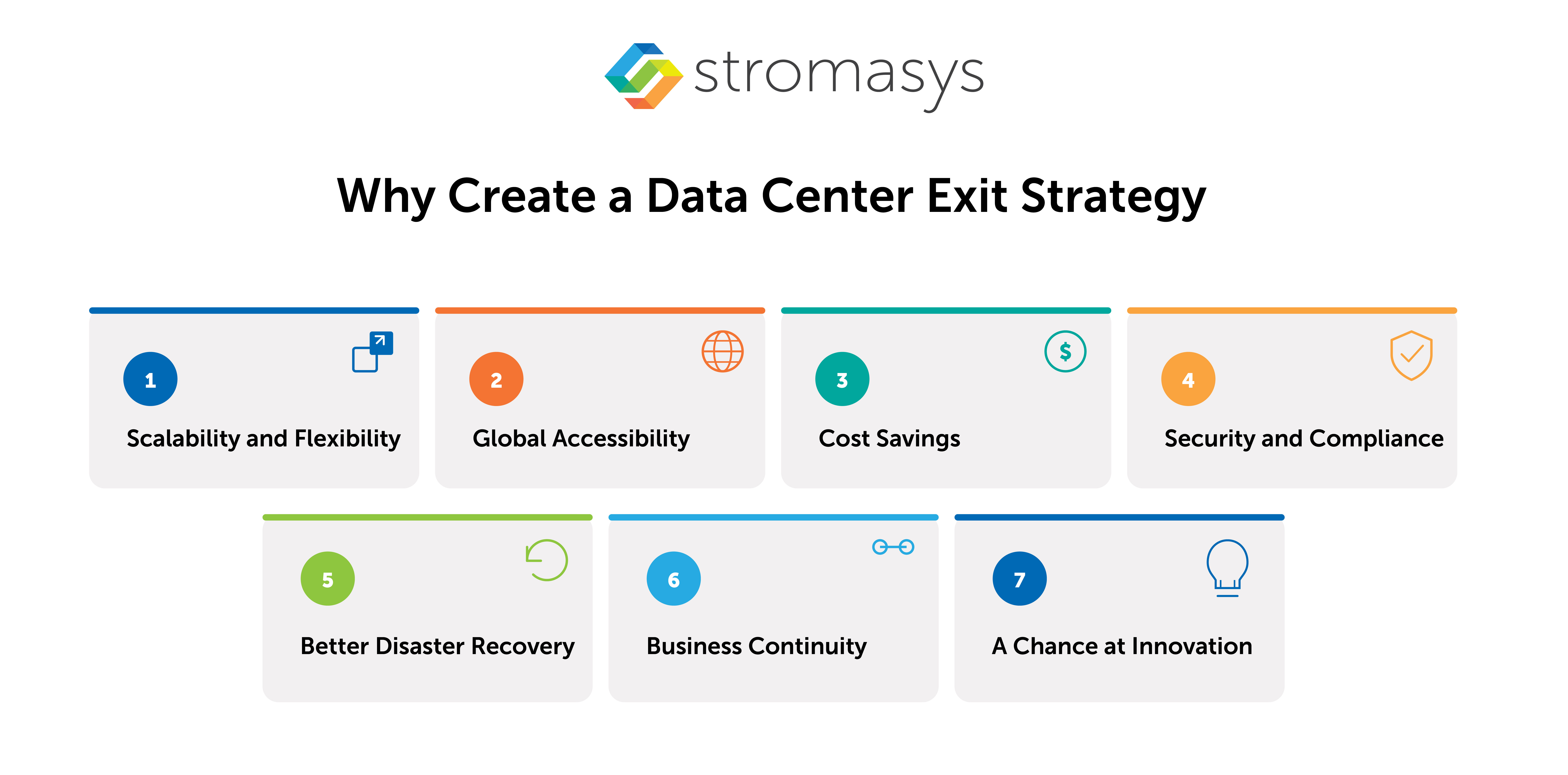
The cloud provides the advantage of scalability to users, scaling their storage and activities as needed. You can upsize your resources during busy times like a product or service launch or downsize during slow times. Such flexibility does not require permission or extra hardware.
Perhaps the greater advantage of data center migration services is the access of your system from all over the world. Clients and employees residing in any part of the world can operate the functions they need – no need to go to a particular location as long as access credentials are on hand.
Optimize business costs as you move from move from higher CapEx to a largely OpEx procedure with low hardware and no subsequent costs. You use pay-as-you-go or subscription payment, which saves your business from lateral spendings that often accompany hardware-based infrastructure.
Most companies use lift-and-shift migration as their initial approach. They move to refactoring or re-architecting once they advance. It shows how enterprises get the confidence to spend money once they have experience.
Cloud platforms provide and ease the installation of security tools like encryption, vulnerability and cyberthreat monitoring, identity management, firewalls, etc. Even updateable compliance notifications and industry-wise certifications are available for robust, all-over defense.
Organizations with strong cloud security measures were 2.3 times more confident about their position than others, according to the 2023 KPMG Cloud Transformation Survey. This shows that while the cloud can make you nervous, a proactive approach can quash such feelings.
One of the key points of disaster recovery is geographic span: you need to have your system working in multiple locations to ensure true business continuity. In the current age when geopolitical tensions abound, the cloud is the only way to allow operations to continue in the face of calamity.
DR plans frequently fail in multicloud arrangements. DR or failover often happens between clouds for 49% of companies. Only with a sound plan and a capability to control multiple, interconnected environments in unexpected scenarios should exercise DR activities of that sort.
Speaking of business continuity, you can also endure downtime, hardware breakage, and system malfunctions that are born out of hardware by using a system free of these. Active/passive and active/active sites require a lot of work and effort. Consistence and continuance are best possible with the cloud.
Newer technologies, or old ones with new features, are all possible with innovation available on time, every time. Access to real-time analytics and Big Data, AI and ML, SaaS and IaaS, multi-party collaboration, and much more are made possible only after the usage of cloud migration services.
This is impossible without a data center exit strategy that matches your business requirements and future needs.
Selecting the right cloud migration partner takes thought and consideration. On many fronts, it can be risky. To make sure it pays off, here are some questions you must ask and some assessments you must make:
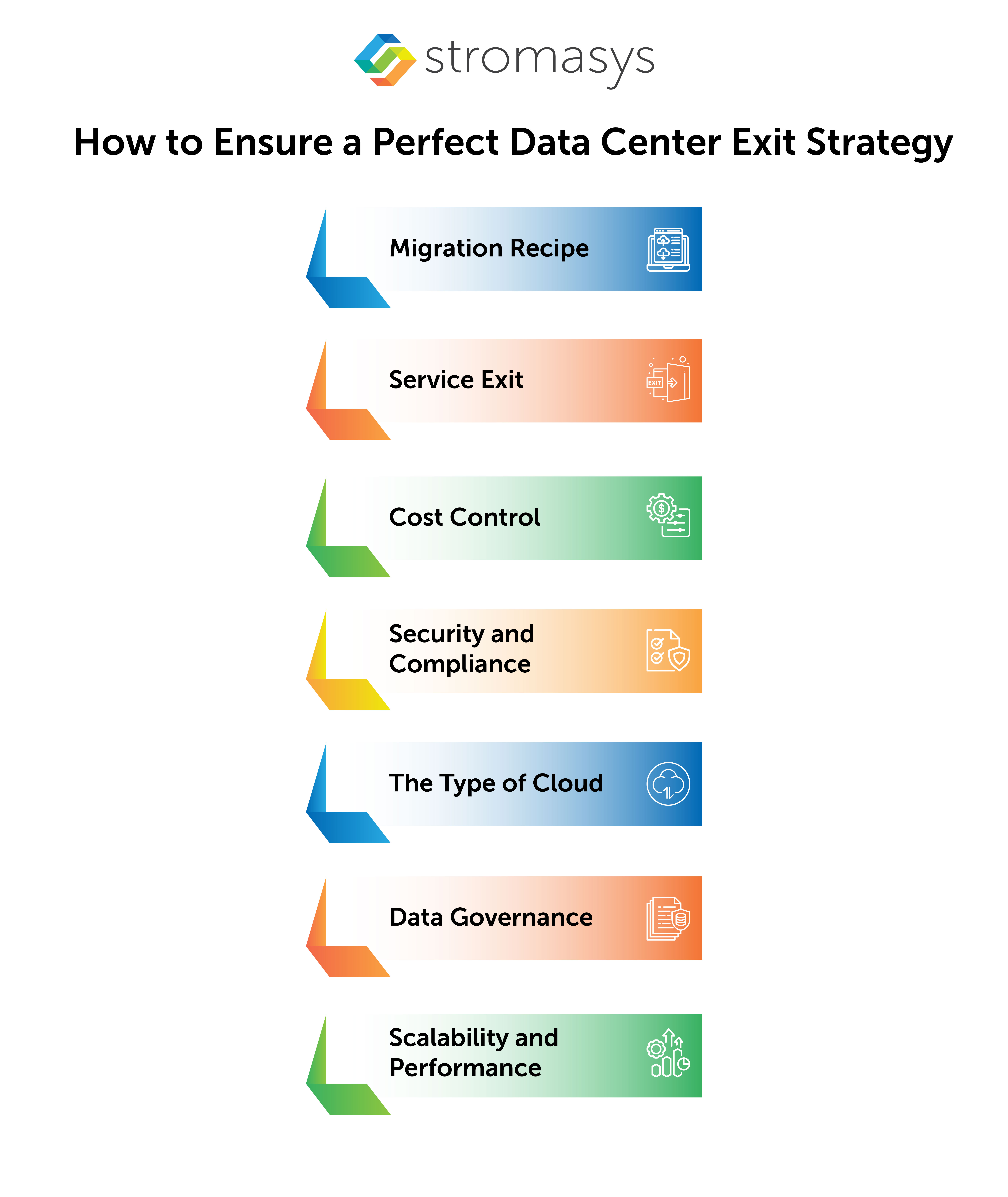
The first consideration in your data center exit strategy should be how to migrate. While certain applications can be migrated without any change, certain others require more structural modifications. In the end, the final form should maintain or improve your existing functionality. Your provider should go with that.
Your cloud migration partner choice should be done very carefully for exit principles. It starts with cost and ends with vendor lock-in. Find out the policies and penalties for exiting the service, especially for early discontinuance.
Ensure that the new service you take matches your old cloud where it needs to. Preserve regulated data in enterprise hardware and utilize transfer flexibility-promoting cloud tools for the rest, while inquiring about integration.
Cost of the cloud is beyond initial pay. Cloud waste came up this year to 29%, against five previous years of going down, according to the State of the Cloud Report by Flexera. Maintain metrics, ask for accountability, question anomalies, track spend, and optimize usage for the best results. Your cloud service should have facilities for these.
You need a provider that ensures encryption, threat detection, firewalls, monitoring tools, etc. to prevent any risk breaching your system. Ask about backups, RTO, recovery plans, and other measures to prevent or reduce data loss. You cannot forget compliance standards you need to follow, depending on your location and work. Ensure your provider is aware too.
Sebastien Cano, senior vice-president of cybersecurity products at Thales, commented, “The accelerating shift to cloud and AI is forcing enterprises to rethink how they manage risk at scale.” Thus, you must be vigilant in this era, even reminding your provider when necessary.”
Your data center exit strategy must include whether you want the public cloud, private cloud, hybrid management, or multicloud arrangement. Do not forget to choose between IaaS, PaaS, or SaaS, before you select between providers.
Sensitive data and data retention play a major role in selecting the data center migration services of a provider. Make sure you find out from your provider about access control, audit processes, and resource tagging, and the rules surrounding data deletion.
A data center exit strategy always depends on two main factors: scalability and performance. For the first, you must ensure if there are limits on any known resource like performance or storage and if hidden fees exist for scaling up.
Similarly, ask about uptime guarantees, latency, and bandwidth. Among Google Cloud, Azure, and AWS, the first maintained the highest uptime at 99.98%. Use every known metric to judge your provider.
There might be more queries you have. Feel free to ask your service provider every question before making an informed decision.
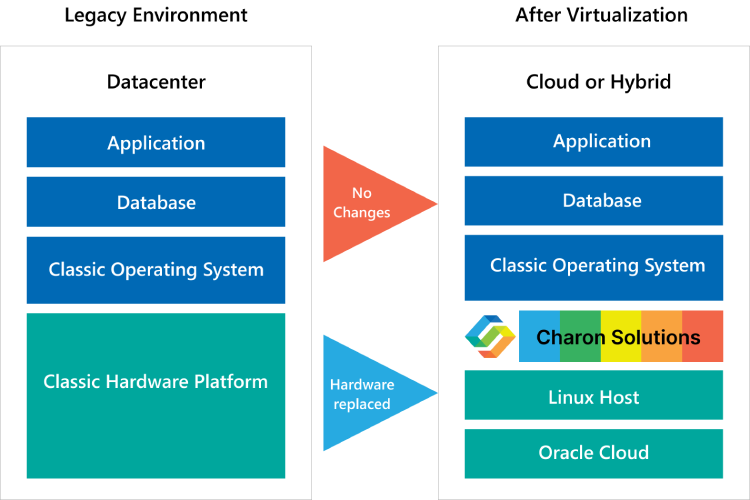
You now know how to choose a cloud migration partner. However, if you have a legacy system, how do you make the migration seamless? The answer is simple: Charon on the Cloud. We will maintain your legacy infrastructure and ensure a smooth movement to the cloud.
Using lift-and-shift, we rehost your legacy software, no changes observed, and move them to the cloud. Legacy applications on SPARC, VAX, AlphaServer, PA-RISC, and PDP-11 can be migrated to the cloud, to extend the lifespan of systems that reside on EOL hardware.
A software company wanted to move to the cloud from their on-premises hardware for better management and more scalability for its event log management for financial concerns. They made the wise decision to ask for Stromasys’ assistance.
The results were phenomenal. Without any changes to their applications, they obtained what they were looking for. With greater scalability, easy maintenance, and simple operations, the company achieved exactly what they were looking for.
Achieving a data center exit strategy that fulfills your requirements and provides the added benefits of migrating to the cloud is an advantage we all want. However, few achieve it, due to predictable outcomes or even unforeseen circumstances.
A smooth movement to the cloud is only possible with the right cloud migration partner holding your hand. You need support and assistance of the right kind. You will receive this only if you ask the right questions before signing up.
Every enterprise will eventually move to the cloud, as on-premises infrastructure slowly goes extinct. However, risks also exist; in fact, they are greater on the cloud. Regulated industries too face the inability to shift sensitive data on the cloud. Learn them before you make a choice.


The IT landscape is rapidly evolving, and businesses still running legacy hardware are facing numerous...
Read More
DEC Alpha hardware has been pivotal to many businesses due to its reliability, performance, and...
Read More
Legacy application migration is a new trending buzz of IT discussion. Businesses are migrating from...
Read More