
×

 How are geopolitical risks impacting disaster recovery for legacy infrastructure?
There have been constant geopolitical tensions since the beginning of 2026. This can result in trade wars, sanctions, and export controls that are making legacy systems increasingly vulnerable. These aging platforms have been the core of business operations for several sectors like banking, manufacturing, semiconductor, government, healthcare, and more. But the dependency on obsolete hardware with limited resources due to global restrictions is skyrocketing the budget, with no guarantee that after maintenance, they will continue to operate without any hiccup.
A single hardware failure can lead to unplanned downtime for an indefinite time, as traditional DR plans were not designed for supply chain disruptions or sudden loss of spare parts. As a result, legacy systems pose a serious risk to business continuity, turning minor technical issues into major operational crises when geopolitical shocks occur.
With legacy emulation, businesses can effectively eliminate this problem. It replicates physical hardware behavior and eliminates the hardware dependency, which is a major factor contributing to legacy DR failure. This enables seamless failover to modern infrastructure, making it an essential strategy for geopolitically resilient operations.
 Article

Geopolitical instability is no longer a distant concern but a challenge that is now driving enterprises’ operations at risk. You can see that trade wars, sanctions, technology restrictions, and nation-state cyberattacks are altering the business IT environment.
Various reports have shown how organizations are struggling with the geopolitically motivated cyberattacks, such as critical infrastructure disruption or espionage, taking advantage of the rising tensions. This has become a top factor influencing cyber risk strategies.
Here are some significant challenges faced by businesses across the globe:
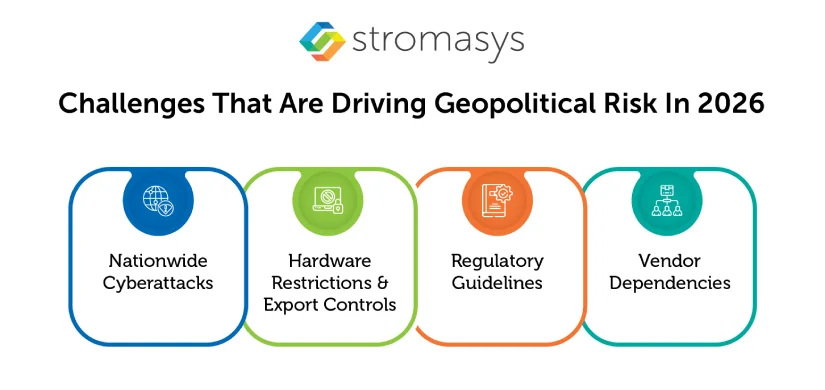
Threat actors are now targeting different industry sectors like energy, finance, transportation, and healthcare infrastructure, which are increasing at an alarming rate. The threat actors are now using more sophisticated and AI-based attacks that are exploiting vulnerabilities at a very fast pace, which are beyond what traditional defenses can tackle.
These issues are particularly faced by the semiconductor industries, which are creating dangerous new gaps in legacy system durability. It becomes problematic when businesses are unable to get access to replacement parts that are impacted by geopolitical mandates, resulting in the delay or discontinuation of the hardware, as there is no other alternative.
The regulatory responses have become more swift with time. The EU’s Digital Operational Resilience Act (DORA) and CISA’s updated guidelines. They are now pushing organizations to demonstrate measurable, tested resilience, not just simple documented policies. The message is simple, i.e., to hope for stability, not just a strategy, in this current situation with geopolitical tension. It is the pressure to integrate better DR initiatives to ensure seamless business continuity.
The restrictions have forced businesses to evaluate their dependencies on foreign technologies at a policy level. Vendor lock-in has become a strategic vulnerability. For example, if your core banking system is running on hardware from a particular manufacturer. What will you do if they are facing sanctions or export controls due to these geopolitical tensions? You will be left with no backup plan and a crisis that will put your operations on hold indefinitely.
Based on a 2025 IBM study, 60% of organizations have experienced extended downtime due to hardware procurement delays. One of the reasons might be the supply chain disruptions. They are not minor inconveniences but critical issues that can impact business operations, brand reputations, ROI, and ultimately customer experience.
The above issues are more prominent if the organizations are running their critical operations on legacy systems, as they are not designed to deal with this type of threat environment.
In enterprise IT, there is a troubling paradox that exists. The more critical the system, the more vulnerable it becomes when geopolitical risks escalate. This is especially troubling when the business is running its operations on legacy systems.
Let’s talk about a hypothetical scenario. If, due to current rising tensions, critical components required for the legacy hardware do not arrive on time, then it will delay operations, resulting in unplanned downtime. And this can result in an indefinite pause as legacy systems are ships without lifeboats.
Legacy systems such as IBM AS/400s, HP 3000s, VAX systems, decades-old mainframes, Alpha servers, and other outdated platforms are ticking time bombs. Yet, they continue to power critical operations across various sectors. Industries such as banking, government, energy, and manufacturing still rely on these outdated systems to run financial transactions, manage nuclear facilities, control production lines, and handle other core functionalities.
So, now the question is, why haven’t organizations replaced them? What are they waiting for?
Based on the Forrester reports, the average cost of replacing the entire legacy system can be very expensive. For example, a mainframe system can range from $50 million to $200 million, and the entire replacement project can take from three to seven years. And this timeline does not count the risk of catastrophic failure that might occur during the transition. You’re processing millions of daily transactions or controlling critical infrastructure. A failed legacy system transition process not only means losing revenue but also a complete system shutdown. As a result, it is going to be a huge, catastrophic incident.
So, often organizations try for the easiest and safest option, according to them, which is still running operations on those outdated systems till they collapse.
Running critical operations on legacy systems has various challenges. One of the most significant challenges is DR.
But legacy systems create DR challenges that modern approaches can’t solve. These systems are either discontinued or vendors have ended support. Also, spare parts are not easily available, and the delay due to supply chains can endanger the operations. What happens when a disk controller fails that was operating on a 20-year-old system? The first thing that you do is look out for parts in inventory rather than calling customer support.
These systems are not compatible with modern DR solutions, especially cloud-based. You will not be able to lift-and-shift a VAX system to AWS, as architectural frameworks are completely different. And traditional virtualization may not be the right choice as they are designed on the outdated architecture.
Apart from this challenge, there is another issue of a lack of documentation. The engineers who developed these systems have either retired or are going to retire. It means the institutional knowledge has evaporated. So, if there is any hardware failure or something breaks, then organizations will be struggling to find skilled resources. And, even if they find someone to maintain it, it may be very expensive.
Legacy emulation is a process of replicating the behavior of the existing outdated platform on a modern environment without any changes in the binary source codes and other applications running on it. They are a cost-effective way to upgrade the business infrastructure. They not only preserve the existing critical applications running on these platforms but also leverage the benefits the modern platform brings.
You can improve the operational efficiency, performance, scalability, security, agility, and compatibility with modern technologies like cloud and AI. This makes the business more resilient and future-ready to tackle any issues without disruptions. With rising geopolitical tensions, eliminating any issues that can cause delays in operations should be the top priority. Legacy emulation eliminates the single most fragile link in a legacy DR chain, which is physical hardware dependency.
This approach makes emulation a strategic fit for DR in volatile times and creates portable and hardware-independent replicas. This enables rapid failover when geopolitical events can easily compromise physical on-premises systems.
In a world of sanctions, supply chain disruptions, and targeted attacks, legacy emulation has become one of the quickest and safest means to transform legacy vulnerabilities without spending astronomical prices on a rip-and-replace modernization approach.
Stromasys is a global leader in transforming legacy infrastructure. It offers emulation solutions for various legacy platforms like DEC VAX, AlphaServers, Sun SPARC, PA-RISC, and PDP-11 hardware.
Its flagship product, the Charon emulation solution, has cost-effectively transformed several data centers globally and ensures seamless operations of critical workloads. Legacy system transformation enables integration with modern technologies like AI, ML, and cloud, which will help in optimizing performance tuning and predicting failure modes before they actually happen.

Modernizing legacy infrastructure is no longer an option but an absolute necessity. The IDC report predicts that by 2027, 65% of Global 2000 organizations will incorporate emulation technologies as part of their legacy system DR strategies due to increasing geopolitical and supply chain risks. Organizations are now preparing themselves for how to survive disruptions without clinging to traditional approaches.
A leading cement manufacturer in Saudi Arabia was struggling with some significant challenges. Their mission-critical SPARC servers were running on Oracle EBS, which has no disaster recovery site. Also, there was a constant threat of catastrophic downtime that could abruptly shut down business operations.
They couldn’t afford to replace their legacy applications, yet their single-site infrastructure was a major challenge. They partnered with Stromasys and CloudWRKS to move from an outdated server to a modern cloud environment.
Within three months, using Stromasys’ Charon-SSP, they migrated their entire Solaris workloads to AWS Cloud. This resulted in:
They achieved this without touching a single line of application code. Their business now operates with confidence without any tension of hardware failures.
The question isn’t whether geopolitical disruption will test your disaster recovery plan. It’s whether your legacy systems will survive it. It’s time to act fast before your legacy system results in a complete system shutdown.
No, you do not need to modify your existing legacy applications. Emulation mimics the exact legacy hardware on a modern platform so that applications run unchanged. Your decades-old code, configurations, and dependencies remain intact.


The IT landscape is rapidly evolving, and businesses still running legacy hardware are facing numerous...
Read More
DEC Alpha hardware has been pivotal to many businesses due to its reliability, performance, and...
Read More
Legacy application migration is a new trending buzz of IT discussion. Businesses are migrating from...
Read More