
×

 What risks do enterprises face from SPARC hardware end-of-life?
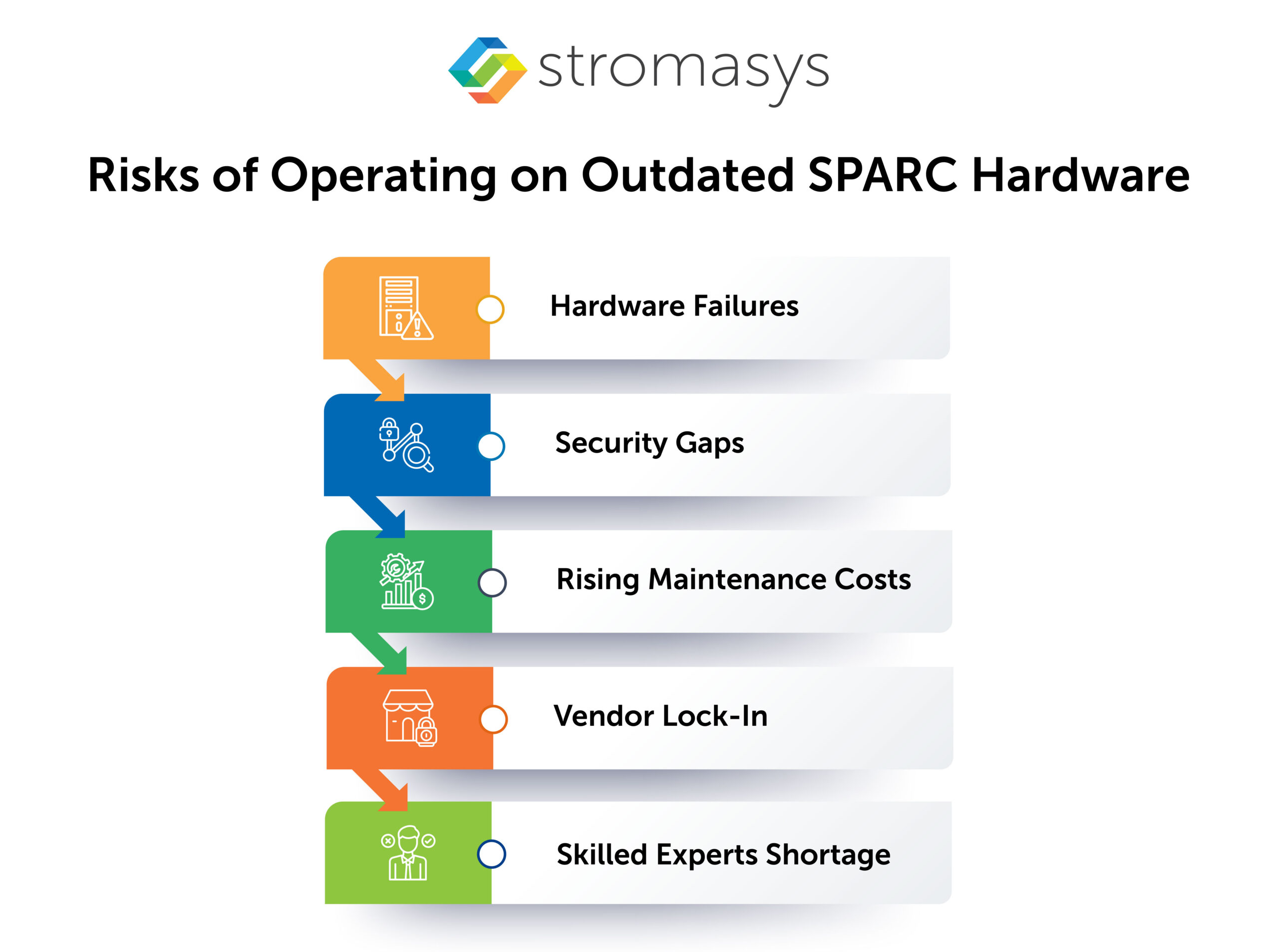
SPARC hardware end-of-life is forcing enterprises to think of alternative means to continue operating on critical workloads. With Oracle's SPARC platforms losing vendor support, businesses face real risks, including hardware failures, security gaps, and rising maintenance costs. Modern strategies like hardware emulation, virtualization, and containerization seamlessly transform the outdated SPARC infrastructure at a fraction of the cost required to maintain the aging systems. There are several benefits of upgrading the outdated SPARC infrastructure, like preserving existing critical workloads, cost reductions, improved reliability, scalability, security, and agility without any operational disruptions.
 Article

For example, some of the SPARC models, including the T7 series and M7 series, have reached their EOSL.
T7 Series EOSL Timeline
M7 Series EOSL Timeline
The main issue is that without transforming the outdated SPARC hardware, enterprises will continue to face challenges like unplanned outages, unavailable security patches, escalating maintenance expenses, inefficiency, and declining productivity. The good news is that by adapting SPARC emulation, virtualization, and hybrid strategies, enterprises can future-proof their critical workloads running on them. So, here is a blog that will break down the challenges and proven solutions to keep your SPARC/ Solaris applications running without any aging hardware headaches.
SPARC hardware was introduced by Sun Microsystems, now owned by Oracle Corporation. Its design is based on the RISC architecture. It has powered several critical SPARC workloads and Solaris operating systems for decades, but now this aging hardware has reached its end-of-service-life.
With time, the SPARC hardware support is dwindling. For instance, M7 ended premier support in 2024, while T8 will follow in 2026. Also, extended support is pricey and is not a permanent solution. For the enterprises that have built their core infrastructure on these platforms, they need to look for alternative options to ensure seamless operational continuity.
Here are some significant risks of operating on aging SPARC systems:
Enterprises are not entirely ripping and replacing their SPARC infrastructure, as it’s the hardware that has reached its end-of-life, but the critical workloads and Solaris operating systems are still in operation. Here are some modern strategies for enterprises that can help them continue operating on SPARC workloads after Oracle hardware EOL:
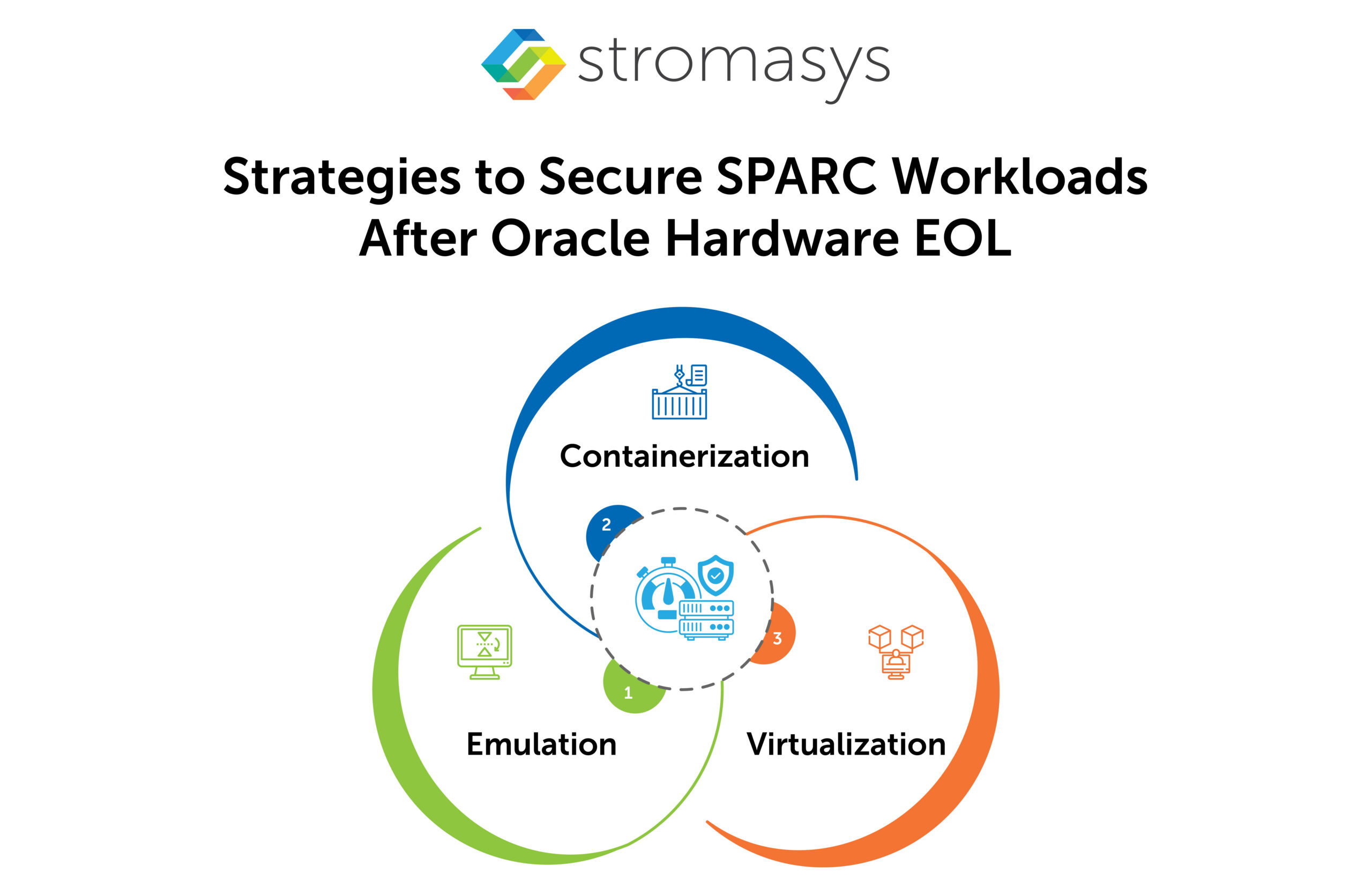
One of the most common legacy hardware modernization methods is emulation. It recreates SPARC hardware behavior on a modern platform like x86 servers or cloud environments, so that all the critical workloads can easily operate without any disruptions. It provides near-100% binary compatibility without making any modifications to the code or application rewrites. It also ensures that the Solaris operating system can run as it was previously running on the original SPARC, preserving exact behavior, interfaces, and data. It is one of the cost-effective methods of preserving critical SPARC workloads and Solaris OS while leveraging the benefits of modern platforms.
Virtualization is a process that layers SPARC workloads using native tools as virtual machines (VMs) on hypervisors like VMware, KVM, or Oracle VM. It consolidates multiple legacy SPARC instances on different modern hosts. Sometimes, it is also combined with emulation for full SPARC compatibility. Virtualization enables centralized patching, monitoring, and access control, while offering hypervisor-enforced isolation.
Visualization minimizes the attack surface by eliminating the outdated SPARC hardware and incorporating modern hypervisor security, like encrypted VMs, while ensuring compliance.
Containerization is a process in which applications are compiled in lightweight containers, which are then layered on emulated SPARC bases for legacy binaries. It modernizes deployment for modular parts while keeping core SPARC workloads and Solaris applications intact. It isolates applications in containers to ensure a secure environment as compared to monolithic VMs. It integrates seamlessly with Kubernetes for orchestrated scaling and self-healing.
Several reports have shown that businesses still operate on outdated SPARC hardware as they have been deeply embedded in their core infrastructure. Complete overhauling can be very expensive and time-consuming. Also, there are proprietary applications that only run on SPARC hardware; it will be difficult to rewrite applications to run on a new platform. Stromasys brings Charon SSP that emulates legacy SPARC hardware on a modern platform. It is available for both on-premises (x86 servers) or cloud environments (AWS, Azure, Oracle Cloud, or Google Cloud) without modifying existing critical applications, code, databases, or configurations. It uses the lift-and-shift migration strategy to move the applications from outdated SPARC hardware to a new platform.

Stromasys has recently launched the new Charon SSP 6.0, which offers exclusive features like MMU pass-through, supports multi-CPU emulation (SMP), and is compatible with most of the Solaris OS versions.
Here are the significant benefits of emulating the SPARC hardware with Stromasys:
Charon-SSP supports multiple Oracle SPARC systems:


Companies still rely on mission-critical applications running on Sun SPARC, Alpha, or other legacy systems like PDP, VAX,...
Read More
What was the biggest advantage of using a SPARC system for you? Maybe you were...
Read More
Sun SPARC hardware was introduced in the late 1980s and was popular for its high-end...
Read More