
×

 What is the best strategy for telecom systems modernization without service disruption?
Extending legacy telecom workloads to hybrid cloud ecosystems means preserving the core operations like network functions and billing systems that were running on the existing infrastructure and connecting them to public cloud and edge environments. This helps in leveraging the benefits of cloud, AI, analytics, and real-time services. It is a phased approach that avoids the risks of a full migration, as it requires a complete shutdown, and it is not possible in the telecom sector.
Studies have shown that by moving to a hybrid cloud environment from the outdated legacy infrastructure, telecom can cut operational costs up to 30 to 40 percent, while edge computing is projected to unlock $150–200 billion in telecom enterprise revenue by 2030. This also addresses the security gaps in older signaling protocols that are tied to roughly $41.82 billion in annual telecom fraud losses. Considering such heavy losses and given challenges, the best approach for migrating critical workloads from legacy systems is the phased modernization strategy rather than a rip-and-replace strategy, as that risks both service reliability and revenue.
 Article

Telecom networks are designed on a centralized framework with tightly coupled platforms to scale up performance and reliability. These designs have served operators for decades, but with the rise of 5G, AI-driven services, IoT, and enterprise digital offerings, it has compelled them to rethink. The outdated architectures have centralized systems that slow the distributed, real-time services that operators must deliver without any interruptions.
Reports have shown that nearly 70% of telecom operators cite OSS/BSS complexity as a primary obstacle in digital transformation. By modernizing the infrastructure, they can leverage new capabilities that are layered around them to improve efficiency, scalability, security, and drive innovation. So, rather than choosing between “keep everything on-premises” and “move everything to the cloud,” a hybrid environment allows telecom operators to distribute workloads across private infrastructure, public cloud, and edge locations depending on their latency, regulatory, and performance needs.
The core network functions and regulated data remain where governance is strongest, i.e., on-premises like x86 systems. While the AI workloads, analytics, and customer-facing digital services scale where elasticity matters most. Statistics have shown that modernizing infrastructure around hybrid cloud and edge computing can reduce operational costs by up to 40%.
Considering a full migration may look nice on paper for legacy telecom systems, but practically, it is one of the riskiest moves an operator can make. The major drawback for this approach is shutting down the core for a simultaneous update without interrupting critical business processes, which is not possible.
Another issue is security. It is not to be underestimated. Outdated signaling protocols such as SS7 and Diameter lack modern security measures like built-in authentication, and they can be easily exploited by threat actors who are actively looking for vulnerabilities. Based on the CFCA Global Fraud Loss Survey, the global losses from telecom fraud are estimated at approximately $41.82 billion annually. This figure alone is alarming, showing the cost of still operating on legacy environments.
But the question here is not about legacy versus cloud but how to extend legacy workloads into hybrid environments without exposing them to vulnerabilities while eliminating the risks and leveraging the benefits of modernizing. So, the phased migration approach, also known as the Strangler Fig approach, is used. In this process, the deployment of an API-first integration layer is carried out over the existing monolith, followed by gradually decoupling individual functions into cloud-native modules. Finally, migrating network functions to modern infrastructure. This is a hybrid cloud strategy applied to telecom infrastructure. It protects the critical workloads while opening the door to new capabilities.
Here are some benefits of extending telecom workloads to a hybrid cloud environment:
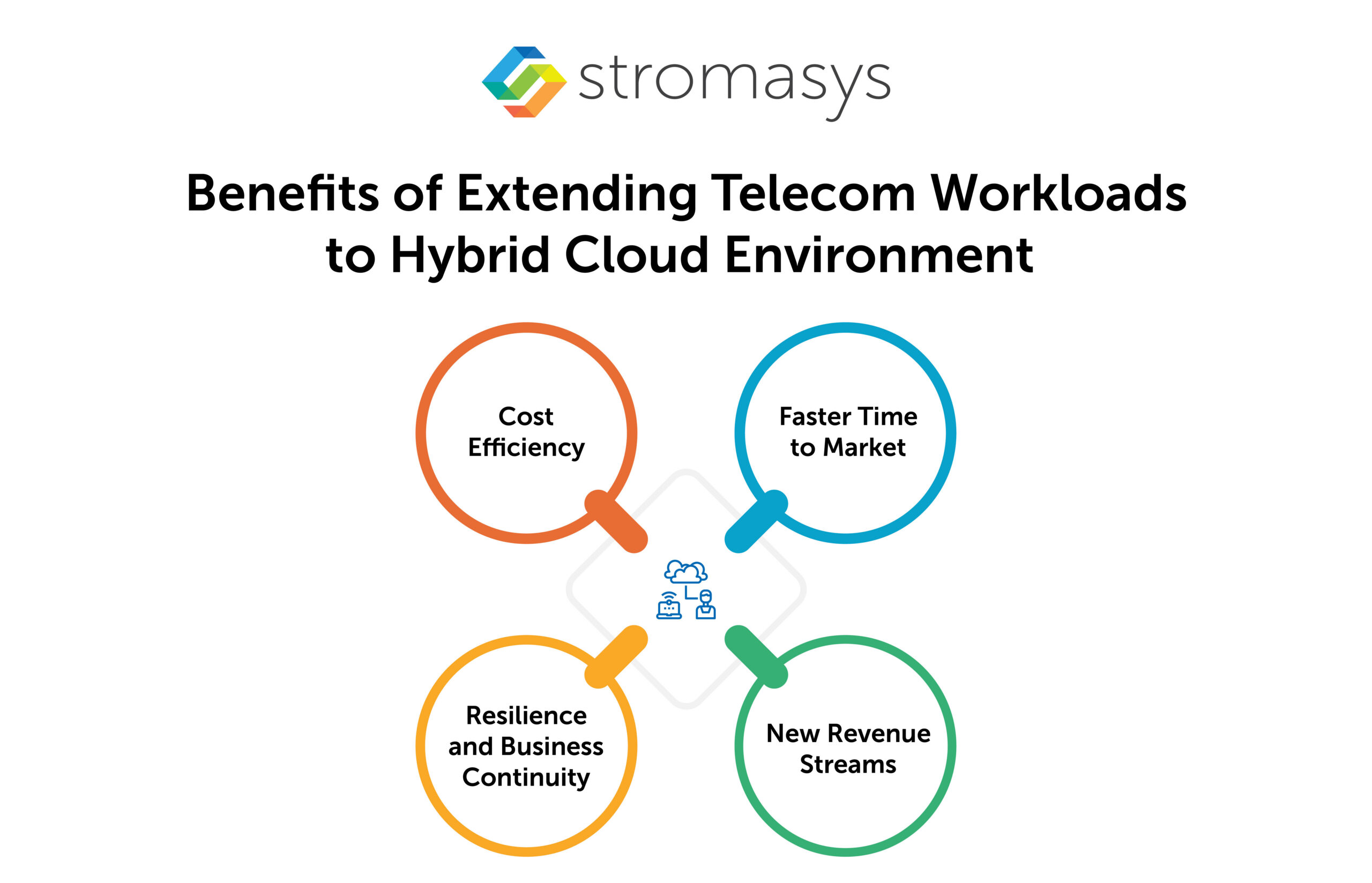
Sharing infrastructure across workloads helps maintain a dedicated system for every function. This reduces both capital expenditure and operating costs, which frees resources and budget that can be later utilized for AI and digital-service investment.
Cloud-native architecture built from independent microservices, automation, and DevOps practices. These let telecom operators respond to market demand early and launch new services faster than outdated systems.
Hybrid cloud improves disaster recovery as it allows replicating the workloads and failover across both private and public environments. This helps minimize downtime, which helps prevent any compliance and regulatory challenges.
A survey report from McKinsey estimates that edge computing could unlock $150–200 billion in telecom-related enterprise revenue opportunities by 2030, driven primarily by industrial automation, AI services, and real-time data platforms. These opportunities do not require discarding the legacy core but smartly connecting to it while leveraging the benefits of modern tech.
Here are some real-world examples:

Enterprises can now connect the production equipment to private 5G networks, with edge computing processing sensor data locally. This helps the machinery and robotics to be controlled in real time, while core billing and network management continue to run on established, centralized systems (on-premises).
Detecting anomalies to prevent hardware failure by analyzing the machine data from industrial sensors.
According to the IDC Telco Forum, telecom companies are shifting from traditional connectivity providers to full-stack technology suppliers, which is a structural change to gain profitability and open new opportunities. Operators already sit on geographically distributed infrastructure. Hybrid cloud abstracts that infrastructure into a programmable platform that is capable of delivering AI services, GPU-as-a-Service, and enterprise digital offerings while preserving network functions.
For operators running legacy telecom workloads on aging SPARC, VAX, Alpha, or PA-RISC hardware and who do not want to entirely move their infrastructure but are looking for flexible options, a hybrid cloud approach is the best option for them. It is especially for regulated industries that cannot move their entire workloads to the cloud due to regulations. So, here they can keep their sensitive information on-premises while migrating required applications and workloads to the cloud. This will improve their operations efficiency, scalability, and flexibility.
This approach also eliminates the legacy hardware dependencies. It means no more aging hardware challenges while leveraging the benefits of modern platforms. Stromasys Charon emulates that legacy hardware in software, letting the original operating system and application run unchanged on the on-premises (standard x86 infrastructure) and in a cloud environment. Businesses can choose from different cloud partners. This way, they can preserve the application logic operators depend on while eliminating aging, single-point-of-failure hardware. It gives operators the stable foundation needed to sequence OSS/BSS modernization and hybrid cloud adoption on their own timeline.
Extending telecom legacy applications such as billing, OSS/BSS, and network functions running on existing infrastructure to hybrid cloud means connecting to a new environment to leverage the benefits of the new infrastructure to improve their efficiency, scalability, AI processing, or low latency.


The IT landscape is rapidly evolving, and businesses still running legacy hardware are facing numerous...
Read More
DEC Alpha hardware has been pivotal to many businesses due to its reliability, performance, and...
Read More
Legacy application migration is a new trending buzz of IT discussion. Businesses are migrating from...
Read More