
×

 What factors are to be considered when deciding to transform legacy PA-RISC hardware?
Organizations that still run their critical applications on the legacy PA-RISC hardware have a very uncertain future. HP discontinued the sale of PA-RISC systems in 2008, while ceasing support in 2013, leaving organizations with obsolete hardware that was prone to failure.
To ensure business continuity, it is recommended that the legacy infrastructure be transformed. With the modernization of legacy PA-RISC hardware, organizations can transform their outdated infrastructure. This way, they can maintain their critical applications without hardware dependencies, while eliminating maintenance costs and concerns about spare parts.
 Articles

But the question, of course, is HOW. The answer lies in adaptability. This is where this article comes in. But before we get into how you can make informed decisions to future-proof your business, let’s first explore the architecture that is powering critical workload for decades.
Basically, PA-RISC is the Reduced Instruction Based Computing architecture developed by HP.
For example, HP 9000 and HP 3000 systems were prominent users of PA-RISC architecture. The HP 9000 series were workstations and servers designed mainly for technical and scientific computing. On the other hand, the HP 3000 series was a business server with a reputation for solid performance and proven reliability in enterprise environments.
The key features of PA-RISC include:
Furthermore, it went through three major versions:
All right, that is all about PA-RISC architecture. It was a popular microprocessor of its time. But today, the PA-RISC microprocessor is outdated and unable to keep up with modern technologies. In fact, the most alarming fact is that it can hinder your business growth in numerous ways.
Legacy Hardware Still in Use:
PA-RISC may not be cutting-edge, but it remains integral to legacy computers like the HP 9000 and HP 3000 series. And still used in technical, scientific, and enterprise applications.
But is it a smart choice to use this legacy hardware at a time when the technology is growing at a lightning pace?

Why do some businesses have already started modernizing PA-RISC systems?
Well, the answer is straightforward: In 2008, HP discontinued PA-RISC architecture, and support for PA-RISC systems was stopped in 2013. Consequently, PA-RISC systems have become obsolete.
With the discontinuation of PA-RISC and the end of support, finding resources & spare parts for maintaining and troubleshooting PA-RISC systems has become increasingly difficult.
It is a no-brainer that dealing with obsolete hardware is like disrupting your business continuity.
Another problem with this hardware is performance limitations. Though the PA-RISC architecture was fast for its time, it may not be as suitable as the modern systems.
Finally, legacy hardware increases the risk of unplanned downtime, which is detrimental to business operations and drains your budget.
These operational and financial challenges frustrate business owners, leading them to consider modernizing PA-RISC.
The PA-RISC architecture has played a pivotal role in computing history. But as technology evolves, its limitations become increasingly evident.
At this point, enterprises have two choices:
1. Status Quo: It means keeping the hardware as it is – no changes made. But it presents numerous challenges. Limited support and the scarcity of parts make it difficult to ensure smooth operations. Additionally, finding skilled labor familiar with this aging technology is becoming increasingly rare and costly.
2. Legacy Modernization: On the other hand, adopting modern solutions offers a path forward. By decoupling legacy hardware from outdated software, businesses can future-proof their infrastructure. This transition boosts operational efficiency and aligns with current technological advancements.
Remember one thing – legacy hardware may be end-of-life, but the applications running on it are not. With emulation, your mission-critical applications will continue to run as usual (unchanged) on a modern platform, thus ensuring minimized risk and seamless business continuity.
By removing the classic hardware from the equation, you can eliminate the risk of system failure. Regarding expenses, it’s not just cheaper than a full migration, but often, it’s even less than what you would pay annually to maintain old hardware.
All right, you have the solution that looks so obvious. Yes, we have reached a point where finding a PA-RISC emulator is the need of the hour.
Before you undergo the emulation, here are the steps you need to keep in mind:

Legacy emulation solutions, such as Charon-PAR by Stromasys, allow organizations to virtualize their PA-RISC systems on modern Intel x64 servers.
Here is how it works:
Charon-PAR creates hardware virtualization running under HP-UX (Linux-based servers) operating systems. It emulates various 64-bit and 32-bit PA-RISC hardware, enabling users to transition to modern Intel-based servers.
Here is an illustration showing how this works:
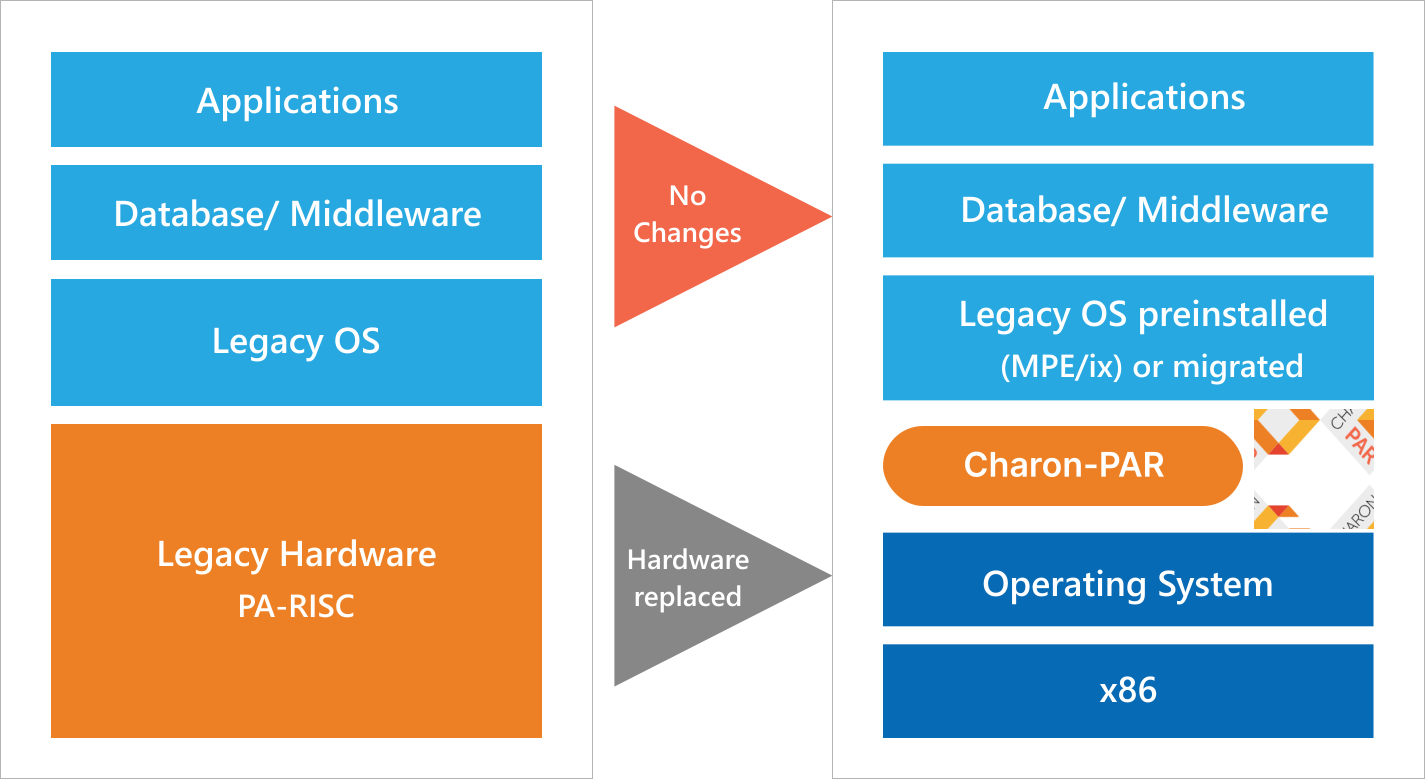
Modern operating systems use a hardware abstraction layer (HAL) to create a software layer over the hardware, virtualizing its functionality. Charon-PAR products act as HALs for legacy hardware, accurately modelling the old systems, including PCI-based I/O devices. They emulate legacy CPUs, console subsystems, buses, I/O adapters, disks, and tapes.
Installing Charon-PAR on a general-purpose host platform recreates the historic PA-RISC hardware virtually. This allows you to install and run your legacy operating system and applications as if you were using the original hardware. Typically, no software changes are needed. Charon-PAR emulated systems run the same binary code and I/O drivers as the original hardware.
Ultimately, Charon-PAR by Stromasys brings your legacy applications back to the modern computing era. With Charon-PAR, your computational tasks will become exponentially faster as compared to your old PA-RISC hardware. Don’t settle for slow – experience the difference today with Charon-PAR.
The future of PA-RISC hardware in modern computing is constrained by technological limitations, the risk of hardware failure, and a lack of support. Although it is still used in specific industries, its importance will be marginal compared to more advanced systems.
Furthermore, relying on this outdated technology is becoming increasingly risky, raising an important question: how long can people continue operating their business with this failing hardware and still be sustainable?
Emulation and virtualization are the pathways to shifting workloads for businesses that are still running their mission-critical applications on PA-RISC hardware. In essence, PA-RISC will remain part of computing history rather than a driver of future innovation.
PA-RISC (Precision Architecture-Reduced Instruction Set Computing) is a microprocessor architecture implemented by Hewlett-Packard (HP) in the mid-1980s. It is designed to improve performance and efficiency using a simplified instruction set.


The corporate IT landscape is evolving rapidly, presenting significant challenges for businesses. One major issue...
Read More
Did you know that the NASA/ESA Solar Orbiter mission launched in 2020 is powered by...
Read More
Are you looking to eliminate the risks associated with your HP 9000 PA-RISC systems? If...
Read More