
×

 Explain How Virtual Alpha Eliminates the Legacy Alpha Hardware Challenges in 2026?
Alpha servers were once the backbone of enterprise computing, but have transitioned from powerful assets to operational liabilities. Organizations running their critical workloads on the legacy Alpha hardware face challenges, including hardware obsolescence, rising maintenance costs, security vulnerabilities, and limited scalability. Virtual Alpha is a legacy modernization approach that virtualizes Alpha environments on modern infrastructure while eliminating hardware dependencies and preserving critical applications.
This migration approach reduces costs by 60-70%, enhances disaster recovery capabilities, and provides flexibility to deploy on-premises or in the cloud without any expensive application rewrites.
 Article

This transformation enables organizations to maintain critical applications without the liabilities of maintaining the traditional Alpha servers. So here is a blog post that will help you understand the challenges of operating on outdated AlphaServers and how virtual Alpha can help in resolving this issue.
AlphaServers were widely popular for their enterprise computing excellence. The Alpha AXP architecture delivered superior 64-bit processing while others struggled with 32-bit limitations. This resulted in several industries like manufacturing, telecommunications, healthcare, finance, and government sectors moving to DEC Alpha systems for running their OpenVMS, Tru64 UNIX, and other critical workloads. They offered reliability, performance boost, and better scalability, which overall improved the performance.
Here are some industries that heavily rely on the Alpha for running their critical operations, like:
Especially for the above industries, Alpha systems weren’t just the hardware but the backbone of operations running critical workloads. Several industries have also developed custom applications and workflows optimized to run on the Alpha platform. They are the heavy investments made by organizations and have decades of accumulated business logic and operational knowledge.
Here are some significant challenges that organizations face when running their critical workloads on Alpha hardware:
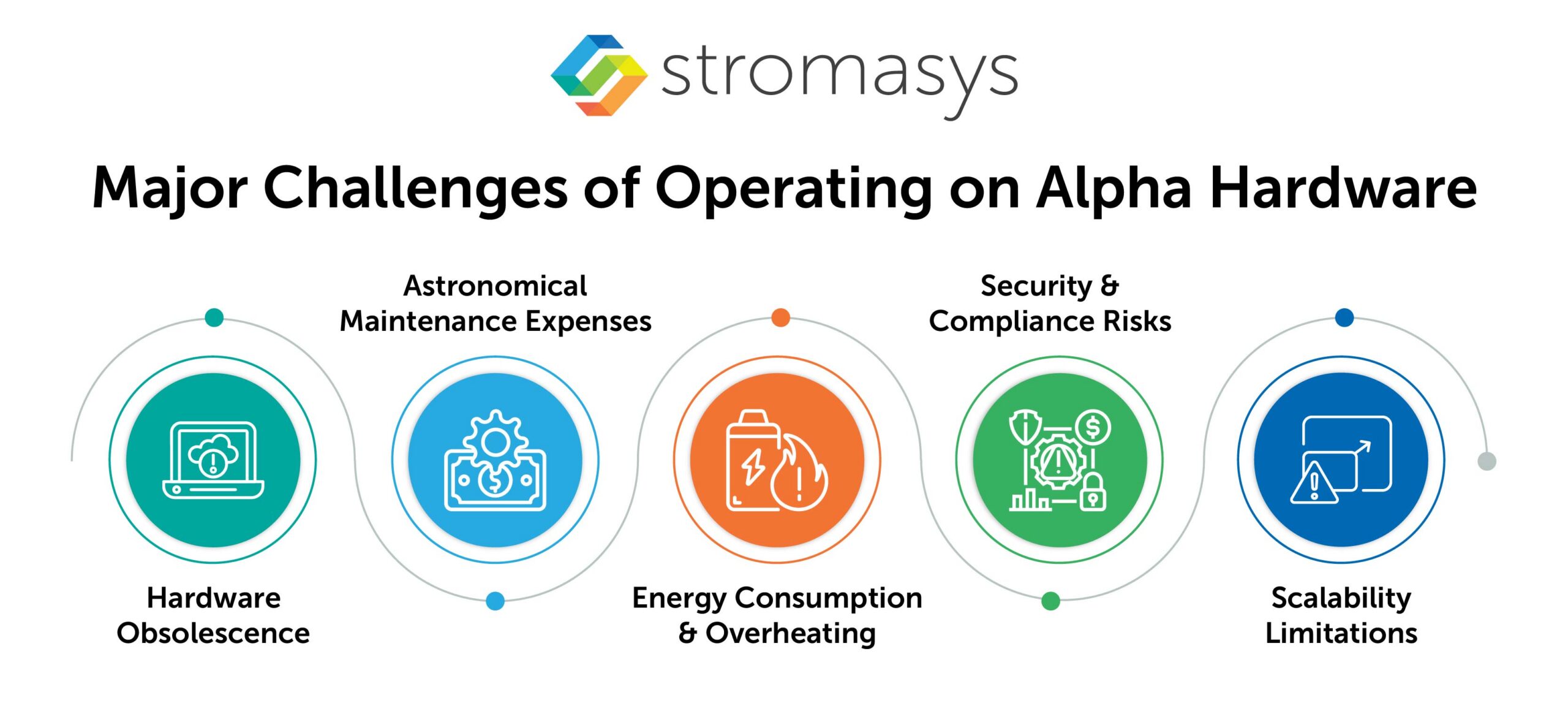
DEC discontinued the manufacturing of Alpha hardware several years ago. It means enterprises will have difficulty looking for replacement parts. Every day the Alpha hardware is in operation, the risk of system failure is higher, as when a critical component fails, and no replacement exists, the business impact can be catastrophic.
Maintaining outdated legacy hardware is expensive due to limited support, declining resources, and scarce replacement parts. This makes organizations pay premium rates for third-party support contracts and sourcing scarce parts at rising costs. As the skilled resources are retiring fast, this also contributes to rising costs, creating a financial burden that compounds year over year.
Physical Alpha servers consume a lot of energy compared to modern infrastructure. They were mostly used in data centers that required disproportionate physical floor space that generated heat. These outdated Alpha hardware tend to consume a lot of energy and overheat. Maintaining the rising temperature of these aging data centers requires expensive cooling systems. These inefficiencies directly contribute to unnecessary operational expenditure.
As the Alpha hardware is no longer supported by its manufacturer, it will no longer receive security patches and updates. This results in vulnerabilities getting exposed, and threat actors can easily breach, taking control of the sensitive information and undermining the organizational security posture. Then there is another factor, i.e., compliance. Outdated legacy systems are not compatible with modern compliance frameworks like GDPR, HIPAA, SOX, and others, creating real regulatory exposure.
As the business evolves, the workloads also increase depending on the growing market needs. But the traditional Alpha hardware does not offer the flexibility or scalability that modern operations require. It is not capable of scaling up or down depending on the changing business demands. Also, it is not designed to interact with modern applications like cloud or AI, creating performance bottlenecks.
Legacy Alpha hardware has been successfully running the critical workloads for decades now. But they are not compatible with the modern solutions. With Alpha virtualization businesses can transform their outdated Alpha environments into modern, virtualized solutions that run on standard x86 hardware or cloud infrastructure. This approach maintains complete compatibility with existing critical Alpha applications while eliminating the challenges with the physical hardware.
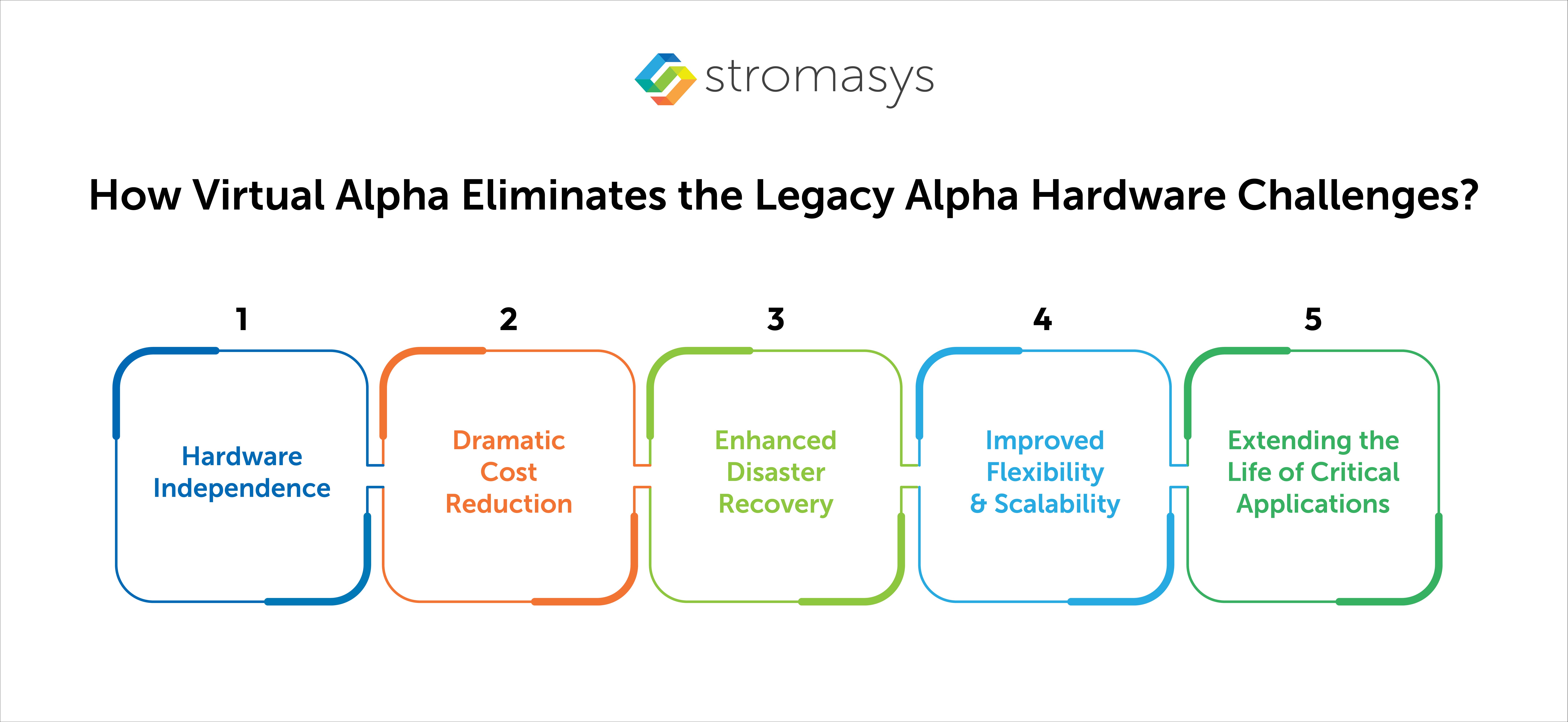
Virtual Alpha enables businesses to run their critical Alpha workloads like OpenVMS and Tru64 OS on a modern infrastructure. It extends the life of these critical workloads while eliminating the dependency on discontinued Alpha hardware.
Virtual Alpha presents a compelling financial case of cost optimization. With the virtual Alpha legacy modernization approach, organizations can seamlessly eliminate the aging hardware maintenance costs, reduce energy consumption substantially, and remove the need to look for expensive resources. Modern x86 servers are far more energy-efficient and can easily consolidate multiple workloads on a single platform, which helps in reducing both power usage and cooling requirements significantly.
Virtual Alpha enables organizations to implement improved disaster recovery strategies. These DR approaches are designed to protect against more advanced security risks, but they are not compatible with the outdated Alpha architecture. Virtual environments support snapshot-based backups that allow businesses to capture the entire system in just seconds and create recovery points that can help in easy restoration if problems occur. Backup procedures that previously caused several hours of downtime can now be completed in just minutes. Testing disaster recovery plans before implementing is a practical option that will help in validating recovery procedures without risking production systems.
Virtualizing outdated Alpha hardware not only extends the life of the critical applications running on the platform but also improves the scalability and flexibility to meet the growing demands of the market. Virtual Alpha can be deployed in both on-premises and cloud environments. This also enables the seamless integration with modern applications that help in enhancing efficiency and gaining the operational agility they need without sacrificing any applications they depend on.
Virtual Alpha is a method of legacy modernization that virtualizes the environment of outdated Alpha hardware on modern platforms like x86 servers or cloud ecosystems like AWS, Azure, OCI, or Google Cloud. This legacy migration approach preserves critical business applications without expensive, risky rewrite projects. This way, applications can seamlessly continue running exactly as before while maintaining all functionality. It eliminates any forced migration scenarios that can result in rushed decisions and project failures at the last mile. It helps the enterprises to modernize applications strategically while focusing on the resources from which they can get maximum business value.
Here are some significant benefits of modernizing legacy Alpha hardware:
Stromasys is a global leader as a cross-platform virtualization expert for legacy modernization. With Charon-AXP solutions, businesses can seamlessly transform their outdated Alpha system. This virtual Alpha legacy modernization solution mimics the behavior of existing outdated infrastructure on a modern platform while extending the life of critical workloads like OpenVMS and Tru64 UNIX operating systems without any modifications.
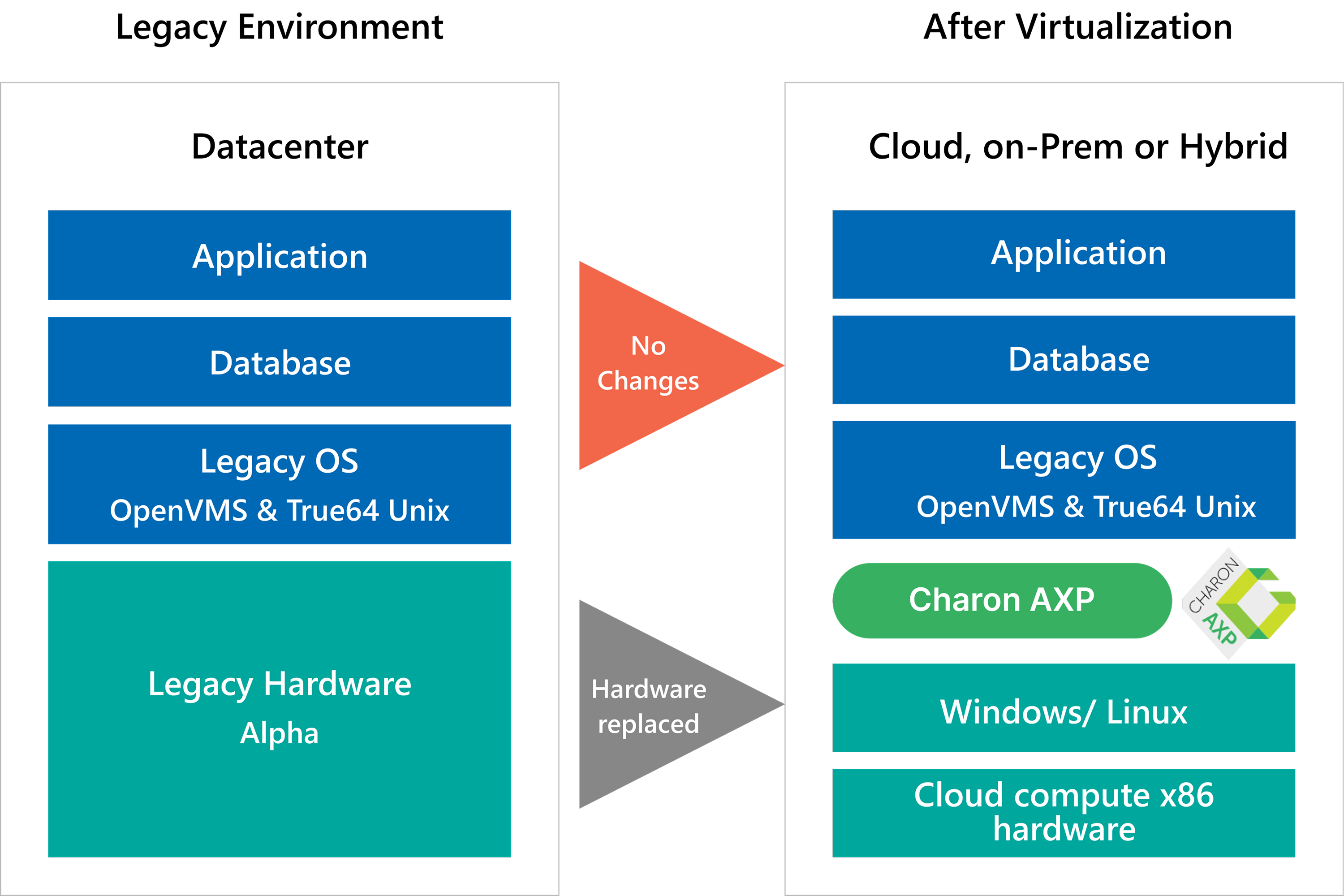
It is a flexible legacy modernization approach that can be deployed on both on-premises and cloud platforms, including AWS, Azure, OCI, and Google Cloud. Stromasys provides ongoing support with regular updates, security patches, and technical assistance.
Virtual Alpha is a legacy modernization method. It emulates an outdated hardware environment on modern x86 hardware or cloud infrastructure. Unlike physical Alpha servers, it eliminates hardware dependencies, offers flexibility, enables rapid disaster recovery, and reduces operational costs. It is compatible with existing critical workloads, including OpenVMS and Tru64 OS.


Mergers and acquisitions (M&A) promise business growth and market expansion, but their core value derives...
Read More
OpenVMS, or Open Virtual Memory System, is a secure and reliable multi-user OS initially developed...
Read More
OpenVMS or (VMS Virtual Memory System) was formerly known as VAX VMS (Virtual Address eXtension/Virtual...
Read More