
×

 What Happens When You Choose the Best SPARC Emulator
Old SPARC hardware presents many challenges for your business, from increased maintenance costs to depleting technical knowledge and operational risks. Stromasys Charon-SSP offers a no-code path to replace those old servers. It rehosts your Solaris apps to industry-standard X86 hardware without opting for any expensive rewriting projects. You can achieve full compatibility with your current software. Further, if your on-premises infrastructure lacks a robust disaster recovery in place, this emulator will be of great help. Overall, this emulator outperforms the rest in terms of speed, cost, risk, and business continuity.
 Articles

Running legacy SPARC hardware is a losing proposition for IT operations. The costs and risks multiply daily.
Secondary market parts for end-of-life SPARC servers may prove inoperable upon delivery. Even functional components are often 20 years old or more. According to data from ServiceNow, maintaining legacy systems can cost nearly $40,000 annually.
Younger engineers aren’t interested in maintaining technology that’s several generations out of date. As more people with legacy expertise retire, who will you rely on to keep your critical systems running?
Vintage hardware often requires special interconnects or switches. This increases data center complexity and demands unique cooling setups that don’t align with modern infrastructure. What is the true cost of higher energy use and wasted space, year after year?
How much innovation is lost when your IT team must maintain old equipment instead of pursuing new projects? Is the inability to move to hybrid cloud environments simply a hardware problem, or a signal to look beyond legacy systems?
By separating your valuable software from its aging hardware, new possibilities for modernization and agility come into focus.
First things first, what is Charon-SSP? It’s a SPARC hardware emulator that mimics the complete SPARC virtual hardware layer on reliable, industry-standard x86 environments. The virtual layer stays fully compatible with any Solaris-based applications running on it. As a result, the existing applications can run seamlessly without realizing that the hardware has been replaced.
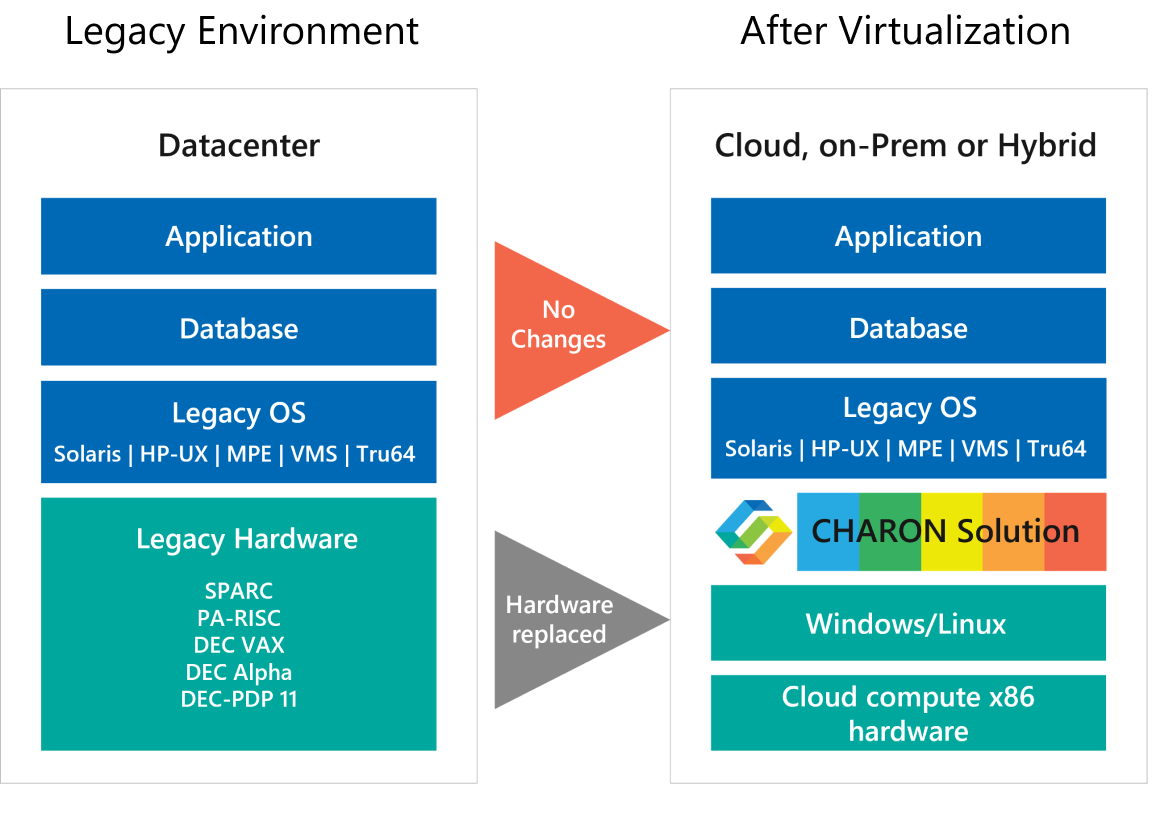
PictureNo risky migration projects are required. No changes to your original software, operating systems, or applications. End users will not notice any difference beyond improved reliability.
Charon-SSP replaces SPARC systems from the sun4c, sun4m, and sun4u families. All legacy applications from SUN Microsystems remain fully operational.
Complete binary compatibility with SPARC hardware means your applications, storage, Ethernet, and serial line I/O work as before. This in turn brings peace of mind knowing the fact that you don’t need code conversion or source code access.
This approach minimizes disruption as you migrate to new hardware. Modern systems also introduce reliability options that simply weren’t available in the past.
Running Solaris on the Cloud is simpler than many expect. Set up the basic Cloud components – virtual networks, virtual machines, and a base Linux environment.
With networking and IP addresses in place, installing the Charon emulator is simple. Your team can handle this migration simply by performing a UFS dump and transferring it to the cloud.
When evaluating replacement alternatives, what criteria matter most? Speed, cost, risk, and continuity?

With Charon-SSP, organizations can complete migration in just a matter of days. If you could switch to new infrastructure without disrupting business, would you?
Unlike other choices that demand costly rewrites, Stromasys preserves your software investment in full. Keeping your Solaris applications unchanged removes risk and protects business continuity.
Why pay more for annual legacy hardware support when a cost-effective alternative is already available? Stromasys’ solution often costs less than just one year of support, with power-saving features that help your bottom line. How could this free up resources for innovation instead of maintenance?
No end-user training is needed. The systems look and feel the same for your team. That means, you can keep your familiar systems and processes alive.
By implementing virtualization with hypervisors, organizations can consolidate multiple legacy servers into a single reliable virtual data center. Consider the time, money, and effort you could save.
With Stromasys, it is possible to bridge vital legacy applications with modern infrastructure. This approach means no more hardware headaches – only the benefits of modern infrastructure, without compromise.
One of our customers was facing similar challenges. They have a legacy invoice management system that could be upgraded. Here is what they said:
“Markview product obsolescence can’t be upgraded and must use Solaris OS in the Oracle Cloud Infrastructure. Advice from the Oracle Consulting team, who proposed Stromasys Solaris OS emulator running on Linux.”
(Explore their Solaris to Oracle migration story in detail.)
Imagine relying on a single physical host to support all your mission-critical production activities. That’s exactly where a leading Saudi Arabian cement manufacturer found itself.
Their on-premises environment had no backup disaster recovery site. High maintenance costs and shrinking expert support made outages a serious threat. The company needed modernization without risking its most crucial legacy applications.
They made the move to the cloud using Stromasys Charon-SSP, partnering with CloudWRKS to shift Solaris applications to AWS.
Here is how the customer expressed their satisfaction with Stromasys: “Now the business feels more confident because the disaster recovery process can reduce potential downtime and keep systems running smoothly.”
Single points of failure were removed, full application functionality was maintained, and maintenance costs dropped. Support improved thanks to the flexibility of a cloud solution.
Are your legacy applications protected from unplanned downtime? If not, it is time to pursue a safer and more reliable future.
Curious about your path forward?
Generally speaking, in a few days to weeks. But the timeline could take longer for organizations where the change management process is based on how long internal approvals take, and how the planning goes.


Companies still rely on mission-critical applications running on Sun SPARC, Alpha, or other legacy systems like PDP, VAX,...
Read More
SPARC hardware has been trusted by companies around the world for decades now, and rightly...
Read More
Sun SPARC hardware was introduced in the late 1980s and was popular for its high-end...
Read More