

Is your legacy infrastructure protected against unplanned downtime?
Evaluate your legacy environment for freeThe hidden cost of doing nothing with your old SPARC hardware is much more than you think. Enterprises often consider two popular choices: emulation and replatforming. Emulation emerges as a clear choice for organisations where Solaris operating systems perform very specific functions and are vital for business continuity. Replatforming, on the other hand, involves changing the code to meet your objectives. So, the process is much longer, costlier, and can have a lot of friction in the middle.
There is no one-size-fits-all strategy. Choosing the right approach depends on your specific workloads and the business outcomes you want to achieve. However, if you are looking for a frictionless, affordable, and quick alternative, emulation is a clear winner.
When SPARC servers get older, they become risky and less productive. Disk controllers start to make mistakes. As the original manufacturer declares them end-of-life, it becomes harder to find replacement parts. Support contracts are coming to an end, and the engineers who know these systems inside and out are retiring rapidly.
But the Solaris applications running on that hardware? They are still very important to the business. They handle important transactions for revenue, pass compliance audits, and run manufacturing workflows that took decades to build and fine-tune. Have you ensured that they have a safe environment to run in?
When IT leaders face this situation, two options usually come up:
Complete hardware migration
is expensive. Instead explore the most cost-effective alternative today!
This blog will explain what each path really means and help CTOs make an informed decision, especially those who are in charge of organizations that run mission-critical legacy applications on SPARC hardware.
Before we proceed, let’s take a moment to compare the two options briefly.
| Parameter | Emulation | Replatforming |
|---|---|---|
| Code changes | Zero to minimal | Code changes are required to adjust new features or functionalities |
| Timeline | Comparatively quicker. It can be as short as a day or take up to a couple of weeks | A much more time-consuming project that can take up to a year or more |
| Business risks | Low. Because nothing will be changed except for the old hardware. | Much higher due to the changes in application and architectural behavior. |
| Cost | Much lower, as you are not building something from scratch. | Multi-million dollar project. |
Replatforming is an application modernization strategy that involves moving (migrating) your application to a new platform (cloud or a new operating system). For example, it can involve updating the database, adjusting configurations, or using cloud-based services instead of local servers.
With replatforming, core application functionalities remain the same. Though it’s not a complete rewrite, it requires you to update or modify certain parts so that the application performs better, becomes secure and scales easily.
In comparison with emulation (lift and shift), it moves an application without changing it. Replatforming, on the other hand, makes modifications and code changes.
Replatforming usually follows a set order:
On paper, that looks manageable. In practice, each step carries dependencies. Problems in the assessment phase surface during testing. Compatibility issues that looked minor during design become blockers during migration. The sequence rarely runs clean.
Before you start a replatforming project, you should know about the problems that could come up.
When you replatform, you have to run both the old SPARC hardware and the new platform that’s being built simultaneously for a long time. Running two operations at once costs money and keeps teams from getting things done. SPARC workloads are often poorly documented, closely tied to old infrastructure, and deeply rooted in daily business operations. This makes migration more likely to go wrong.
You still need to retest the whole stack even if you can get the core application to work on Linux. The operating system, the database, the middleware, the batch jobs, and the connections. Performance traits change. You need to start with high-availability and disaster recovery plans that were made for Solaris on the new platform. Your team has been using operational runbooks for years, but they have suddenly become useless.
According to Bloor Research, migration projects often go over budget and take longer than planned. The average cost of a data migration project is about $875,000, and only 62% of these projects were finished on time and on budget. When it comes to SPARC replatforming with custom apps, those numbers get even more alarming.
Engineering teams, on the other hand, spend months or even years working on infrastructure instead of adding new features to the business. Even though it’s harder to put on a spreadsheet, that opportunity cost is real.
Problems happen with 83% of migrations. The most common problem is unexpected downtime, followed by data corruption, problems with technical compatibility, and problems with application performance.
Emulation mimics your existing SPARC hardware interface on a different physical platform and creates an exact equivalent interface for the software. The emulator is a piece of software that sits between the guest system (your original SPARC hardware environment) and the host system (a modern infrastructure).
For example, a SPARC emulator like Stromasys’s Charon-SSP imitates the SPARC hardware interface on standard x86 infrastructure. This way, it eliminates the dependency on aging hardware so that the legacy applications can run on a more reliable host.
Solaris operating systems see what it expects to see: the same CPU architecture, the same memory layout, the same device interfaces. It has no idea it’s running on completely different hardware.
Here’s how emulation works: you capture a full backup of your OS, applications, and data from the physical SPARC server. You restore that backup to the emulated environment. The application boots up and runs exactly as it did before. No code changes. No recompilation. No revalidation of application logic.
Emulation is more effective than replatforming in several key areas:
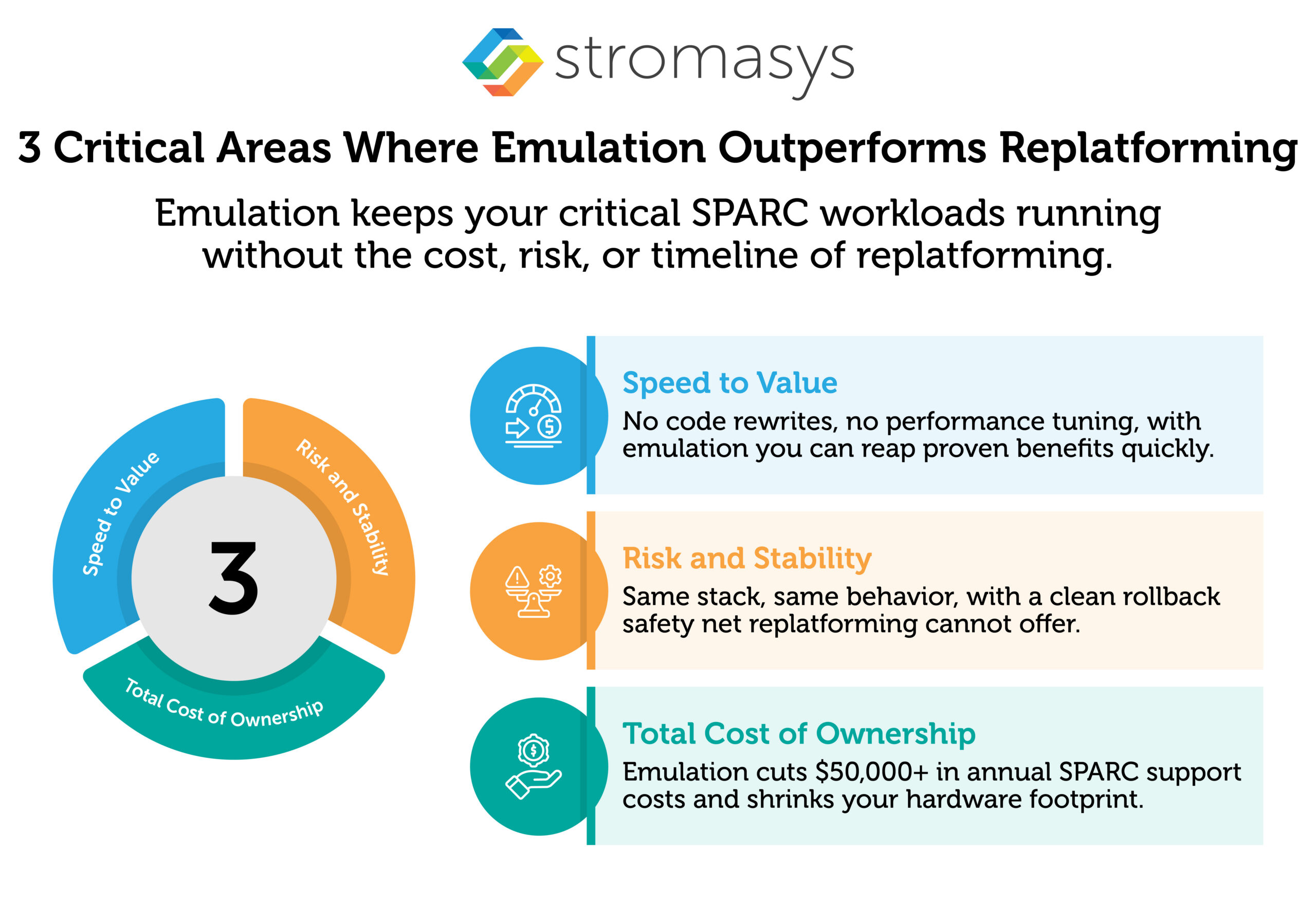
Emulation projects typically wrap up in weeks to a few months. Most of the work involves inventorying your SPARC estate, capturing disk images, and running validation tests. There is no code to rewrite, no middleware to reconfigure, no performance tuning to redo.
Compare that to a replatforming program that commonly runs two to three years, with significant engineering effort throughout. For workloads that support revenue-generating operations, that gap matters enormously.
Emulation keeps what already works. Same Solaris version. Same binaries. Same application behavior. You’re simply running that stack on more reliable infrastructure.
Even the rollback story is clean. During testing, if something looks off, you can revert to the physical SPARC environment. That safety net doesn’t exist in a replatforming project, where the old and new systems diverge more with every sprint.
Hardware failure accounts for 31% of unplanned downtime, according to Forrester. Gartner estimates organizations face 87 hours of system downtime per year, at an hourly cost of roughly $42,000. That’s $3.6 million annually just in downtime exposure for large enterprises. Removing aging SPARC hardware from the equation addresses the root cause directly.
Many companies pay upwards of $50,000 annually to support a single legacy SPARC system. Emulation eliminates these expenses. It also lets you consolidate multiple SPARC boxes onto fewer x86 hosts or cloud instances, cutting power, cooling, and physical footprint in the process.
In general, one Stromasys customer shared a powerful example of cost savings after emulation:
“We went from paying more than $100,000 in maintenance fees per year to paying just under $10,000 per year. And it took virtually no effort on our part.”
This indicates a 90% reduction in maintenance costs, clearly showing how emulation can significantly lower the expenses in your data center.
Sometimes, legacy applications simply can’t be replatformed, not because it’s technically impossible, but because the institutional knowledge required to rewrite them no longer exists, or the cost and risk of doing so far outweigh any business benefit.
Imagine a manufacturer whose ERP runs entirely on Solaris. That system encodes two decades of custom workflows, plant-floor integrations, and compliance logic. The hardware underneath it is failing. But the application itself works. Emulation removes the failing hardware without touching the application. That’s the right call for a system like that.
Orange Business faced exactly this situation. Their Tungsten Markview ERP ran only on Solaris. Instead of rewriting it, they opted for emulation on a cloud host. The result was three-plus years of additional business continuity, no code changes, and no downtime risk during the transition.
If you’re responsible for SPARC infrastructure, here are clear steps to move forward.
For many businesses, emulation is the only solution. Applications that are stable, compliant, and don't need new features can run on emulated infrastructure for a long time. For some, emulation is a way to achieve long-term modernization. Both ways are correct.

That door doesn’t close when you emulate. It actually buys you some time to see if you really need strategies that require changing code. You get rid of the hardware risk, make operations more stable, and have peace of mind. Then you can choose to replatform with all the information you need.
For a lot of businesses, emulation is the only answer. Emulated infrastructure can run applications that are stable, compliant, and don’t need new features for a long time. Some people use emulation as a way to modernize things over time. Both ways are right.
The Stromasys Research Team is a collective of experts specializing in researching and writing about legacy systems modernization, virtualization, and hardware emulation. With a combined experience of over 15 years, the team has researched, written, and published 200+ in-depth content pieces exploring how organizations across manufacturing, aerospace, finance, and public sector environments extend the life of mission-critical platforms while transitioning to modern infrastructure. Their work is informed by real-world customer deployments, input from engineering, and updated insights on what is latest in the world of legacy systems including SPARC, PA-RISC, VAX, Alpha and PDP environments.
Companies still rely on mission-critical applications running on Sun SPARC, Alpha, or other legacy systems like PDP, VAX,...
Read MoreSPARC hardware has been trusted by companies around the world for decades now, and rightly...

Read MoreSun SPARC hardware was introduced in the late 1980s and was popular for its high-end...
Read MoreDon't let your legacy systems slow you down! Contact us today and transform your legacy environment into a dynamic, agile platform for success.
Kickstart your journey towards a more efficient and streamlined business environment with just one click.