
×

 The DEC Alpha Processor: Architecture and Legacy
DEC Alpha processors came out in 1992 and experienced instant success. Its registers, instruction, and addressing all had the makings of a successful architecture. The high clock rates, superscalar processing, multiprocessor support, and on-chip secondary cache were all a result of the impressive DEC Alpha architecture.
However, despite several versions and supported operating systems, DEC Alpha ultimately faced complications within a decade of its emergence. Besides being pushed aside by Compaq and HP, its two subsequent owners, and the usual problems of legacy hardware, many enterprises still use DEC Alpha systems.
What you need right now is an emulation solution for uninterrupted business continuity and preservation of DEC Alpha software. Stromasys is the best solution for an enterprise-level AlphaServer emulator that delivers wonderful results for you.
 Article
In the mid-1980s, Digital Equipment Corporation (DEC) badly wanted to move from CISC architecture to RISC. After a long, winding journey, with discussions, debates, and decisions, DEC Alpha came out in 1992.
Once it did though, the DEC Alpha processor was a hit. However, the continuous change of hands left this microprocessor without any clear direction, and development stopped in less than a decade.
Currently, most companies still surviving on Alpha servers and workstations have a hard time completing tasks without common legacy hardware problems associated with obsolescence and replacement by upcoming technologies.
While you may think you, as someone handling an Alpha system, do not have many choices, you do. This blog not only explains the DEC Alpha architecture and processor details but also outlines your options with Alpha infrastructure once the hardware fails completely.
The DEC Alpha processor (originally known as Alpha AXP) is a 64-bit RISC (Reduced Instruction Set Computer) architecture. Since it was a RISC, it used a load/store method for implementation.
It was developed to replace the 32-bit CISC VAX architecture and aimed to provide high performance with a strong emphasis on both simplicity of design and speed. The Alpha had no branch delay slots, byte load/store instructions (until BWX), suppressed instructions, or condition codes.
The different elements of the DEC Alpha architecture consist of the following:
Registers: There are 32 integer registers (R0 to R31), 32 floating-point registers (F0 to F31), a program counter (64-bit PC), two lock registers (lock flag and locked physical address register – LR0 and LR1), and a floating-point control register (64-bit FPCR), registers for PALcode, and optional registers used if required.
Data Types: DEC Alpha has 32-bit longword integer, 64-bit quadword integer, 32-bit single precision IEEE S-floating-point, and 64-bit double precision IEEE T-floating-point, plus 32-bit single precision F-floating point and 64-bit double precision G-floating point for VAX compatibility.
Addressing: The Alpha processor utilizes little-endian byte addressing. The byte manipulation instructions, aided by a single instruction modification, made it possible to access big as well as little-endian data.
Memory: Sporting a 64-bit linear virtual address space without any memory segmentation, the Alpha can implement a smaller VAS of 43 bits minimum.
Instructions: With a fixed-length instruction set of 32 bits, the Alpha has six instruction formats (‘Integer operate’, ‘Integer operate, literal’, ‘Floating-point operate’, ‘Memory format’, ‘Branch format’, and ‘CALL_PAL format’).
The instruction set in the DEC Alpha processor includes:
The control instructions comprise conditional and unconditional branches which use the branch instruction format. It also includes the jump instructions which utilize the memory instruction format.
Integer arithmetic instructions handle addition, multiplication, and subtraction of longwords or quadwords. They also compare quadwords and include conditional move instructions.
The logical instructions take care of bitwise logical operations and conditional moves on the integer registers. The shift instructions, on the other hand, are responsible for arithmetic right shift, and logical left and right shifts.
You get several extensions for the DEC Alpha architecture ISA, including byte-word extensions (BWX) (in later Alphas), motion video instructions (MVI), floating-point extensions (FIX), and count extensions (CIX).
The most well-known DEC Alpha processor versions used in enterprises were EV4 (21064), EV45 (21064A), EV5 (21164), EV56 (21164A), EV6 (21264), EV67 (21264A), and EV7 (21364). There were several others, like LCA4 (21066) and the unfinished EV78 (21364A) or EV8 (21364A). We have only mentioned the most noteworthy ones here.
Here are few unique characteristics that helped Alpha processors to be quite popular back in their era:
64-bit architecture: As we already discussed, Alpha processors brought 64-bit support early on. It had a floating-point unit (FPU), an integer unit, an address ALU, and load units, featuring registers and pointers to support the system.
High clock rates: Its RISC-based design, with simplified registers and fixed instruction sizes, allowed Alpha to hit clock speeds of 192MHz as early as 1992.
Superscalar processing: The CPUs also supported superscalar processing, with the ability to handle multiple instructions at once.
Multiprocessor support: DEC Alpha included built-in multiprocessor support but had a weaker memory model.
On-chip secondary cache: Starting with the Alpha 21164, secondary cache was built in.
Out-of-order execution: It is a technique of utilizing the circles that would otherwise be wasted. Alpha 21264 was one of the first to perform out-of-order execution at high clock speeds, which made the processes faster.
Integrated memory controller: Alpha had its memory controller integrated within, starting with the 21364 model.

DEC AlphaServers were known for accommodating different computing requirements for small and large businesses through clustering. You get to manage a set of systems like a single one, increasing availability and redundancy.
As they support multiple operating systems, AlphaServers can easily meet the growing demands of a business. Assembled together, they form HPC (High-Performance Computing) clusters that allow parallel processing and scalability for challenging tasks.
DEC Alpha workstations and servers were compatible with many different operating systems, including Tru64 UNIX, OpenVMS, and Windows NT. They also allowed Linux and BSD variants, along with other OSs. This versatility allowed businesses to select a platform that best suited their requirements.


Want to change your legacy Alpha hardware without a full-scale migration that disrupts your workloads? Stromasys is perfect for the task!
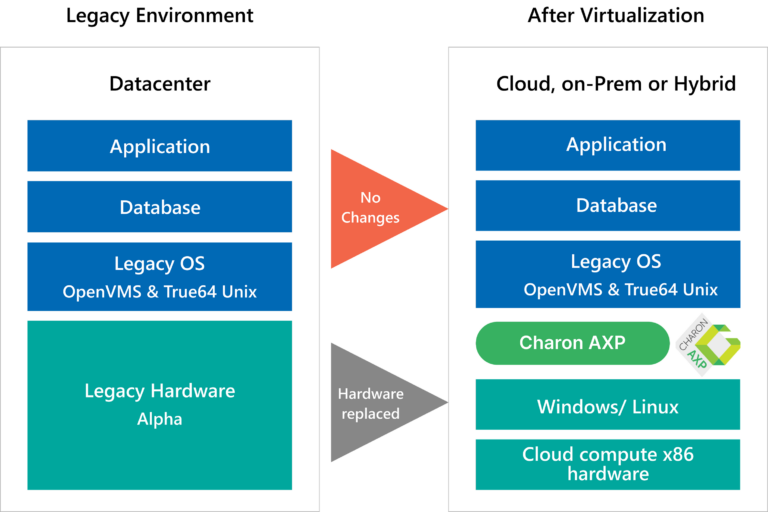
Stromasys uses Charon-AXP, an AlphaServer emulator, for seamless DEC Alpha to x86 migration that retains the OS, applications, and databases, but on the modern hardware. Our solution recreates the original environment, making the software feel like it is running on Alpha again.
You can even shift your workload to the cloud. The process reduces the risk posed by aging infrastructure and boosts both performance and reliability. It empowers organizations to maintain their critical operations without interruption.
EIS Wire & Cable faced the problem that any company running legacy AlphaServer ES40 hardware faces: frequent system failures being hard to fix because replacement parts were difficult to find, and technical experts becoming rarer every day.
They had a business system with proprietary software, including ODBC software connected to RMS databases. However, even though they would eventually move to a full migration, they needed an easy and quick solution while preserving their work.
Stromasys, with Charon-AXP, was the final choice for them, and it worked wonders. As Pete Gaudet, IT manager of EIS Wire & Cable, said “An MRP that took 15 minutes to process now happens in under 1 minute!”
Other than that, redundancy and reduced backup times were two other major gains. Want to know the full story of this DEC Alpha to x86 migration that led to such impressive results? Read here.
The DEC Alpha architecture, launched as Alpha AXP, is a 64-bit RISC instruction set architecture (ISA) developed by DEC. It was introduced as a processor to replace the 32-bit CISC VAX. An aggressive RISC processor for enterprise servers and Unix workstations, it provided impressive clock speeds, a pipeline-friendly design, and commendable compiler support.


Mergers and acquisitions (M&A) promise business growth and market expansion, but their core value derives...
Read More
OpenVMS, or Open Virtual Memory System, is a secure and reliable multi-user OS initially developed...
Read More
Modernizing your old DEC Alpha servers and hardware is crucial due to numerous underlying risks....
Read More