
×

 EXPLAIN THE ARCHITECTURE AND BENEFITS OF THE RISC-V.
RISC-V is an open-source ISA (instruction set architecture). It was designed and developed at UC Berkeley and represents the fifth generation of RISC processors. This processor is not like the proprietary ISAs like x86 servers pr ARM as it is available for free to other users.
RISC-V processors are managed by RISC-V International and have more than 3000 employees. Its scalable, modular design supports 32-bit to 128-bit address widths and enables applications from microcontrollers to supercomputers. The significant benefits include simplified instruction sets, robust security, energy efficiency, and tailored processor development.
 Article

RISC-V architecture can be defined as the fundamental set of instructions that processors can comprehend and execute. RISC V is not a proprietary ISA, but an open-source architecture that is available for free, unlike x86 or ARM processors. It allows anyone to customize and implement it without any licensing fees. It builds a collaborative environment for everyone.
Here are the characteristics of RISC-V explained:
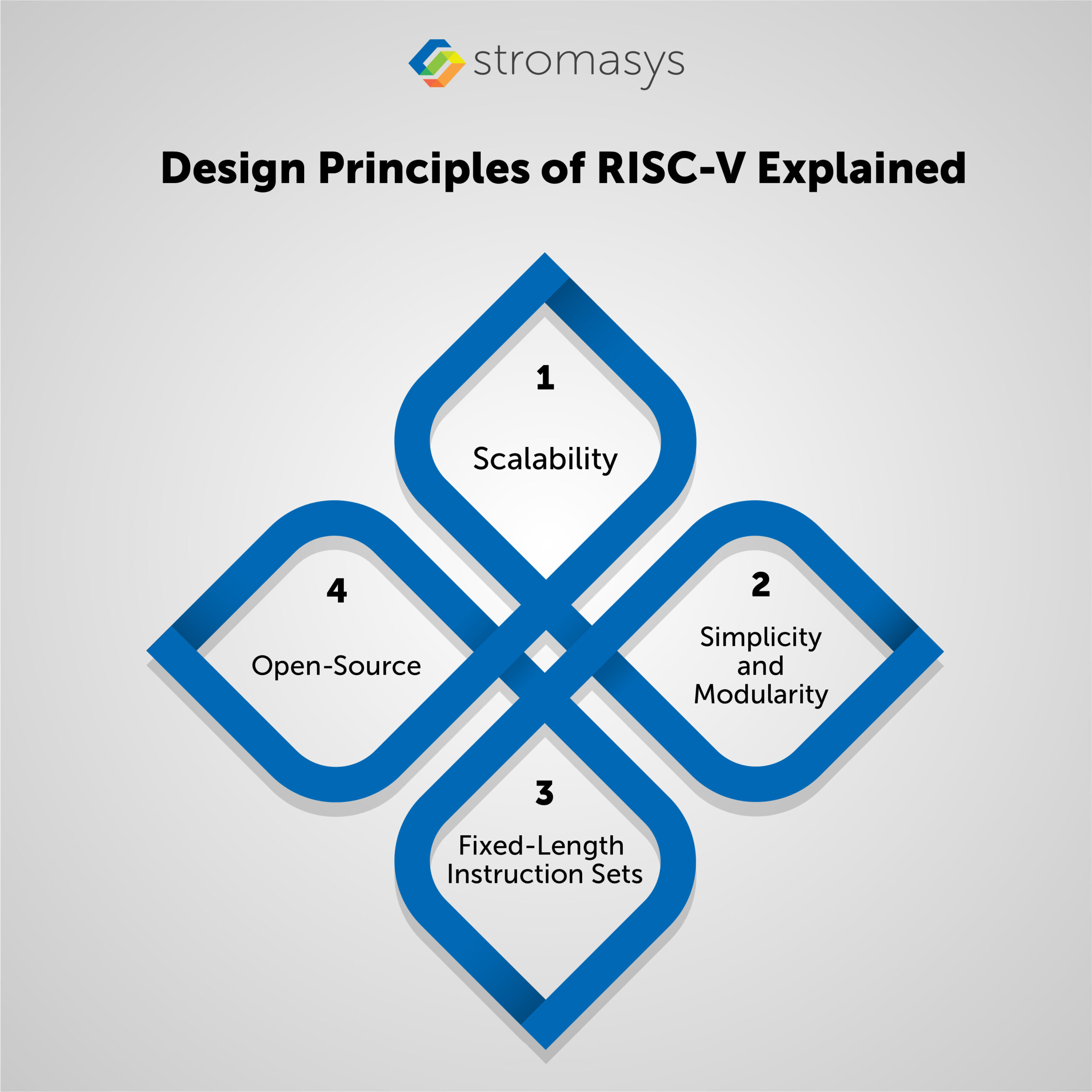
The RISC-V instruction set was developed in 2010 at the Parallel Computing Laboratory, UC Berkeley. The research team comprised Professors Krste Asanović, David Patterson, and Andrew Waterman. Their primary goal was to develop an instruction set architecture for academic use that avoids complexities and licensing challenges.
In 2015, the RISC-V Foundation was established to standardize and promote the ISA commercially. In 2020, the headquarters was moved to Switzerland and was rebranded as RISC-V International. Gradually evolved into a global standard.
Its headquarters are now in Switzerland, allowing designers worldwide to maintain neutrality without any government regulations. Based on the recent reports, it has over 4,200 members across 70+ countries. Sources reveal that more than 10 billion RISC-V cores had shipped by around 2022, with NVIDIA alone shipping 1 billion in 2024. Market projections show an extraordinary growth in the RISC-V SoC shipments, that could reach 16+ billion units by 2030, with significant revenue gains.
RISC-V architecture is gaining momentum across industries and is recognized as a standard. This growing commercial adoption is fueling the continued evolution of processor architecture.
The core components of RISC-V architecture at a high level are:
RISC-V architecture follows a load-store architecture with a small base set of instructions. For example: RV32I/RV64I base integer ISA with ~47 instructions. The fetch-decode-execute cycle processes instructions efficiently.
Designers select a base ISA and add extensions, like floating-point, vector processing, or security as per requirement. This modularity lets teams optimize power, performance, and area (PPA) for specific applications. While strong in embedded/microcontroller markets, it’s expanding rapidly into AI, data centers, automotive, and HPC.
RISC-V is highly popular in computing due to its architecture, which offers simple instruction sets for processors to complete multiple tasks. It even enables developers to design several customized processors quickly, depending on the market requirements. This compatibility with IP processors is time-saving.
Here are some significant benefits to migrating to the RISC-V instruction set:

RISC-V is an open-source instruction set architecture that allows seamless collaboration and customization across industries without any licensing fees.
The common ISA feature enables easy development for processors, as the same architecture is used throughout the software. Developers mostly use the same base ISA, ranging from large supercomputers to simple embedded systems, personalizing their processors according to market demands, as compared to their previous ISAs. The RISC-V instruction set architecture offers several unique functionalities that can be tailored to meet specific business requirements.
RISC V is available in a variety of smaller, modular, and energy-efficient options.
The RISC V architecture utilizes advanced security measures, which are enabled by its open-source ISA reference framework, security extensions, and software analysis applications. Also, its open-source nature allows it to be regularly monitored by the public, which eliminates hidden channels and backdoors.
Here are some examples of RISC-V architecture applications in different industries:

RISC V is an open-source ISA that is based on the principles of RISC architecture and offers free licensing. It provides a set of instructions for a processor to execute simple, modular, and extensible operations.


The IT landscape is rapidly evolving, and businesses still running legacy hardware are facing numerous...
Read More
Did you know a 1990s-era processor design still flies on NASA/ESA Solar Orbiter? That’s right!...
Read More
Fun fact: The HP 9000 series reached its End of Life (EOL) on April 30,...
Read More