
×

 Understanding Legacy Operating Systems and Why They Still Run the World’s Most Critical Infrastructure
Legacy operating systems are outdated operating systems that have been in operation for decades and are no longer actively developed, patched, or supported by their original vendors. Organizations continue to rely on them to maintain the continuity of critical applications. These are mostly proprietary systems such as HP-UX, Solaris, OpenVMS, Tru64, and MPE/iX that still run on legacy hardware. Businesses typically retain them because these applications contain decades of customized, irreplaceable business logic.
Legacy operating system support is important because unsupported systems no longer receive security patches. This exposes organizations to vulnerabilities that threat actors can exploit, as well as compliance risks under frameworks such as PCI DSS 4.0, HIPAA, and DORA. When managing legacy operating system environments, businesses generally follow four strategic options including extended vendor support contracts, third-party support providers, full re-platforming and migration, or hardware emulation. Hardware emulation, in particular, helps preserve the application layer while eliminating obsolete physical hardware. Stromasys Charon seamlessly modernizes the hardware running underneath legacy operating systems, allowing organizations to continue operations smoothly.
 Article

For a very long time, the standard response for this issue was simple to leave it all alone as it was in working condition. If the system works, why touch it? But now the times have changed. The compliance regulations and standards have tightened. Cybersecurity threats have grown more sophisticated.
The legacy experts and engineers who know these systems are retiring fast. And the assessments conducted by auditors are getting tough. They are asking harder questions about infrastructure as to why they are no longer receiving security updates and patches. According to the IBM X-Force’s 2026 research, the AI-accelerated reconnaissance lets attackers scan for unpatched systems and launch exploits within hours of a vulnerability getting exposed. The stats shows a shocking 44% year-over-year increase in attacks that begin with the exploitation of public-facing applications.
Legacy operating system support is no longer a backroom IT concern. It has now become a strategic priority as it talks about cybersecurity posture, compliance standing, business continuity, and long-term modernization planning. So, here is a blog that explains why and what steps organizations are taking to resolve these issues in 2026.
Legacy operating systems are older OS that are mostly proprietary and tied to specific hardware architectures. They continue to power mission-critical applications to ensure seamless operations and are still running even though the hardware support has ended by the vendor. They were designed for reliability and stability in a complex environment, but they are now facing obsolescence.
Most are proprietary and tied to specific hardware architectures they were built decades ago to run on. For example, based on the Xtendedview’s report, the Windows 7 still accounted for 1.67% of Windows desktop activity in 2026, while Windows XP retained 0.17%. These legacy editions continue to remain in use even though their support has ended. You can multiply that risk profile by enterprise-critical infrastructure, and the stakes look very different.
Here are some widely known legacy operating systems that are still running critical applications across several industries:
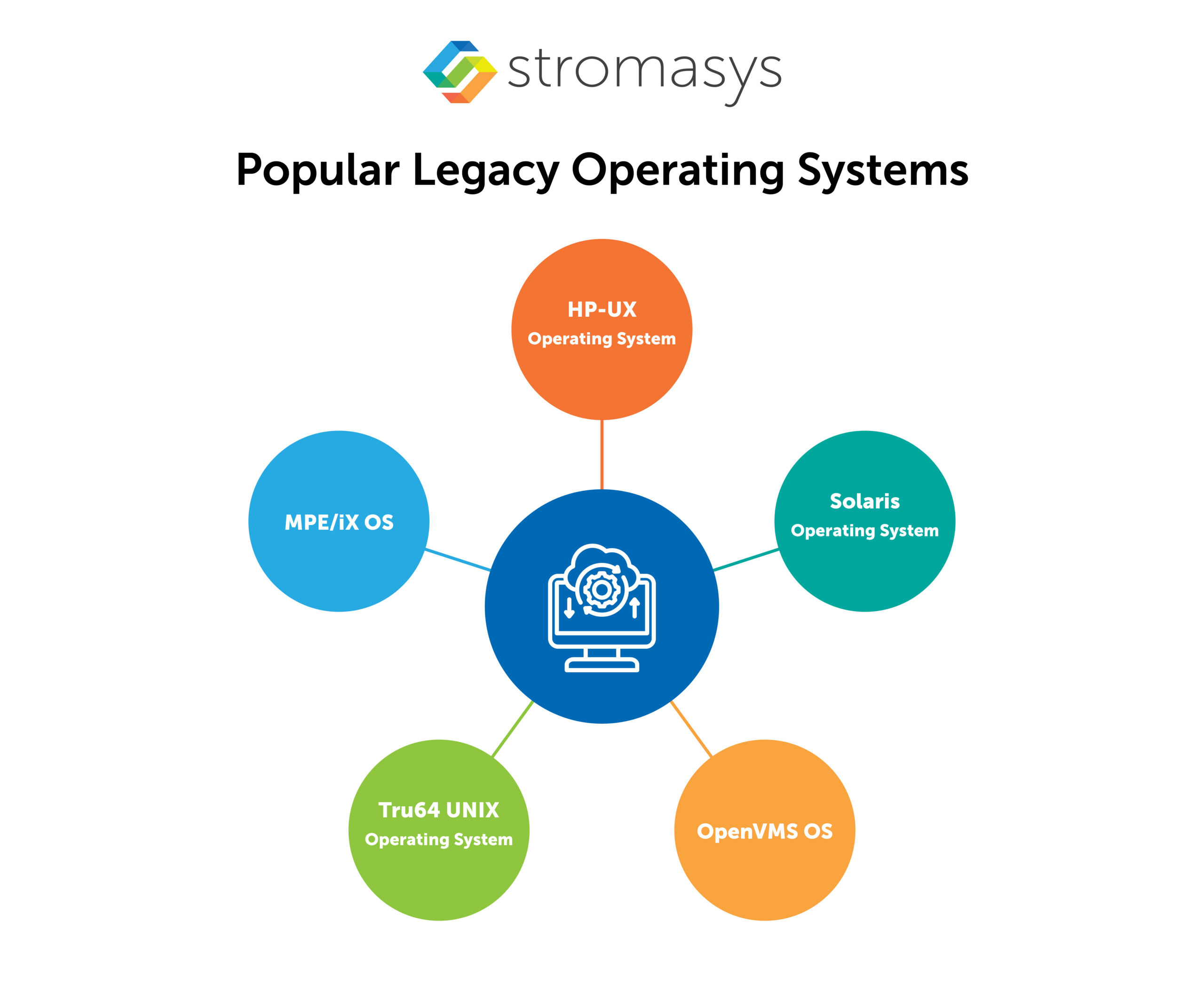
Hewlett-Packard’s proprietary Unix implementation is based on System V and was first released in 1984. It powered HP 9000 legacy hardware but later also catered to Integrity (Itanium) servers in enterprise settings for different industries like telecom, finance, and manufacturing.
The standard support for HP-UX final version (11i v3) officially ended on December 31, 2025. It means HP will no longer provide security patches and updates for HP-UX OS.
The Solaris operating system was introduced by Sun Microsystems, but now it is owned by Oracle Corporation. It is a Unix-based OS that is known for operating SPARC hardware. It was popular in enterprise-grade computing due to its high performance and how it manages its workloads.
Solaris operating system has powered large-scale financial institutions, the telecom sector, and government databases for decades. The latest version is Solaris 11.4, and the support extends to 2034.
OpenVMS is an operating system that was introduced by Digital Equipment Corporation (DEC). It is a robust, high-availability operating system that runs on VAX and Alpha hardware. It was widely known for clustering, transaction processing, and fault tolerance. OpenVMS is widely used in different industry sectors like finance, healthcare, and government, where uptime is not negotiable. It is mostly common in large enterprises.
A 64-bit Unix operating system that runs on Alpha architecture. Its most significant features are advanced clustering and the AdvFS filesystem. The vendor support ended in 2012. But it is still operational due to its unique capabilities of managing specialized workloads in legacy environments, which cannot be easily fully replicated elsewhere.
It is HP’s business-oriented OS, which was running on the HP 3000 series. It emphasizes reliability for transaction processing, especially with the integrated database. This legacy operating system has powered many mid-market business systems and still remains in niche use for payroll, inventory, and custom apps despite the end of mainstream support.
These systems have been operating for decades because their applications handle irreplaceable business logic, mostly due to decades of customization. However, the platform it is operating on is already obsolete, which increases the risks of hardware failures, unavailability of replacement parts, and energy inefficiency.
Legacy systems are quite persistent; despite reaching their end-of-lifecycle, they are still actively operating. Based on a survey report in 2025 of 500 U.S. IT professionals, it was found that 62% of organizations still use legacy software systems. Among Fortune 500 companies, nearly 70% of businesses operate on legacy software that is at least two decades old.
The GAO has reported that the U.S. federal agencies spend roughly 80% of their IT budgets on operations and maintenance of their legacy systems. Based on the runZero report, recent enterprise data shows 8.56% of assets across studied U.S. organizations run an end-of-life OS, with 5% already beyond security support.
The reasons for not migrating from their outdated infrastructure include business continuity risks (downtime could cost millions), multi-year budget cycles, and deep application dependency lock-in. Sources have shown that one hour of downtime at a large enterprise can cost $300,000 to $1 million. It is not a number that makes the “don’t touch it” instinct feel rational, right up until a ransomware group finds the one unpatched door left open.
Most of the business stakeholders and CTOs have a mindset of “if it isn’t broken, don’t fix it” due to its false safety net. But this is only until a ransomware attack exploits an unpatched vulnerability or hardware fails catastrophically, halting production for days.
When a vendor declares end of support (EOS) or EOL signals for legacy operating systems, it means the consequences of continuing to operate on it can be disastrous. Here are three things that can happen at once:
One of the most common impacts will be no more security updates and patches. It means every vulnerability discovered after the end of life will not be addressed and resolved. There will be no more fixing of the issues, and if attackers know this, they will be immediately targeted. Verizon’s 2026 Data Breach Investigations Report found that vulnerability exploitation surpassed stolen credentials as the #1 initial access vector, accounting for 31% of breaches. This trend poses the greatest risk to unsupported and unpatchable systems.
Now, let’s not forget that the compliance exposure is severe. Frameworks like HIPAA, GDPR, the EU’s Digital Operational Resilience Act (DORA) and PCI DSS require secure, supported infrastructure. The auditors have repeatedly flagged EOL systems. Non-compliance can result in legal penalties, higher insurance premiums, and reputational damage.
Also, there is a difference between the end of mainstream support and the end of extended support. This can often add a layer of confusion. Many think that the “extended support” provides the same level of coverage as mainstream support does. But it is not. Extended support usually covers security patches only. It doesn’t offer any feature updates or non-security fixes. It is also substantially higher in cost than standard support agreements.
One of the real-world examples is WannaCry ransomware. The 2017 WannaCry ransomware exploited unpatched legacy Windows systems years after support ended, affecting more than 200,000 systems across 150 countries and causing an estimated $4 billion in global losses. Another example is of the most recent one, CISA confirmed in October 2025 that active ransomware campaigns were exploiting a known Linux kernel flaw (CVE-2024-1086) that had gone unpatched across enterprise environments, based on the Command Linux.
Here are the three converging pressures that have elevated legacy operating systems support from an IT operations issue to a board-level concern.
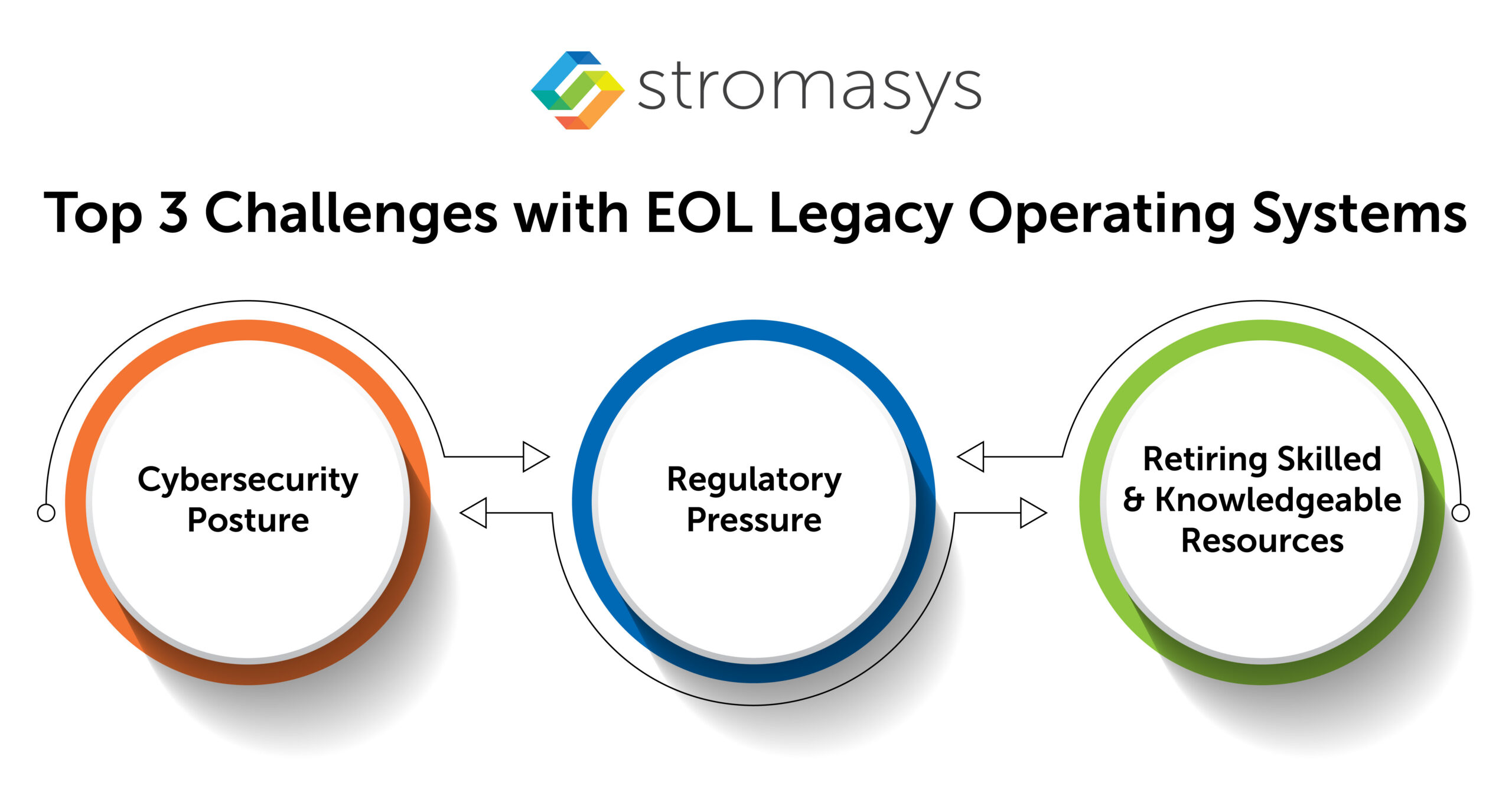
The end-of-life systems are vulnerable as their vendors do not offer any more security updates and patches. This leaves them exposed with more surface attack area that can be easily exploited by the hackers. They become the prime targets for ransomware and supply chain attacks. Based on Microsoft’s Digital Defense Report, over 90% of ransomware attacks exploit unmanaged endpoints with unsupported OS versions.
Auditors and regulations demand patched environments. Organizations have seen that over the past couple of years, the compliance requirements have tightened around software currency and patch management. The EU’s DORA regulation, which came into full effect in January 2025, explicitly requires financial institutions to manage ICT risks, including those arising from legacy systems. PCI DSS 4.0, effective March 2025, similarly tightens requirements around EOL software in cardholder data environments. Non-compliance leads to hefty fines, legal penalties, and reputational damage.
Specialists who have been operating on legacy infrastructure are retiring. Also, the new engineers and developers are not well-versed in legacy knowledge. It means these experts are taking away the decade-long institutional knowledge with them. This lack of skills for legacy systems has now become a significant barrier to both maintaining and modernizing those systems.
Here are the four key strategies for keeping legacy operating systems running:
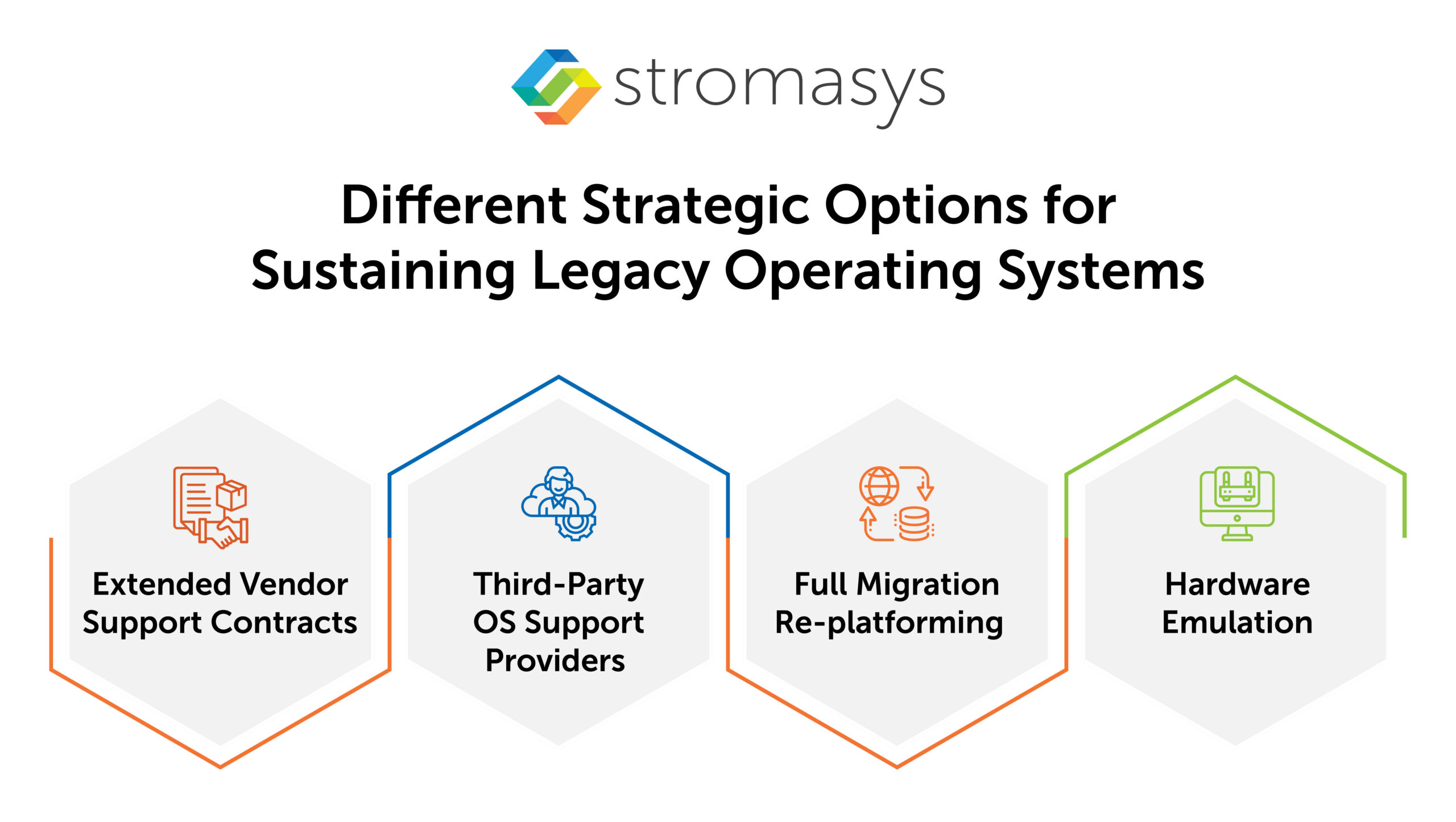
The extended support offers security patches and support, but they are expensive and limited. Also, it is only available for short-term runways. They are the best option for low-criticality systems with budget flexibility.
The third-party OS support offers better and broader coverage at a lower cost than vendors. They even include the custom patches. They are best suited for enterprises that will still be operating on legacy hardware for a longer duration. There are some moderate risks and timeline challenges involved.
With full legacy application migration or re-platforming, businesses can leverage the highest upfront disruption and cost. It offers the greatest long-term payoff through modern cloud-native or containerized environments. It is an ideal option for non-critical applications that can be modified or rewritten, especially when business drivers align. There is a high risk of regression if not phased properly.
It is the ground step where legacy hardware is emulated, and the legacy operating system continues to operate on a modern platform without any modifications. Hardware emulation is a safer option with minimal disruption and extends the lifecycle significantly. Low risk profile for continuity-focused organizations. It is mostly applicable when hardware is to be eliminated, but the OS and other critical workloads are still operational.
Also, it is suggested that if a business wants to opt for full migration or replatforming, then it is the first step to be followed. This will avoid any future hardware-related challenges during migration. Each option’s suitability depends on the criticality of the application, migration timeline, and risk tolerance.
It is highly recommended that organizations incorporate regular audits and cross-functional governance to check the health of their legacy infrastructure. Here are some best practices to be followed to create a resilient legacy OS strategy for 2026:
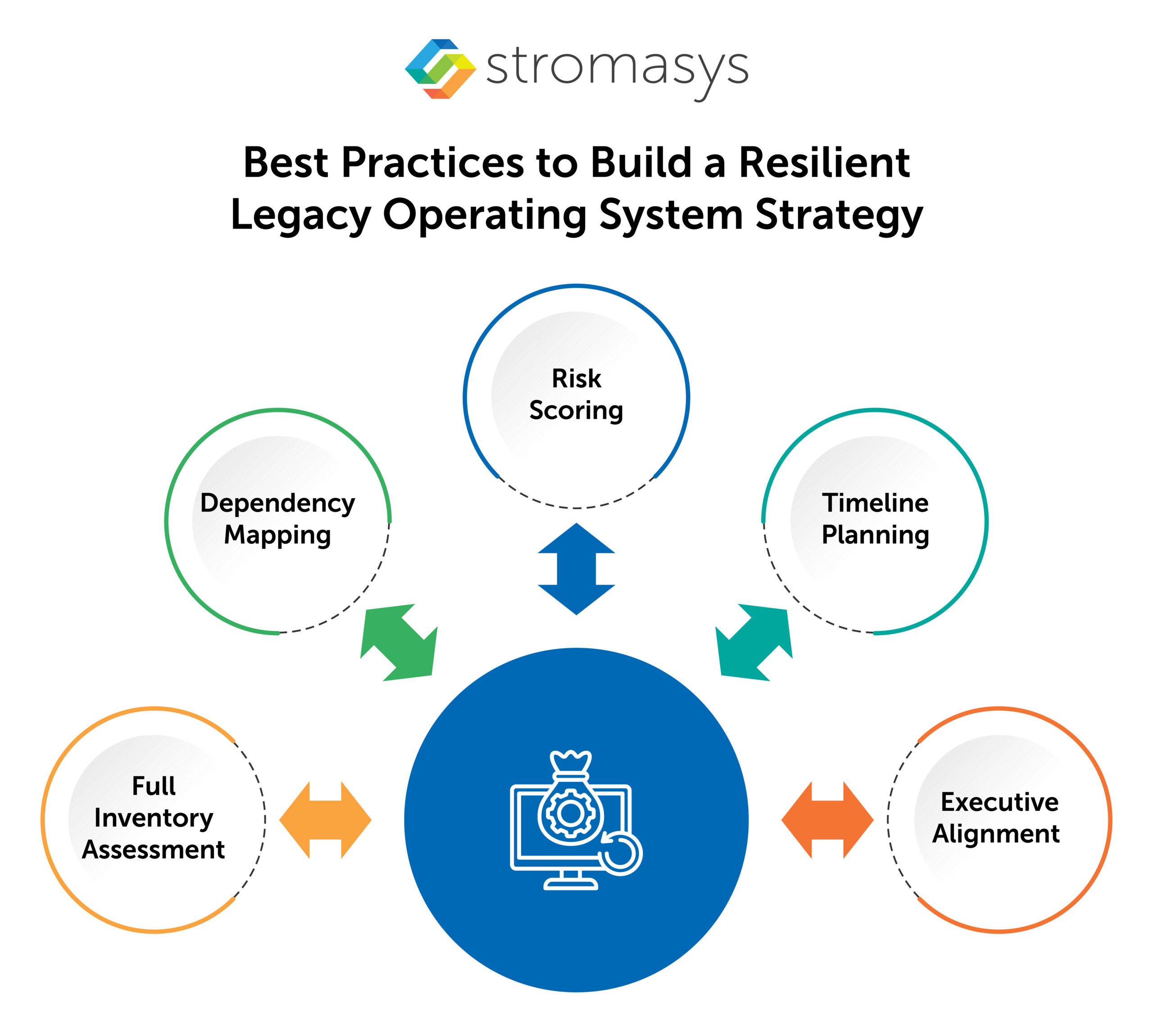
It is essential to evaluate your infrastructure for the entire EOL OS instances. Start with a full inventory assessment and check their criticality. Organizations often do not have a complete picture of what legacy OS instances exist in their environment. This case is particularly common in subsidiaries, acquired entities, or infrastructure managed by third-party vendors.
Mapping the infrastructure helps in identifying applications, integrations, and data flows. This helps check out all the dependencies before any migration or emulation decision can be made.
Not all legacy OS instances carry the same risk profile. A risk scoring helps keep track of the compliance exposure, cyber risk, business criticality, and talent availability.
It is important to create a timeline for your migration process. The organizations that manage legacy OS transitions better are the ones that plan the entire process in phases rather than all at once. It helps in identifying the challenges and taking measures to mitigate them.
The shift from treating legacy OS support as an IT operations issue to treating it as a strategic risk requires executive attention. This is important as it is not a technology upgrade but a risk management and business continuity decision.
Hardware emulation is a process of mimicking the behavior of the existing legacy hardware so that the operating systems and other critical applications can continue operating. It extends the life of legacy workloads by moving them to a new, modern platform.
The advantage of this approach is that it avoids the two biggest problems of legacy systems that are the high cost and risk of a rushed rewrite, and the danger of aging, hard-to-replace hardware. When the application still works well and the only real issue is old physical hardware underneath it. Hardware emulation is often the safest option here that helps organizations stay compliant and keep systems running without changing a single line of proven code.
Legacy migration service providers like Stromasys offer an emulation solution across industries to modernize the outdated hardware. Their Charon emulation solution is available for on-premises, such as x86, and cloud environments like AWS, Azure, OCI, and Google Cloud. It creates virtual replicas of legacy hardware like SPARC, Alpha, PA-RISC, VAX, and PDP-11, allowing legacy operating systems like Solaris, OpenVMS, HP-UX, and Tru64 to run on a modern infrastructure without code changes.
It is a cost-effective method to preserve your legacy investments while leveraging the modern platform benefits. It uses the lift-and-shift migration approach to move the critical workloads and legacy operating system running on the obsolete hardware to a modern platform without any changes to the binary codes.
Legacy operating system support means the assistance required in maintaining and securing older OS. It includes security patches, technical assistance, and strategies such as third-party support or hardware emulation to keep mission-critical applications running safely once they have reached their EOL.


The IT landscape is rapidly evolving, and businesses still running legacy hardware are facing numerous...
Read More
DEC Alpha hardware has been pivotal to many businesses due to its reliability, performance, and...
Read More
Legacy application migration is a new trending buzz of IT discussion. Businesses are migrating from...
Read More